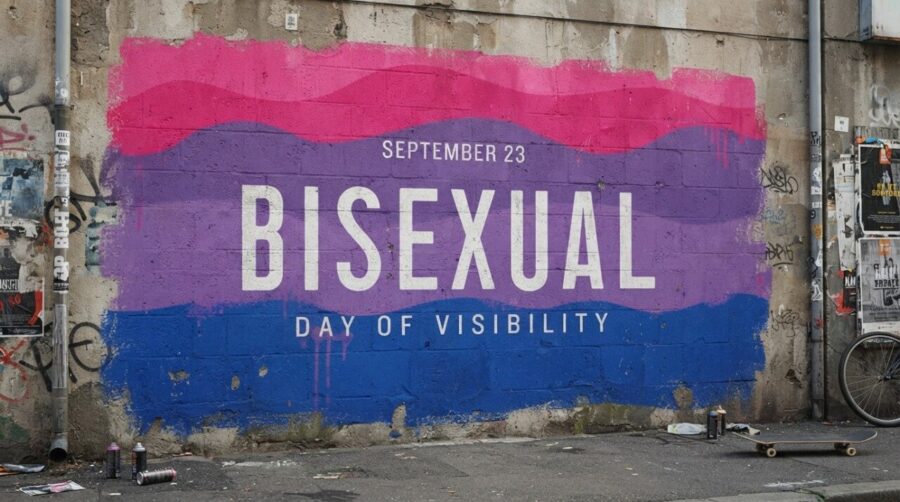

Celebrate Bisexuality Day, also known as Bi Visibility Day, falls on September 23, 2026. The annual observance recognizes bisexual people, the bisexual community, and the history of bisexuality. It exists, according to the awareness organization that maintains its calendar, to “challenge bisexual invisibility and to affirm that bisexuality is a valid, distinct sexual orientation” .
The date is fixed and does not move. In 2026, it lands on a Wednesday. The day is observed by individuals, LGBTQ+ organizations, workplaces, and community groups across the globe, under names including Bi Visibility Day, Bisexual Pride Day, and Bisexuality+ Day .
Table of Contents
ToggleFounding and Origins
View this post on Instagram
A post shared by OUT Against Big Tobacco Los Angeles (@outagainstbigtobaccola)
Celebrate Bisexuality Day was first observed on September 23, 1999, at the International Lesbian and Gay Association Conference in Johannesburg, South Africa. It was created by three American bisexual rights activists: Wendy Curry of Maine, Michael Page of Florida, and Gigi Raven Wilbur of Texas .
The choice of date was deliberate. September was selected because it was the birth month of Freddie Mercury, the bisexual Queen frontman. The 23rd was chosen because it fell on a weekend that first year and because it was Wilbur’s birthday .
Wilbur explained the motivation behind the day in a statement that has been widely cited since: “Ever since the Stonewall rebellion, the gay and lesbian community has grown in strength and visibility. The bisexual community also has grown in strength but in many ways we are still invisible.
I too have been conditioned by society to automatically label a couple walking hand in hand as either straight or gay, depending upon the perceived gender of each person” .
Curry later described the informal conversation that produced the observance: “We were sitting around at one of the annual bi conventions, venting and someone – I think it was Gigi – said we should have a party.
We all loved the great bisexual, Freddie Mercury. His birthday was in September, so why not Sept? We wanted a weekend day to ensure the most people would do something. Gigi’s birthday was Sept 23rd. It fell on a weekend day, so, poof! We had a day” .
The day was conceived as a response to prejudice and marginalization of bisexual people from both heterosexual society and, at times, from within the broader LGBTQ+ community .
Bi+ Awareness Week and Bisexual Pride Flag
In 2014, BiNet USA declared the seven days surrounding Celebrate Bisexuality Day to be Bi Awareness Week, also called Bisexual+ Awareness Week. The week begins on September 16 and culminates on September 23 . GLAAD co-founded and led the first Bisexual Awareness Week that year .
The bisexual pride flag, designed by Michael Page in 1998, is central to the day’s symbolism. The flag features pink, purple, and blue stripes.
Page specified that pink represents same-sex attraction, blue represents opposite-sex attraction, and the overlapping purple stripe represents attraction across the gender spectrum, “just as in the ‘real world’ where most bi people blend unnoticeably into both the gay/lesbian and straight communities” .
Official Recognition
The observance has received formal recognition from government bodies in the United States. The Boston City Council adopted a resolution in 2025 recognizing September 23 as International Celebrate Bisexuality Day and Bi+ Visibility Day, noting that “despite more than half of LGBTQ+ Americans identifying as bisexual, they are up to five times less likely to come out to family and up to thirty times less likely to come out to friends by comparison to gay and lesbian individuals, largely due to stigma and societal misunderstandings of the identity” .
The Wisconsin State Legislature passed a joint resolution in 2025 recognizing September 23, 2025, and September 23, 2026, as Celebrate Bisexuality Day in Wisconsin. The resolution states that September 23 “is designated as Celebrate Bisexuality Day across the United States and internationally, including under other names such as Bi Visibility Day and Bi Pride Day” .
Governor Tony Evers of Wisconsin has issued proclamations for Bisexual Awareness Week and Celebrate Bisexuality Day. His 2025 proclamation cites research from the Human Rights Campaign indicating that “individuals identifying as bisexual make up the largest group within the lesbian, gay, bisexual, transgender, and queer (LGBTQ) community” .
The Visibility Gap
The data behind the observance explains why it persists. According to the Awareness Days calendar entry for 2026, bisexual-identified people comprise roughly half of the total LGBTQ+ population, yet only around 28 percent of bisexual people are out to the people closest to them, compared with much higher rates among gay and lesbian individuals .
A 2024 study cited in the Boston City Council resolution found that 81.8 percent of Bisexual+ respondents experienced discrimination from gay or lesbian people. The resolution states that such experiences “may lead Bisexual+ individuals feel they are not ‘queer enough’ or ‘bi enough'” .
The consequences are measurable. Bisexual+ people are at heightened risk for anxiety, depression, suicidality, and substance use disorders, and are at the highest risk for suicidal ideation and suicide attempts when compared to gay, lesbian, and straight populations, according to the resolution .
What the Day Asks
The Awareness Days entry outlines the day’s core purposes: learn about bisexual history, display the bisexual pride flag, listen to bisexual voices, challenge bi erasure, support bisexual organizations, and attend or host events. It also encourages people to “gently correct myths, such as the idea that bisexuality is ‘just a phase’ or a stepping stone to another identity” .
Robyn Ochs, a bisexual advocate, offered a definition of bisexuality that the Boston resolution includes: “the potential to be attracted — romantically and/or sexually — to people of more than one sex and/or gender, not necessarily at the same time, not necessarily in the same way, and not necessarily to the same degree” .