
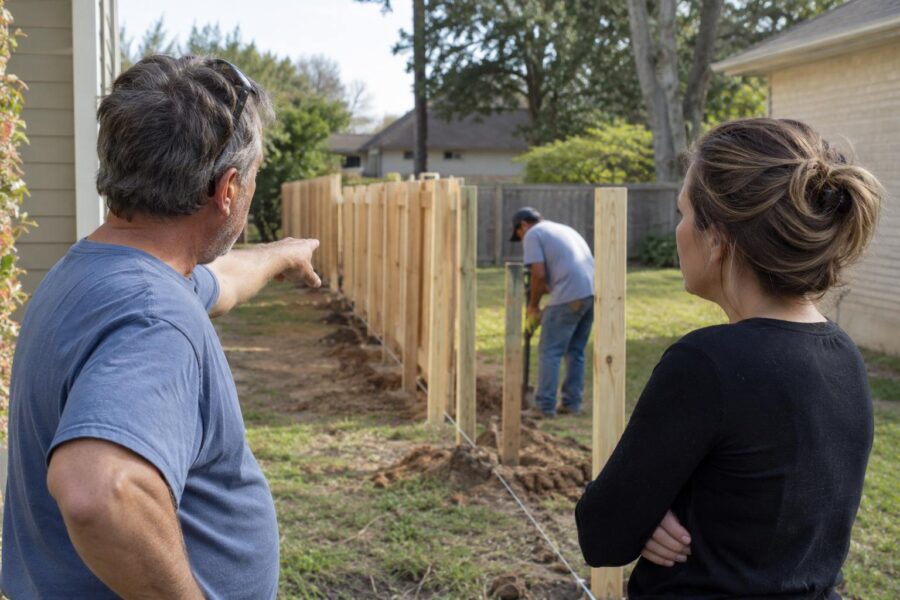

Your neighbor has hired a contractor, and new fence posts are going into the ground. The problem is that several posts appear to be on your side of the property line. Nobody asked for your permission, and the contractor says the neighbor told them where to build.
In general, your neighbor cannot build a fence on land you own without your permission or another legal right to use that land. But a fence built directly on a shared boundary is a separate issue. State laws, property agreements and local regulations determine what each homeowner can do.
If construction has already started, the first priority is to establish where the boundary actually lies. An old fence, a row of trees or the edge of a driveway is not reliable proof of a property line.
Can Your Neighbor Legally Put a Fence on Your Land?
A neighbor who builds entirely inside their property generally does not need your personal approval, although local permits and homeowners association rules may apply.
Crossing onto your land is another situation. Installing posts, panels or foundations over the boundary can create a property encroachment. An easement or existing agreement may affect the legal position, but simply wanting a larger yard does not give your neighbor permission to use yours.
The Texas Real Estate Research Center explains property encroachment and the legal consequences of placing structures across a boundary. Depending on the circumstances, a property owner may be able to seek damages or obtain a court order requiring removal.
Before accusing your neighbor of crossing the line, establish its location. Fence contractors sometimes work from the homeowner’s instructions rather than an independent boundary survey.

What If the Fence Is Built Directly on the Property Line?
Boundary fences are treated differently from fences standing entirely on one property. Some states have laws governing construction, maintenance and the division of costs between neighboring owners.
California provides a clear example. Under California Civil Code Section 841, adjoining landowners are generally presumed to benefit equally from a fence dividing their properties and share reasonable construction or maintenance costs, subject to exceptions.
A homeowner planning covered fence work must give the affected neighbor 30 days of written notice, including the proposed work, estimated cost and cost-sharing arrangement. A court can reduce or eliminate a contribution when equal sharing would be unjust.
Texas takes another approach. The Texas State Law Library explains that neighboring owners are generally not required to share the cost of a boundary fence unless they have agreed to do so.
Neither example creates a nationwide rule. A homeowner in Florida, New York or another state needs to check the law that applies to the specific property.
Check the Boundary Before Choosing a New Fence
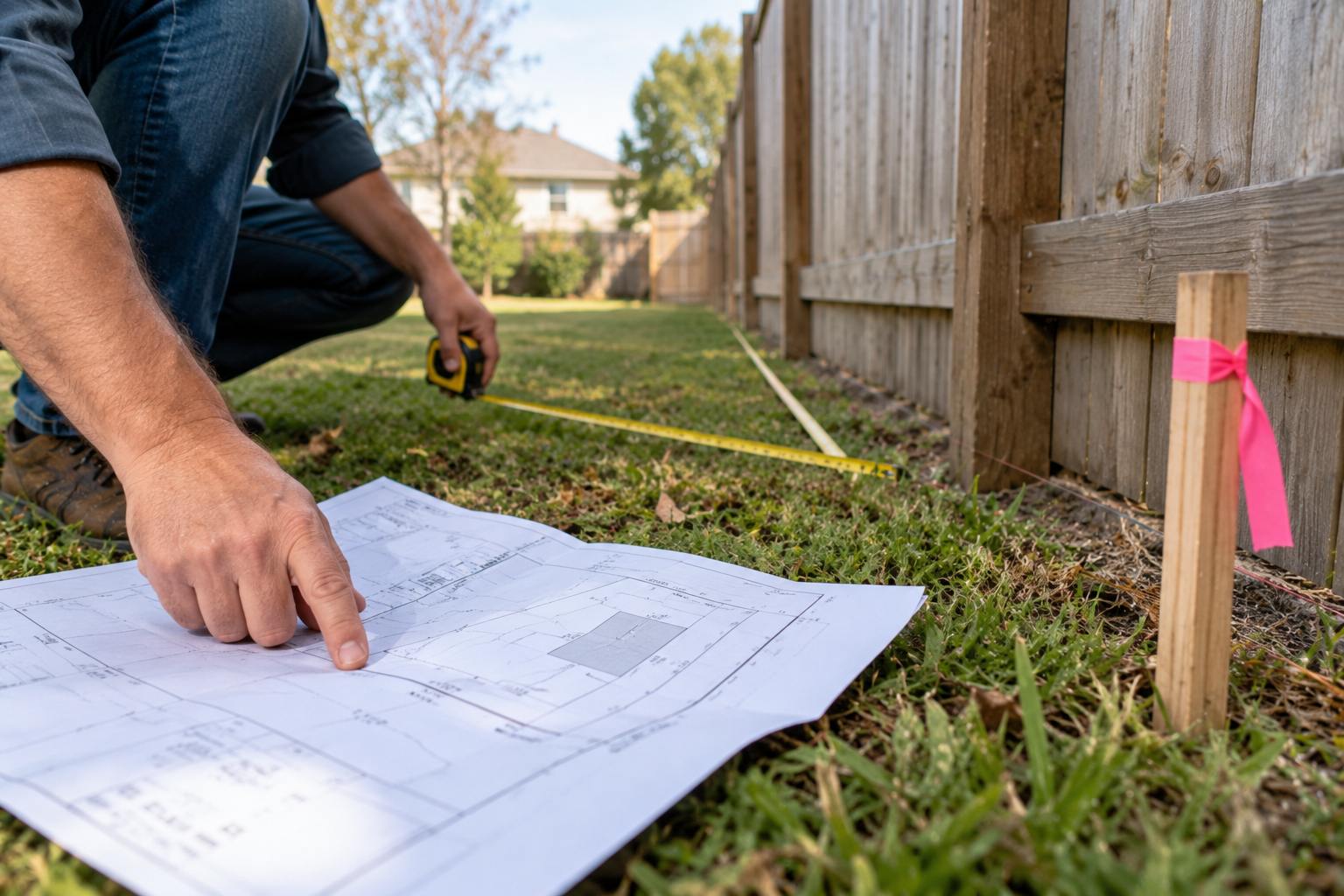
Many fence disputes begin with an incorrect assumption about where one yard ends and the next begins.
When replacing old fencing, homeowners may choose taller panels, new posts or a completely different layout. The materials and design are secondary to the property line, especially if the old fence was never installed on the legal boundary.
Start with the documents you received when buying the house. A previous survey may show the lot dimensions, building positions and boundary markers.
County property maps can help identify the general shape of a lot, but online parcel maps are not a substitute for a professional boundary survey. Their lines may not be accurate enough to settle a dispute involving a few inches of land.
A licensed land surveyor can identify the legal boundary using deeds, recorded plats, existing monuments and field measurements. Ask for the findings in writing.
If construction has not started, the survey should come before the contractor digs holes. Moving a planned fence line is generally easier than removing completed posts set in concrete.
What Should You Do If Your Neighbor Has Already Built the Fence?
Discovering a fence on your property is frustrating, but tearing it down yourself can create another legal problem.
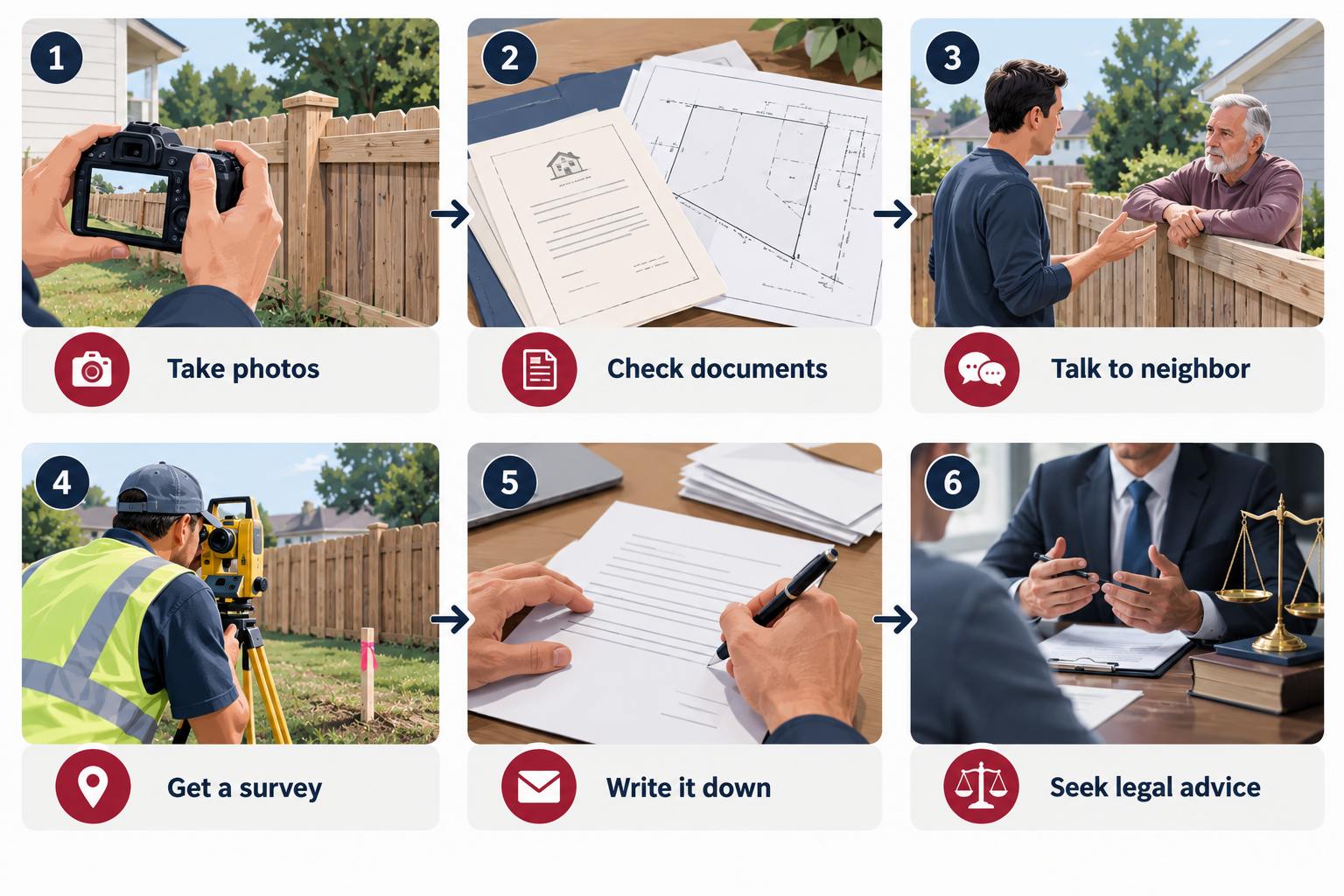
[su_note note_color=”#F4F4F0″]Start with evidence and a clear conversation:
- Photograph the fence – Include the posts, nearby structures and any visible boundary markers. Keep photographs showing construction progress if you have them.
- Find your property documents – Locate the deed, survey and any recorded easements or boundary agreements.
- Speak with your neighbor – Explain which part of the fence concerns you and ask what information they used to establish the boundary.
- Arrange a survey if necessary – A professional measurement is more useful than arguing over the position of an old fence.
- Put the disagreement in writing – Once you have evidence, explain the issue and request a response. Keep copies of correspondence.
- Seek legal advice if the dispute continues – A local property attorney can assess the survey, agreements and remedies available under state law.[/su_note]
If construction is ongoing, contact the neighbor and contractor promptly. Explain that the boundary is disputed and request that work near the disputed area stop until it is clarified. The contractor may cooperate, but your request alone does not necessarily create a legal obligation to stop.
Where immediate action is needed to prevent further construction, an attorney can advise on the possibility of seeking a court order.
Can Your Neighbor Refuse to Remove the Fence?
Yes, your neighbor can refuse your request. That does not establish a right to keep the fence on your property.
A survey showing an encroachment provides important evidence, but removing the structure may still require negotiation or legal action.
Possible outcomes include moving the fence, agreeing to a revised arrangement or pursuing a court remedy. Some neighbors settle disputes by signing a written agreement allowing a fence to remain in its current position.
Do not sign an agreement without considering future consequences. A permission agreement, easement or boundary adjustment can affect property rights and may need to be recorded.
If the parties cannot agree, an attorney can explain the available claims and legal deadlines. A court may consider the nature of the encroachment, the property rights involved and the remedies authorised by local law.
Can a Neighbor Eventually Claim the Land Behind the Fence?
A misplaced fence does not automatically transfer ownership of land. However, leaving a boundary problem unresolved for many years can make the situation more complicated.
Adverse possession is a legal doctrine that, under specific conditions, can allow someone to obtain ownership rights over land belonging to another person.
The requirements depend on state law. They can involve possession that is actual, open, exclusive, continuous and hostile to the legal owner’s rights for a required period.
A fence alone is not enough to prove every requirement. Permission, the conduct of the parties and the history of the land can affect a claim.
Our coverage of property ownership and squatters’ rights explains the legal concerns that arise when people occupy land or buildings without the owner’s permission.
If a fence has enclosed part of your yard for many years, consult a local property attorney before removing it or signing a boundary agreement.
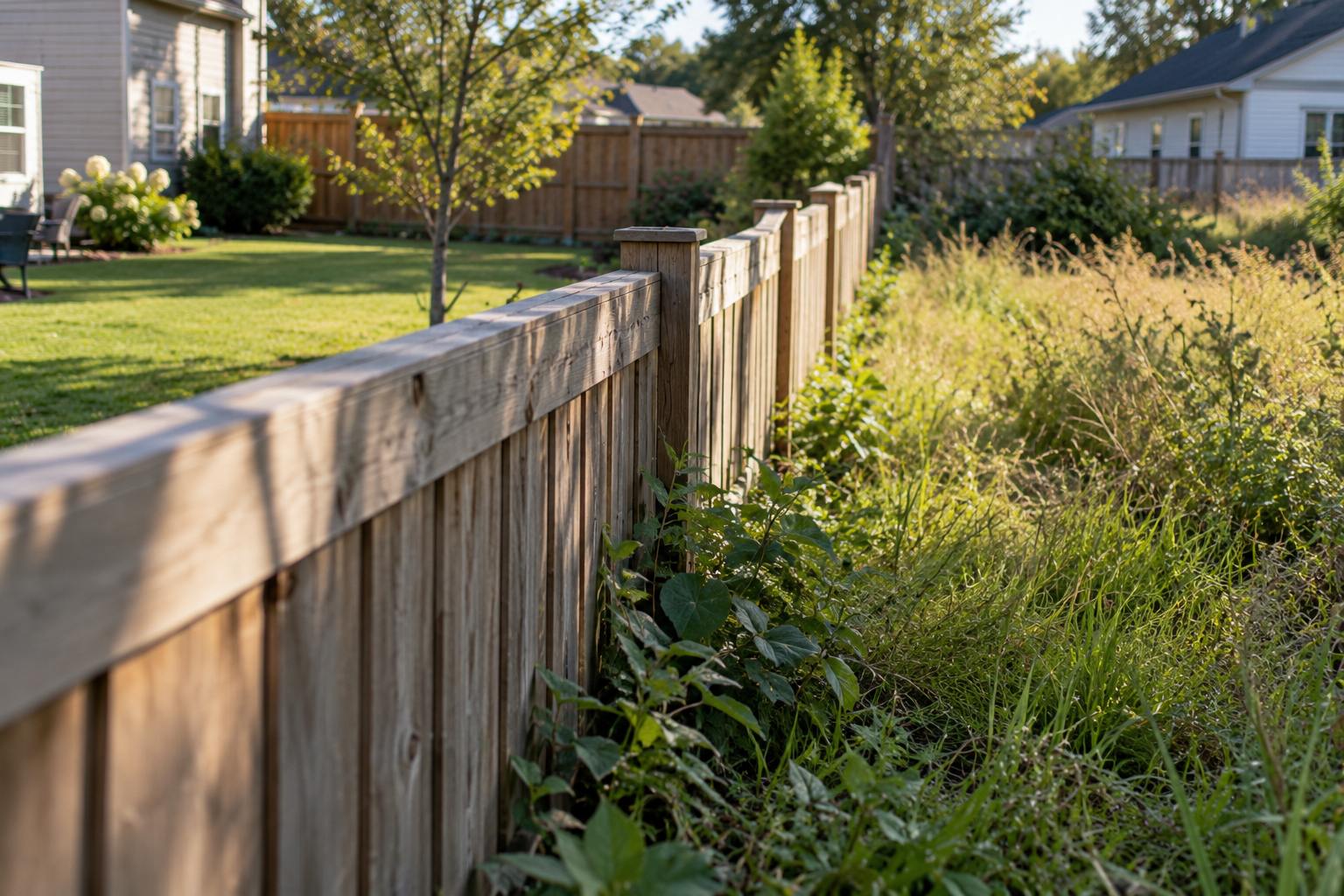
Who Pays for a Fence Between Two Houses?
There is no single American rule requiring neighbors to split every fence bill.
The answer depends on where the fence stands, who owns it, existing agreements and state law.
[su_table responsive=”yes”]
| Situation | What Usually Determines Responsibility |
| Fence entirely on your property | Your ownership and applicable local rules |
| Fence entirely on your neighbor’s property | Neighbor’s ownership and applicable local rules |
| Fence directly on a shared boundary | State boundary-fence law and any agreement |
| Fence damaged by one neighbor | Cause of damage and applicable liability rules |
| One neighbor wants a more expensive fence | Agreement, statutory cost rules and reasonableness of the expense |
[/su_table]
For example, a homeowner may want to replace a basic wooden fence with an expensive privacy fence. That preference does not automatically mean the adjoining owner must pay half the upgrade.
Where cost sharing is legally required, the applicable law may limit responsibility to reasonable expenses rather than whatever design one homeowner chooses.
Do You Need Permission to Replace an Existing Boundary Fence?
Replacing a fence in the same location does not automatically eliminate legal requirements.
If the fence is jointly owned, an agreement or state law may govern replacement. A local government may also regulate fence height, materials, setbacks and placement near streets or driveways.
Before replacement, establish ownership, confirm the boundary and check permit requirements with the city or county building department.
Homeowners association rules may impose additional design restrictions. Local law can also limit what an association may prohibit, so both sets of rules deserve attention.
For privacy fences, height restrictions are particularly important. A six-foot fence may be permitted in a rear yard but restricted in a front yard or near an intersection because it blocks visibility.
Settle the Property Line Before the Fence Becomes a Bigger Problem
Your neighbor generally cannot place a fence on your land without permission or another legal right. A fence on the shared boundary, however, may fall under specific state laws governing ownership, construction and costs.
If the location is disputed, get the property documents and establish the legal boundary before removing anything. A professional survey and a written discussion with the neighbor can prevent an avoidable disagreement from becoming a costly court case.
For a fence that has remained in the wrong place for years, local legal advice is especially important. The longer the boundary remains disputed, the more complicated the evidence and potential property claims can become.