


Americans filed nearly 5 million applications to start businesses during the first nine months of 2026, setting a new record for the period. Retail remains the most popular industry, but professional services, construction and several other sectors are also attracting large numbers of new entrepreneurs.
According to the latest US Census Bureau figures, 4,927,840 business applications were filed between January and September 2026. That represents a 15.3% increase compared with the same period in 2025.
Some applicants are planning to open shops or hire employees. Others are freelancers, consultants or people starting small businesses they intend to run alone.
The numbers show considerable interest in entrepreneurship across the country. However, they also reveal important differences between industries, especially when it comes to how many applicants are likely to establish businesses with employees.
Retail, Professional Services and Construction Lead New Business Applications

Retail trade accounted for more applications than any other industry, with 933,528 filings during the first nine months of 2026.
Professional, scientific and technical services ranked second with 728,921 applications. Construction followed with 451,105.
The following figures come from the US Census Bureau Business Formation Statistics, using applications filed between January and September 2026.
[su_table responsive=”yes”]
| Rank | Industry | Business Applications | Change From 2025 |
| 1 | Retail trade | 933,528 | +10.4% |
| 2 | Professional, scientific and technical services | 728,921 | +29.6% |
| 3 | Construction | 451,105 | +12.1% |
| 4 | Other services | 408,654 | +9.0% |
| 5 | Administrative and support services | 356,589 | +21.4% |
| 6 | Transportation and warehousing | 324,774 | +15.0% |
| 7 | Health care and social assistance | 308,778 | +16.4% |
| 8 | Accommodation and food services | 263,104 | +13.9% |
[/su_table]
Source: US Census Bureau, Business Formation Statistics. Figures are not seasonally adjusted. Percentage changes compare January through September 2026 with the same months in 2025.
Retail and professional services together accounted for more than 1.6 million applications. Add construction, and the three industries represent nearly 43% of all applications filed during the period.
The ranking also shows that people continue to start businesses in established industries such as retail, construction and transportation, even as digital services become more accessible.
Retail Trade Remains the Most Popular Industry for New Entrepreneurs
Nearly one in five business applications filed in 2026 belonged to retail trade.
The category includes businesses selling clothing, electronics, furniture, sporting goods and many other products. Online retailers also account for part of the industry.
One attraction is that entrepreneurs can begin on a relatively small scale. Someone selling handmade jewelry or secondhand clothing can test customer demand before investing in a physical store.
Online marketplaces and ecommerce platforms have also made it possible to reach customers without renting commercial space.
Choosing a business name is another important consideration, particularly when entrepreneurs need to determine whether they can trademark a name already used by another company.
However, the high number of retail applications should not be mistaken for evidence that retail businesses are easy to run.
Product costs, advertising, shipping, returns and competition can quickly reduce profit margins.
The Census Bureau also identifies a relatively small share of retail applications as likely to become employer businesses. Many retail entrepreneurs appear to be planning operations that they will manage themselves.

Professional Services Recorded Almost 30% Growth
Professional, scientific and technical services recorded one of the largest increases among major industries.
Applications rose 29.6% compared with the first nine months of 2025, reaching nearly 729,000.
The category includes legal services, accounting, consulting, engineering, advertising and other professional activities.
Many of these businesses require specialist knowledge rather than expensive equipment or large commercial premises.
For example, an experienced accountant may establish an independent practice after years of working for a larger company. A marketing professional might begin offering services directly to clients.
However, professional services are not automatically inexpensive to establish. Lawyers, engineers and other regulated professionals may face licensing requirements, insurance expenses and other costs.
The figures also suggest growing interest in independent professional work, although the application data alone cannot establish exactly why people are entering the industry.
Construction Continues to Attract New Businesses

Construction ranked third, with 451,105 applications.
The industry covers residential and commercial construction, along with specialist trades such as electrical work, plumbing, roofing and painting.
Some applicants may be experienced tradespeople establishing their own companies after years of employment.
Others may be expanding from individual contracting work into businesses capable of handling larger projects.
Unlike many online businesses, construction companies must consider equipment, insurance, permits and workplace safety requirements.
They may also need employees or subcontractors relatively early, depending on the type of projects they undertake.
Construction applications increased 12.1% compared with the same period in 2025.
However, national business application figures do not establish that demand for construction services increased in every state or city. Local housing conditions and commercial development still influence how much work is available.
Other Services, Transportation and Health Care Also Attracted Thousands of Applicants
Several industries outside the top three recorded substantial numbers of applications.
Other Services
The Census Bureau recorded 408,654 applications in the other services category.
The classification includes activities such as personal care, repair and maintenance services.
Many businesses in this category serve customers in their immediate communities. A hair salon, repair shop or cleaning and maintenance business depends heavily on local demand and customer recommendations.
Administrative and Support Services
Administrative and support services received 356,589 applications, an increase of 21.4%.
The sector includes employment services, office administration, business support and certain cleaning and maintenance activities.
Companies often purchase these services rather than hiring additional permanent employees to perform every task internally.
Transportation and Warehousing
Transportation and warehousing accounted for 324,774 applications.
Businesses in the category include freight transportation, delivery services and warehousing operations.
Some can start with one vehicle, but fuel, insurance, maintenance and vehicle financing can create substantial ongoing expenses.
Health Care and Social Assistance
Health care and social assistance recorded 308,778 applications, up 16.4%.
The category includes medical practices, outpatient services, home health care and other activities involving patient care and social support.
Many businesses in this industry face licensing and regulatory requirements. Unlike a general online store, opening a health care practice may require professional credentials, suitable premises and compliance with health regulations.
The Information Industry Is Growing Faster Than Most Other Sectors

One interesting finding is that the information industry recorded a 39.8% increase in business applications during the first nine months of 2026.
The sector received 116,919 applications, considerably fewer than retail or professional services.
Information includes software publishing, telecommunications, data processing and other information-related activities.
The growth is notable at a time when artificial intelligence and digital tools are changing how people develop software and offer online services.
However, the Census Bureau data do not identify artificial intelligence as the cause of the increase.
The industry also recorded a decline in applications classified as having a high likelihood of becoming employer businesses.
In other words, more people applied to start businesses in the sector, but the figures do not show a corresponding rise in applications most likely to lead to hiring.
Starting a Business Is Only the Beginning, Marketing Helps Keep It Alive
If you are thinking about starting your own business, the application figures offer an interesting picture of where other Americans are putting their energy.
But entering a popular industry also means competing with many other businesses for the same customers.
Consider opening a small accounting practice. Your qualifications may be excellent, but potential clients still need to discover your services and understand why they should choose you.
The same problem affects plumbers, online retailers, restaurants and almost every other business.
Marketing is therefore an expense worth planning before opening, rather than something to consider only after sales begin to slow.
A local service business should know which neighborhoods it wants to reach and what customers usually search for. An online retailer needs to calculate how much it spends attracting buyers and how much profit remains after each sale.
Professional services have their own challenges. A newly opened law practice, for example, needs to be visible when people search for help with specific legal problems.
Investment in AI SEO services for law firms can form part of that effort as potential clients increasingly search for answers through AI search tools.
For any business, the important question is how marketing spending turns into actual customers.
Start by tracking where inquiries originate. Compare the cost of advertising with the revenue those customers generate. If a marketing channel consistently costs more than it earns, change the approach before the losses become difficult to manage.
The Census figures show how many Americans are interested in establishing businesses. A steady supply of paying customers is what allows those businesses to continue operating.
Nearly 5 Million Applications Do Not Mean 5 Million Businesses Opened

The most important limitation of the figures is also one of the easiest to overlook.
A business application is generally based on an application for an Employer Identification Number, or EIN, submitted to the Internal Revenue Service.
Filing an application does not establish that a company has opened, hired workers or started generating revenue.
Some applicants never proceed with their plans. Others establish businesses that operate without employees.
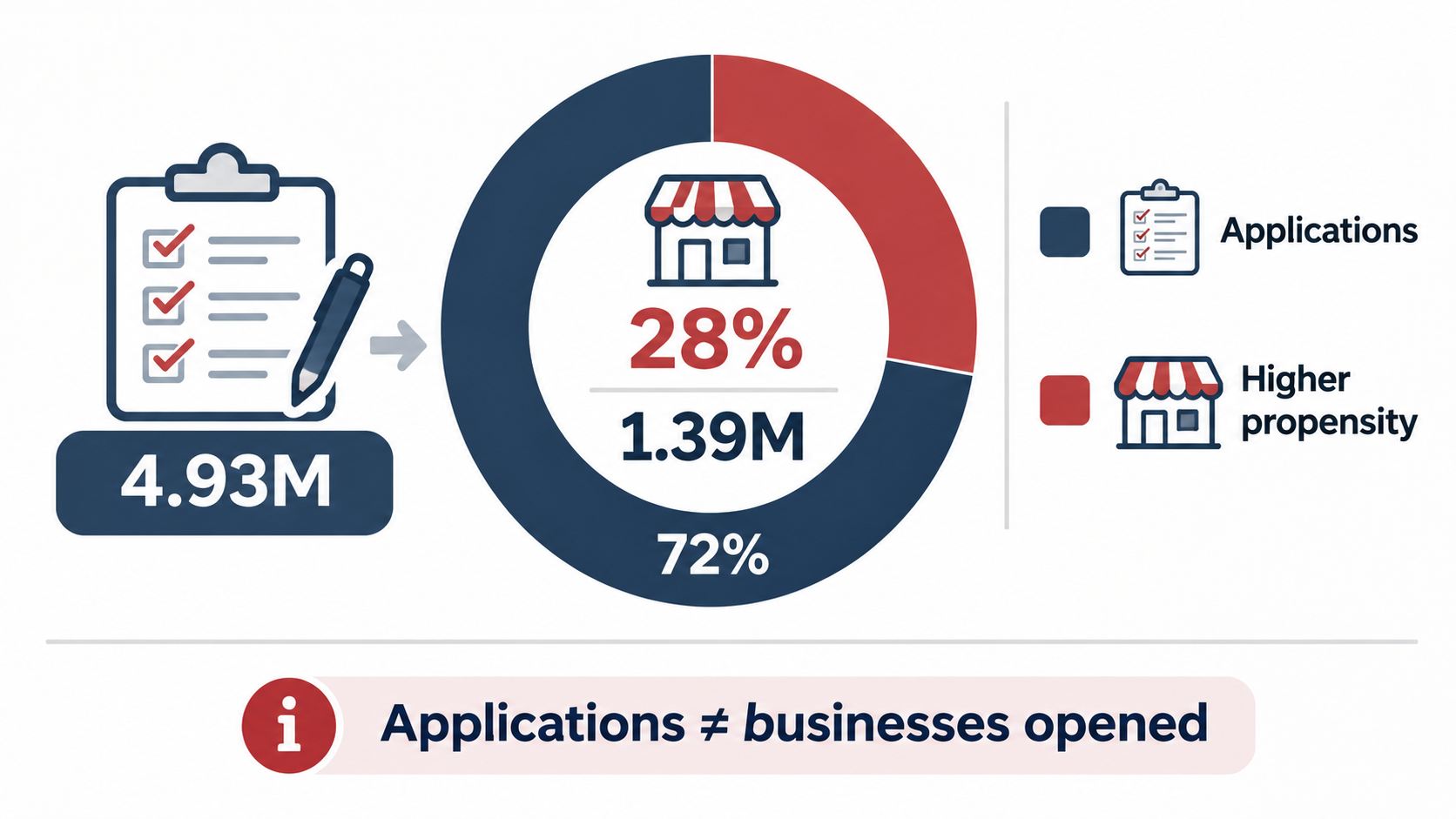
The Census Bureau separates total applications from those classified as having a greater likelihood of becoming employer businesses.
Of the nearly 4.93 million applications filed through September, about 1.39 million were classified as high propensity. That represents around 28% of applications.
The latest Census Bureau monthly report also projected that 29,022 employer businesses would form within four quarters from the applications filed in September, using seasonally adjusted data.
The number is a projection rather than a count of businesses already operating.
The difference helps explain why record application activity does not necessarily mean the country will see the same level of growth in employment.
The Bottom Line
Business applications are running well ahead of last year, with retail, professional services and construction attracting the largest numbers.
The increase also extends to industries such as health care, administrative services and information technology.
At the same time, applications most likely to become businesses with employees are growing more slowly than total applications.
The figures suggest that independent work and smaller business models remain an important part of American entrepreneurship.
For someone considering opening a business, the industry rankings provide useful context, but they are not a list of the most profitable opportunities.
A popular industry may have substantial customer demand, but it may also have intense competition. A smaller industry could offer opportunities for businesses with relevant experience or a clearly identified local market.
By September 2026, Americans had already submitted nearly five million business applications. How many of those plans become lasting businesses will depend on far more than the initial paperwork.