
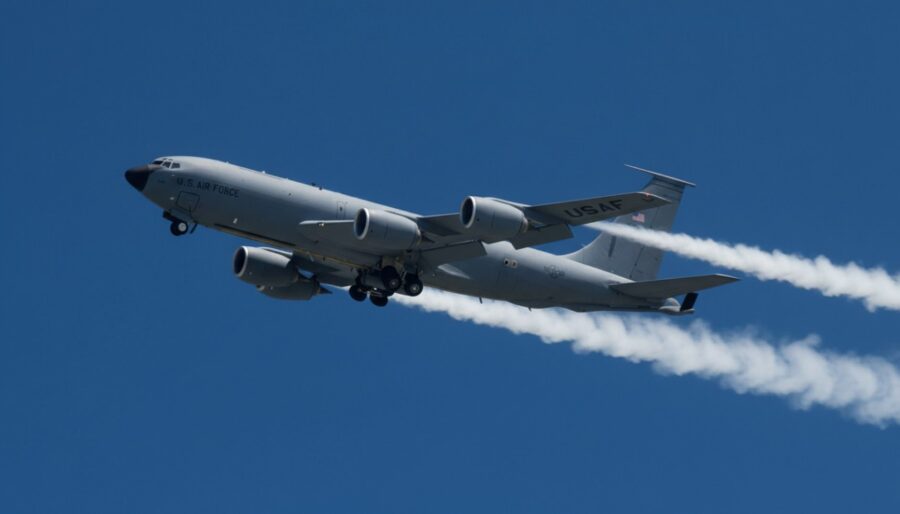

A U.S. KC-135 refueling aircraft crashed in western Iraq on March 12 during Operation Epic Fury, killing four service members and leaving two others still unaccounted for as rescue efforts continued into Friday.
U.S. Central Command said the aircraft went down at about 2 p.m. ET in what it described as “friendly airspace.” It also said the incident involved a second aircraft, which landed safely. CENTCOM added that the crash was not caused by hostile fire or friendly fire.
Table of Contents
ToggleWhat The Military Has Confirmed
The Pentagon’s public description remains limited. CENTCOM said only that the circumstances are under investigation and has not yet explained what kind of in-flight event occurred between the two aircraft.
The identities of the dead have not been released publicly, which is standard while families are being notified. Reuters, citing the military, reported that four of the six crew members aboard were confirmed dead by Friday while the search continued for the remaining two.
Why The Aircraft Matters
The aircraft involved was a KC-135 Stratotanker, one of the Air Force’s core aerial refueling platforms. According to the Air Force, the KC-135 provides the backbone of U.S. aerial refueling capability and has served in that role for more than 60 years.
That makes it a critical support aircraft in any sustained air campaign, because tankers allow fighters, bombers, and surveillance aircraft to remain airborne longer and operate farther from base.
Associated Press reported that the crash came at a sensitive moment, with U.S. operations tied to the expanding conflict with Iran. AP also noted that while the Air Force is gradually replacing the aging KC-135 fleet with the KC-46A, the older tanker remains deeply woven into current operations.
In practical terms, the loss of a refueling aircraft is not just an aviation accident. It can affect the tempo and reach of broader military missions.
Conflicting Claims
The crash quickly drew competing narratives. Reuters reported that the Islamic Resistance in Iraq, an Iran-backed umbrella group, claimed responsibility for bringing the aircraft down.
That claim directly clashes with CENTCOM’s statement that the loss was not the result of hostile fire. At this stage, the official U.S. account is the strongest verified version on the record, while the militia claim remains unproven in the public evidence available so far.
What Comes Next
The next phase will depend on the investigation and on the outcome of the continuing rescue effort.
For now, the confirmed facts are narrow but significant: a U.S. KC-135 went down in western Iraq, four crew members are confirmed dead, two remain unaccounted for, another aircraft landed safely, and the U.S. military says enemy action was not the cause.
Until investigators release more, any detailed explanation of how the aircraft was lost would go beyond the established facts.
Related Posts:
- The 100 Most Dangerous Cities in America (2026):…
- Iran Launches Missiles at US Forces as Trump Meets Netanyahu
- Safest Cities in California in 2026: An Honest,…
- America’s Murder Capitals - Updated 2026 Rankings of…
- What Is the Most Dangerous Country in the World in 2025
- Safest Countries in the World in 2025 - GPI…