
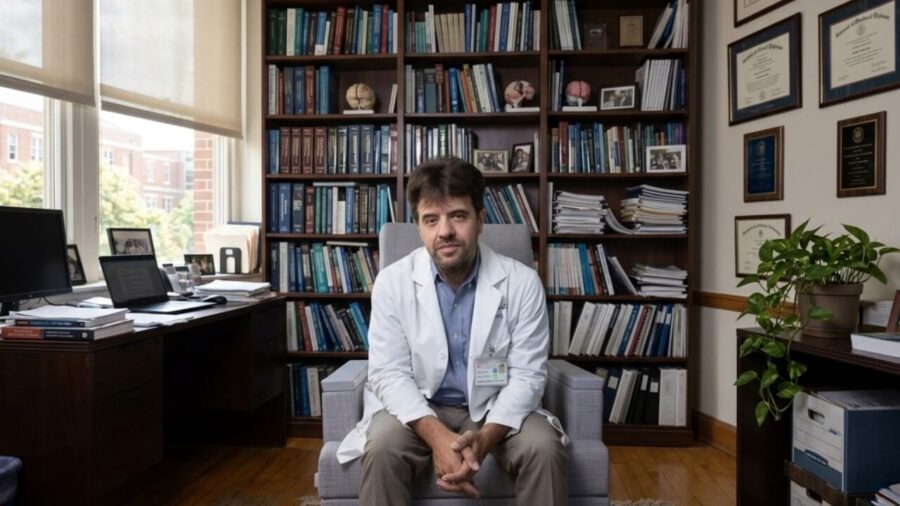

Karl Deisseroth, the Stanford University psychiatrist, neuroscientist, and bioengineer, has won the 2026 Nobel Prize in Physiology or Medicine with German scientists Peter Hegemann and Georg Nagel for discoveries that created and advanced optogenetics, a technique that uses light to control the activity of selected nerve cells.
The Nobel Assembly at Karolinska Institutet announced the award in Stockholm on October 5, recognizing the three scientists “for their discoveries concerning light-gated ion channels and optogenetics.”
According to Karolinska Institutet’s announcement, the technique transformed neuroscience by allowing researchers to test how specific neurons and brain circuits contribute to behavior, memory and emotion rather than simply observing brain activity.
Table of Contents
ToggleThree Scientists Share the 2026 Medicine Nobel
Deisseroth, 54, is a professor of bioengineering and of psychiatry and behavioral sciences at Stanford University and an investigator at the Howard Hughes Medical Institute. Hegemann, 71, works at Humboldt University of Berlin, and Nagel, 73, is at the University of Würzburg.
The three researchers will share the Nobel award of 12 million Swedish kronor, valued at about $1.2 million when the prize was announced. Reuters reported that their contributions represent different stages in the development of optogenetics.
Hegemann and Nagel’s research identified and characterized channelrhodopsin, a light-sensitive protein found in single-celled algae. Deisseroth subsequently demonstrated how such proteins could effectively become switches for controlling nerve cells with light.
Why Optogenetics Changed Brain Research
Optogenetics combines genetics and light. Scientists introduce genes encoding light-sensitive proteins into selected cells. When those cells are exposed to light of particular wavelengths, researchers can activate or inhibit their electrical activity with considerable precision.
In an October 5 interview with WBUR’s Here & Now, Deisseroth gave a concise description of the breakthrough, saying his team figured out how to “use light to control cells in the brain.” He explained that researchers can manipulate cells inside a functioning brain and examine how those changes affect behavior.
That ability is important because neuroscience has long struggled to separate correlation from causation. Recording increased activity in one brain region during fear, movement or memory does not prove those cells caused the behavior. Optogenetics gives scientists a way to switch defined cells on or off and observe the result, a distinction highlighted in Nature’s coverage of the Nobel-winning research.
The Discovery Began With Light-Sensitive Algae
The Nobel-winning work developed through a series of discoveries rather than a single experiment.
Hegemann had studied how the green alga Chlamydomonas reacts rapidly to light. Working with Nagel, the researchers established that channelrhodopsin could act as a light-gated ion channel. In 2003, their research demonstrated that the protein could generate electrical activity when introduced into mammalian cells.
Two years later, Deisseroth and colleagues demonstrated precise optical control of neuronal firing using the technique in mammalian neurons. The term optogenetics came into use in 2006, and the technology subsequently spread through neuroscience laboratories around the world.
Latest Research Is Moving Toward Human Medicine
Research using optogenetics has helped scientists investigate neural circuits involved in Parkinson’s disease, epilepsy, addiction, Alzheimer’s disease and psychiatric conditions. Most of that work remains laboratory or animal research, so findings should not be interpreted as established treatments for human brain disorders.
Human applications are nevertheless beginning to emerge. Researchers have tested optogenetic approaches in people with retinitis pigmentosa, a degenerative eye disease, in attempts to restore light sensitivity.
Other groups are studying potential applications involving cochlear implants and neurological or psychiatric disorders. These approaches remain experimental rather than routine clinical treatments.
In reporting published October 6, the Associated Press reported that Deisseroth described the prize as meaningful both for basic brain research and for the possibility of eventually helping patients with conditions including autism and depression. No new therapy approval or immediate clinical change accompanied the Nobel announcement.
Nobel Ceremony Is Scheduled for December
Deisseroth, Hegemann and Nagel are expected to receive their Nobel medals and diplomas at the Stockholm award ceremony on December 10, the anniversary of Alfred Nobel’s death.
The Nobel Prize’s official prize facts explain that laureates also receive documentation confirming their share of the monetary award.
For neuroscience, the significance of the 2026 medicine prize lies less in one prospective treatment than in the experimental tool itself.
Optogenetics gave researchers a way to intervene in precisely selected neural circuits, helping turn questions about how individual brain cells shape behavior into experiments that can be directly tested.