
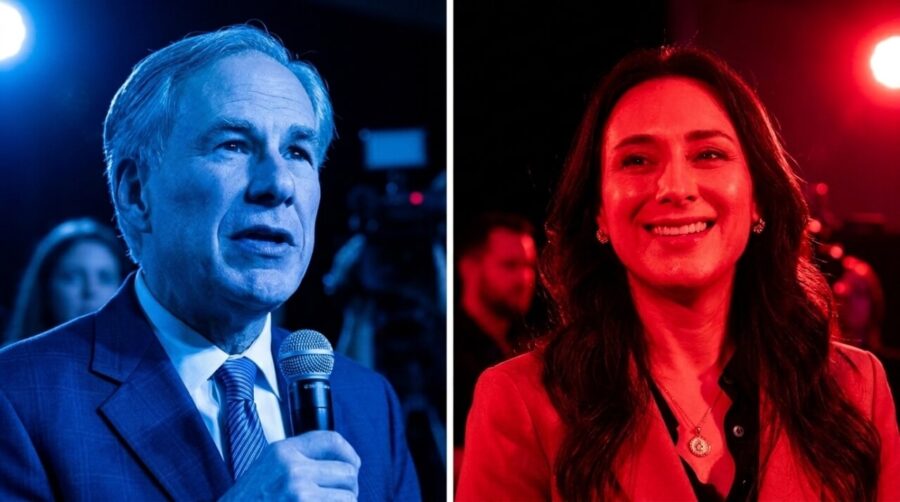

Where this piece stands. This is an opinion column, and I want you to know that before you read a word of it. I support Gina Hinojosa. I think Greg Abbott’s fourth term would be bad for Texas and worse for the people this publication exists to defend. Every number in this article is sourced and checkable — I have not bent a single one — but the interpretation is mine, and I argue for it openly. Where my friends Marko and Wickey disagree with me, I’ve given them room to make their case in their own words, because I’d rather you hear the strongest version of the other side from them than a weak version from me.
If you only want the deadlines, the ID rules, and the mail-ballot instructions with no politics attached, skip to Section 8. That section is written for every Texan regardless of who you’re voting for, and I mean that.
The 60-Second Version
| Election Day | Tuesday, November 3, 2026 · polls 7 a.m.–7 p.m. |
| Register by | Monday, October 5, 2026 — no online registration in Texas |
| Early voting | October 19–30, 2026 |
| Mail ballot application | Must be received by October 23, 2026 |
| Incumbent | Greg Abbott (R), governor since 2015, running for a fourth term |
| Challenger | Gina Hinojosa (D), state representative, HD-49 |
| Also running | Pat Dixon (L) and six independents |
| Latest poll | Abbott 51, Hinojosa 44 (Siena/NYT, June 19–27) |
| Money | Abbott: $67.4M on hand. Hinojosa: ~$6M raised. An 11-to-1 gap. |
| Forecasters | Solid/Safe Republican — all three major raters |
1. Let Me Tell You What This Election Is Actually About
Every four years someone writes the “Texas is turning purple” story, and every four years Texas declines to turn purple, and every four years a certain kind of pundit declares that Democrats should stop trying.
I want to make a different argument. Not that Hinojosa is going to win — I’ve run the numbers in Section 7 and I’m not going to insult you by pretending the polling says something it doesn’t. My argument is that the margin is the message, and that a governor who wins by six points governs differently than a governor who wins by twenty.
Abbott has already told us what he does with a mandate. He got one in 2014 with a 20-point win. Here is a partial list of what followed: the most financially punitive bathroom law in the United States, a private school voucher program that took three sessions and a purge of his own party’s dissenters to pass, a mid-decade redistricting so aggressive that Democratic legislators fled the state to stop it, and a mail-ballot ID rule that in its first outing rejected one in eight mail ballots cast in Texas.
That last number is not rhetoric. I’ll show you the arithmetic in Section 8.
So when I say I’m voting for Hinojosa, I’m not making a prediction. I’m making an argument about what a close race does to a governor’s willingness to keep going.
2. Who’s on the Ballot
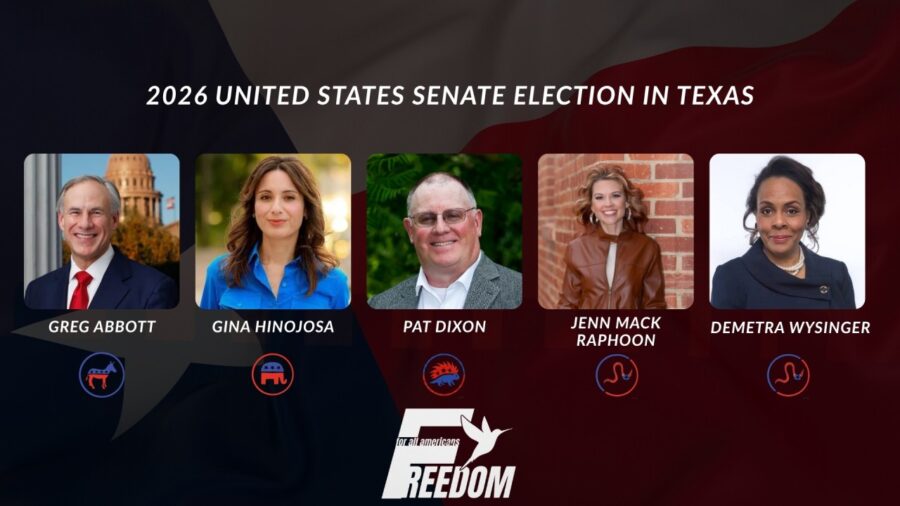
Nine candidates. Verify against your county’s sample ballot in October, because lists shift.
| Candidate | Party | March 3 primary |
|---|---|---|
| Greg Abbott | Republican | Won with 81.8% — 1,764,924 votes |
| Gina Hinojosa | Democratic | Won with 58.5% — 1,289,576 votes |
| Pat Dixon | Libertarian | Nominated at the April 11 convention |
| Sarah Bowman Cunningham | Independent | |
| Elliot Chavez | Independent | |
| Blas Eugenio Padrino | Independent | |
| Jenn Mack Raphoon | Independent | Running as a “Constitutional Independent” |
| Janis Richards | Independent | Formerly Texas Green Party |
| Demetra Wysinger | Independent | Also sought the office in 2022 |
Neither Abbott nor Hinojosa needed the May 26 runoff — both cleared 50% outright. The Senate and attorney general races did not, which is how Texas ended up with the biggest upset of the cycle. More on that in Section 6.
3. The Statistic Nobody Is Talking About
Here is a number I have not seen reported anywhere, and I computed it myself from the certified primary returns. Check my arithmetic — that’s the point of publishing it.
Texas Democratic primary turnout, three cycles:
| Year | Democratic primary | Republican primary | Gap |
|---|---|---|---|
| 2018 | 1,015,442 | 1,537,080 | R +521,638 |
| 2022 | 1,075,601 | 1,954,172 | R +878,571 |
| 2026 | 2,203,671 | 2,156,879 | D +46,792 |
Read that bottom row again.
Democratic primary turnout more than doubled between 2022 and 2026 — up 104.9%, an increase of 1,128,070 votes. Republican primary turnout grew 10.4%. And for the first time in the modern history of Texas primaries, more Texans voted in the Democratic primary than the Republican one.
Now, the honest caveats, because I promised you honest:
- Part of that gap is structural. The blockbuster Democratic Senate primary was decided March 3, while Republicans knew Cornyn–Paxton was heading to a runoff, which depresses first-round turnout.
- Primary turnout is a poor predictor of general election turnout. Texas has open primaries — you don’t register by party — so crossover voting muddies everything.
- Democrats had nine competitive gubernatorial candidates and a Senate race between two nationally known figures. Republicans had an incumbent nobody expected to lose.
All true. And yet: 1.1 million additional human beings walked into a Democratic primary. Whatever caused it, they exist, and they are on the voter rolls, and somebody has to decide whether they show up in November.
Here’s the second number, and it’s the one that reframes the whole “Texas is hopeless” narrative:
Between 2018 and 2022, Greg Abbott lost 219,097 votes. He went from 4,656,196 to 4,437,099. Democrats, meanwhile, gained 7,041 — essentially flat, which is its own indictment. Total turnout dropped 240,535.
Abbott’s margin has narrowed every single cycle: R+20.4 in 2014, R+13.3 in 2018, R+10.9 in 2022. Not because Democrats are persuading anyone — the Democratic vote total has been frozen at roughly 3.55 million for two consecutive cycles while Texas added millions of people. The margin is narrowing because Abbott’s own coalition is shrinking in raw numbers.
My read: Texas is not a red state. Texas is a non-voting state with a red electorate. Roughly 40% of eligible Texans don’t participate in midterms. That is the entire ballgame, and it’s why I spend more of this article on registration deadlines than on campaign ads.
4. Marko and Wickey Take the Floor
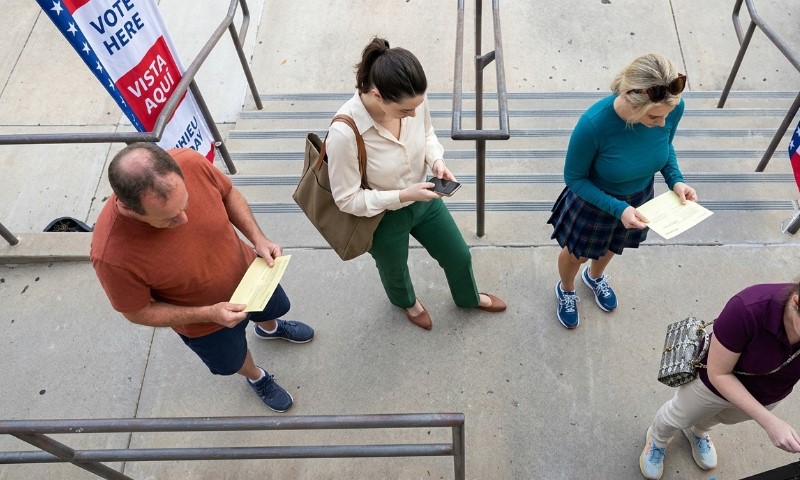
I’ve been arguing about Texas politics with the same two people for years. Marko came to Texas from Serbia in his twenties and now runs a small business outside Houston. Wickey grew up in East Texas, works in the energy sector, and has never voted for a Democrat in his life. We have dinner most months. We disagree about nearly everything and I would take a bullet for either of them.
I asked them both to make their case for this article. I’m printing it, because a column that only quotes people who agree with the author is a press release.
Marko’s case
“You have to understand what it is like to grow up somewhere where the government decides everything. In Serbia in the nineties, my family waited for the state to fix things and the state never fixed anything. It broke things and then blamed someone else.
I came here and in three years I had a business. Three years. Nobody asked me for a permit. My cousin in Germany is still waiting for approvals on something he started before I started mine. So when I hear a candidate say she will take seventeen billion dollars out of the savings account and mail everyone fifteen hundred dollars, my whole body says no. That is exactly the thinking I left. You do not fix an economy by handing out money that you did not earn. You fix it by letting people build.
And your friend, this Hinojosa — she left the state. She ran away from her job to stop a vote she was going to lose. In Serbia we had politicians who did that. It is theater. It is not governing.
I do not love everything Abbott does. The bathroom law, I do not care about it, I think it is a distraction, and I think it is cruel to make people’s lives about that. But I am not going to vote against a man who kept my taxes low and my electricity on because of a bathroom.”
Wickey’s case
“Everybody in Austin wants to talk about the margin narrowing. Fine. Abbott won by eleven points. Eleven. In Michigan they’d call that a landslide and here it’s supposed to be a warning sign.
Here’s what your article isn’t going to say, so I will. Texas added more people in the last decade than any state in the country, and they came from California and Illinois and New York, and they came here, not the other way around. Nobody’s fleeing to Sacramento. That’s not an accident and it’s not oil money — it’s that this state lets you keep what you make and doesn’t spend three years telling you what you can’t build on your own land.
On the schools — and I know this is where you and I go to war — my sister pulled her kid out of a school that was failing him for six years. Six years of the district telling her to be patient. That voucher let her put him somewhere he’s actually learning. You can tell me the policy hurts public schools in the aggregate. She doesn’t live in the aggregate. She lives with her son.
And I’ll say the thing nobody says out loud: Abbott’s not popular because of the culture war stuff. He’s popular in spite of it. Most people I work with couldn’t tell you what SB 8 says. They can tell you what their property tax bill did.”
Where I think they’re right
Wickey’s last point is the strongest thing either of them said, and it’s the one that keeps me up at night. Abbott may be winning on affordability while the civil rights damage rides along in the trunk, unnoticed and unpriced. If that’s true, then the Democratic strategy of leading with economics — which is exactly what Hinojosa is doing — is correct, and the rest of us who care about SB 8 are going to have to accept that it wins elections quietly rather than loudly.
Marko is also right that the $1,500 rebate is a messaging device, not a plan. It requires legislative approval from a Republican legislature that will never grant it. I’d rather she’d proposed something she could actually deliver.
Where I think they’re wrong
Marko, with love: you fled a government that used the machinery of the state against people it disliked, and you’re voting for the man who built a tip line so citizens can report each other for using the wrong bathroom, and whose attorney general has already opened an investigation on the strength of one such tip. You know what that architecture is. You’ve seen it before. You told me once that the worst thing about the old system wasn’t the police — it was your neighbors.
Wickey: your sister’s story is real and I’m not going to argue with a mother about her own kid. But 5.5 million Texas children are in public schools and roughly 300,000 are not. A policy that helps one family and defunds the system serving the other ninety-five percent isn’t a school choice policy, it’s a triage decision made on their behalf without asking them.
And the migration argument cuts both ways. People are moving to Texas in enormous numbers — and Texas is doing everything in its power to make sure the ones who arrive can’t easily register, can’t easily vote by mail, and find their precinct redrawn under them. If the growth is such a vindication, why is the state so afraid of letting the new arrivals vote?
5. What’s Actually at Stake: The Civil Rights Record
This is the section I care most about, and it’s the one MultiState, Ballotpedia, and every horse-race tracker will not write.
The 2025 session was not normal
The 89th Texas Legislature saw over 200 anti-LGBTQ+ bills filed, the majority explicitly targeting transgender people, according to the Transgender Education Network of Texas. More than 94% died. Six became law, effective September 1, 2025. Over 5,000 Texans came to the Capitol to register opposition.
I want to sit with that ratio for a second, because it gets used dishonestly in both directions. Conservatives say “94% failed, you’re being hysterical.” Advocates say “200 bills were filed, this is an emergency.” Both are describing the same fact. Two hundred bills means two hundred separate occasions on which a legislator decided that the most useful thing to do with their filing slot was to make life harder for a small group of people. The failure rate tells you about the House calendar. The filing rate tells you about the party.
Senate Bill 8
Abbott signed it September 22, 2025. Effective December 4, 2025.
- Restricts restrooms, locker rooms, changing rooms, showers, and sleeping quarters in government buildings, public schools, public universities, prisons, and jails to the sex on your birth certificate.
- Directs the prison system to house inmates by sex assigned at birth, with no exception for transgender inmates. If you want to know what that means in practice, ask any corrections officer.
- Bars people assigned male at birth from women’s family violence shelters — unless they are 17 or younger and the child of a woman receiving services. Read that again: a transgender woman fleeing a man who is beating her has fewer options in Texas than she did in 2024.
- Fines institutions $25,000 for a first violation and $125,000 for each one after. A late amendment raised the penalties fivefold from the original $5,000/$25,000. It was adopted without debate.
- Lets private citizens file complaints through a state tip line. The attorney general is required to investigate them.
The House passed it 86–45. The Senate approved the higher penalties 18–8. Nineteen House members and five senators did not vote at all — a fact I find more revealing than either tally.
Abbott called it common sense. The ACLU of Texas called it unconstitutional. When Democratic members asked the bill’s sponsors on the floor to name one instance of the harm it was designed to prevent, they could not produce one.
Texas had rejected bathroom bills for a decade. The Senate passed six of them between 2017 and 2025 and the House killed every one. What changed was not the evidence. What changed was that Abbott called a special session and put it on the agenda.
The enforcement has started, and it started in Hinojosa’s old district
In 2026 the attorney general’s office announced its first SB 8 enforcement action: a notice to Austin ISD, based on a citizen tip-line complaint alleging that a student at Austin High School used the wrong restroom.
A tip line. A complaint about a teenager. A mandatory state investigation. Six-figure liability for the district.
Gina Hinojosa was president of the Austin ISD school board.
I don’t think you can construct a cleaner illustration of what this election is choosing between.
Where Hinojosa stands
In May 2021, on the floor of the Texas House, Hinojosa waved a transgender pride flag while opposing a bill restricting transgender students from school sports. She was a civil rights and labor lawyer before politics – she worked for AFSCME, and in 2005 she was on the legal team that brought money-laundering charges against Tom DeLay.
She is not running on this. Her campaign is about affordability, schools, and corruption, and I think that’s a defensible strategic call in a state where, as Wickey said, most voters couldn’t tell you what SB 8 says. But her voting record and Abbott’s signing record point in opposite directions on essentially every measure of the last three sessions, and a governor’s signature is the whole ballgame.
Why the governorship specifically
Even where the Legislature writes the law, the governor controls everything around it:
- The veto and line-item veto. Any bill. Any budget line.
- Special sessions. SB 8 passed in one Abbott called, with the bathroom bill named among his priorities. Only the governor can convene a special session and set its agenda. This is the single most under-appreciated power in Texas government.
- Appointments. The governor appoints the secretary of state (who runs elections), the commissioner of education, the commissioner of higher education, the Public Utility Commission, and every board of regents at every public university. These bodies decide how policy actually lands in classrooms and clinics.
- Agency directives. Texas governors have repeatedly changed policy by instructing agencies, without passing anything.
More context: our anti-LGBTQ legislative tracker, our anti-transgender legislation tracker, and our state-by-state nondiscrimination map.
6. The Rest of the Ballot — Where This Gets Interesting
View this post on Instagram
| Race | Republican | Democrat |
|---|---|---|
| U.S. Senate | Ken Paxton | James Talarico |
| Attorney General | Mayes Middleton | Nathan Johnson |
| Lieutenant Governor | Dan Patrick (4th term) | runoff nominee |
The Senate race produced the cycle’s genuine shock. Attorney General Ken Paxton beat sitting Senator John Cornyn 63.8% to 35% in the May 26 runoff — after trailing him 42.0% to 40.5% in March. A late Trump endorsement moved 20 points in eleven weeks. Cornyn became the first sitting Texas senator to lose renomination since 1970.
Democrats nominated state Rep. James Talarico, who took 52.4% over U.S. Rep. Jasmine Crockett.
Also on your ballot: comptroller, land commissioner, agriculture commissioner, railroad commissioner, eight State Board of Education seats — the body that approves textbooks and sets curriculum standards for 5.5 million kids — the Texas Supreme Court, appellate courts, all 38 U.S. House seats, the entire Texas House, half the Texas Senate, and your local races.
Please do not stop at the top of the ballot. The lieutenant governor of Texas controls committee assignments and the flow of every bill through the Senate. Many people who work in the Capitol will tell you it’s a more powerful job than governor. It is also one of the most under-voted races on the ballot.
7. The Polling, Honestly
I am not going to spin this for you. Abbott leads in every public poll, by 5 to 7 points, consistently, for four months. Cook Political Report and Inside Elections rate it Solid Republican. Sabato’s Crystal Ball says Safe Republican. None of them has moved off that rating at any point in the cycle.
Three things worth understanding before you read too much into any of it:
- Two of those four polls are from the same pollster for the same sponsor. That’s one trend line, not two confirmations.
- Margin of error applies per candidate. A 51–44 with ±4.5 is consistent with anything from a blowout to a near-tie — though the middle is far likelier than the edges.
- The undecideds are the story. The UT poll has 12% “not sure” among registered voters. Historically, most of those people don’t vote at all. Whether they do is worth more than every ad buy in this race combined.
The money, and why it matters more than the polls
- Texans for Greg Abbott: $67.4 million cash on hand in the July semiannual filing.
- Hinojosa: roughly $6 million raised.
- That is an 11-to-1 advantage.
Abbott’s committee raised over $25 million in the period and spent nearly $55 million — about $302,000 a day, every day, for six months. He entered 2026 with $105.7 million and has drawn it down by $38.3 million. If 8.1 million Texans vote, as in 2022, Abbott has $8.32 in the bank for every ballot that will be cast.
His large donors across recent filings include Midland oil executive Javaid Anwar, casino executive Miriam Adelson, the Texas Republican Leadership Fund, Jerry Jones, Roku founder Anthony Wood, developer Black Mountain Power, and Capital Funding Group’s John Dwyer. Abbott has said publicly he intends to spend most of it in Harris County, with the stated goal of turning the state’s largest county reliably Republican.
Hinojosa’s campaign describes its funding as small-dollar and argues that the overwhelming majority of Abbott’s money came from a few dozen six-figure donors. That framing is a campaign claim — but the filings do show extremely heavy reliance on very large individual gifts, so I’d call it fair comment rather than spin.
Texas has more than twenty media markets. At 11-to-1, you cannot buy statewide television. Hinojosa’s first general-election ad ran as a streaming buy during the NBA Finals, targeted at younger male and Latino viewers — a decision that tells you both her coalition strategy and her budget in a single data point.
And on the debate
Abbott let the deadline for a televised debate pass in mid-July without agreeing to participate. Hinojosa has hammered him for it.
Front-runners skip debates all the time; it’s rational and it’s also cowardly. Abbott has $67 million and won’t spend ninety minutes on a stage answering questions from a woman with six. Marko told me this is “smart politics, not fear.” He’s probably right about the politics. I still think a man asking for sixteen years in office owes the people ninety minutes.
8. How to Vote in Texas – Read This Part Regardless of Your Politics
I mean that. If you’re voting for Abbott, I would rather you vote for Abbott than not vote. A state where only the determined can participate is not a state I want to live in even when my side is winning.
Texas has some of the strictest voting rules in the country, and most rejected ballots are rejected on technicalities that have nothing to do with fraud.
Deadlines
| Register to vote | Monday, October 5, 2026 (in person, or postmarked) |
| Early voting begins | Monday, October 19, 2026 |
| Mail ballot application received by | Friday, October 23, 2026 |
| Early voting ends | Friday, October 30, 2026 |
| Election Day | Tuesday, November 3, 2026, 7 a.m.–7 p.m. |
| Mail ballot postmarked by | Tuesday, November 3, 2026 |
Texas has no online voter registration. Paper only, in person or by mail. Forms are at votetexas.gov, county registrar offices, libraries, and post offices. This one rule disenfranchises more eligible Texans than anything else in the code, and it is the reason I’m putting it in bold twice.
Check your registration today, not in October
Because of the 2025 mid-decade redistricting and the ongoing failures in the state’s voter database (Section 9), do this now:
- Verify your status at votetexas.gov or with your county elections office.
- Confirm your precinct and polling place. Boundaries moved for a very large number of voters.
- Confirm the name on your registration matches the name on your ID. Texas applies a “substantially similar name” standard; a mismatch triggers an affidavit at the polls. This falls hardest on people who have married, divorced, or legally changed their name — including transgender voters whose documents are mid-transition.
- Fix any problem well before October 5.
The seven acceptable photo IDs
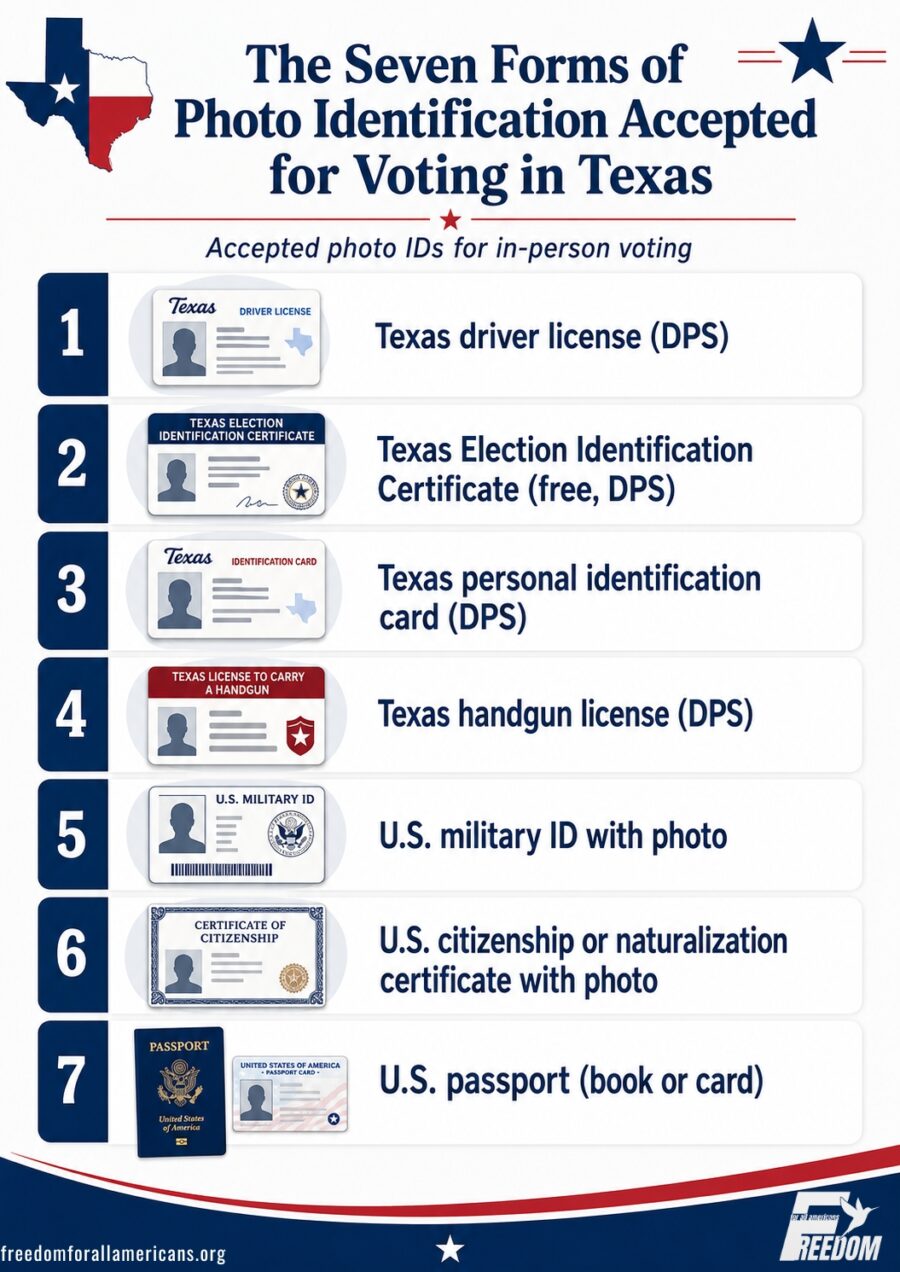
- Texas driver license (DPS)
- Texas Election Identification Certificate (free, DPS)
- Texas personal identification card (DPS)
- Texas handgun license (DPS)
- U.S. military ID with photo
- U.S. citizenship or naturalization certificate with photo
- U.S. passport (book or card)
Expiration: ages 18–69, may be expired up to four years. Age 70+, expired by any amount. Citizenship certificates never expire for this purpose.
Student IDs are not accepted. Not as photo ID, not as a supporting document. A Texas handgun license works and a University of Texas student ID does not. I’ll let that sit there without further comment.
Naturalized citizens: if your Texas license was issued as temporary or limited-term before you naturalized, bring your naturalization certificate too.
No ID? You can still cast a regular ballot
Ask for a Reasonable Impediment Declaration. Sign it, show one supporting document, vote a normal ballot — not a provisional one.
Accepted reasons on the form: lack of transportation; lack of a birth certificate or documents needed to get ID; work schedule; lost or stolen ID; disability or illness; family responsibilities; applied for ID but haven’t received it.
Poll workers are legally forbidden from questioning whether your reason is reasonable. If one tries, ask for the election judge and call 866-OUR-VOTE.
Supporting documents: voter registration certificate, certified birth certificate, current utility bill, bank statement, government check, paycheck, or any government document with your name and address.
Other situations: Forgot your ID? Leave and come back before polls close. Permanent disability exemption? Apply through your county registrar with SSA disability documentation or a VA rating of 50%+. Religious objection to photographs, or a declared natural disaster? Vote provisionally and sign an affidavit at the registrar within six calendar days.
Voting by mail — and the trap that eats ballots
Texas has no no-excuse absentee voting. You qualify only if you are: 65 or older; sick or disabled; out of your county for the entire early voting period and Election Day; confined in jail but eligible; or expecting to give birth within three weeks of Election Day. Military and overseas voters use the federal FPCA.
Now the part that matters. Under SB 1, passed in 2021, you must write an ID number on both the application and the return envelope, and it must match a number already on your registration record.
Here is what that rule did the first time it was used. In the March 2022 primary:
- The statewide rejection rate was 12%. More than 24,000 mail ballots thrown out, plus roughly 12,000 applications rejected before that.
- In the 2020 general election, Texas rejected 8,304 of 982,362 mail ballots — 0.8%.
- That is a fourteenfold increase. One in eight mail ballots, discarded.
- In Harris County, 6,919 ballots were rejected. All but 31 of them were rejected because of the new ID rule.
- Bexar County hit nearly 22%.
- The secretary of state’s own office said most rejections happened because voters left the ID space blank — they never saw it.
And it did not land evenly. The Brennan Center found the share of voters who had an application or ballot rejected under SB 1 was 19% of Asian voters, 16.6% of Black voters, 16.1% of Latino voters — and 12% of white voters. Asian and Latino Texans were more than 50% more likely than white Texans to be rejected.
Rates improved by the November 2022 general — Travis County fell to 2.8%, Williamson to 2.21% — after enormous public education spending and county-level triage. But the rule is still on the books, it is still the leading cause of rejection, and nobody has repealed it.
So protect yourself:
- Provide the number even if the ID is expired.
- Use the same number in both places.
- If you don’t know which number is on your registration record, write both — your driver license number and the last four of your Social Security number. Providing both is allowed and it is the single best thing you can do to keep your ballot alive.
- If your ballot is flagged, your county must give you a chance to fix it — but only if they can reach you. Make sure your phone number and address on file are current.
On the day
- Early voting: use any early voting site in your county.
- Election Day: you must use your assigned precinct unless your county runs a countywide polling place program. Check which.
- Curbside voting is available if you can’t enter. Someone may go in to request it for you.
- Assistance: bring anyone you choose, or ask two poll workers. Your employer or union agent may not assist you.
- Language assistance and Spanish-language ballots are available in covered jurisdictions.
- In line at 7 p.m.? Stay in line. You are entitled to vote.
- Told you can’t vote? Do not leave. Ask for a provisional ballot, then follow up with the registrar within six days.
Get help
| Official information | votetexas.gov |
| Election Protection (English) | 866-OUR-VOTE (866-687-8683) |
| Election Protection (Spanish) | 888-VE-Y-VOTA (888-839-8682) |
| VoteRiders ID help | 866-432-8683 (call or text) |
| Your county elections office | search “[your county] Texas elections office” |
Also worth knowing: the civil rights organizations doing voter protection work in Texas.
9. The Part That Should Worry Everyone
View this post on Instagram
Set the governor’s race aside for a moment. There is a story in Texas election administration right now that I think is underreported, and I want to lay it out without adjectives so you can judge it yourself.
The state’s voter database is broken
TEAM — the Texas Election Administration Management system — maintains the voter rolls, verifies eligibility at the polls, and feeds jury selection. All but 15 of Texas’s 254 counties depend on it directly, and even counties using approved private vendors must sync to TEAM daily and use it to verify voters.
Texas relaunched a completely rebuilt TEAM in July 2025, built by the Louisiana vendor Civix — migrating more than 20 million records and retraining over 2,500 users. Election officials have complained ever since: failures in registration status lookups, precinct assignment, and generating accurate voter lists.
The organizations representing Texas election officials formally asked the state to halt the rollout — in a letter in October 2025, and again in February 2026 — writing that the problems directly affect core parts of the election and jury process.
At a Senate State Affairs hearing on June 23, 2026, Republican Senator Paul Bettencourt of Harris County said he’d heard complaints from Travis, Austin, and Jackson counties among others, and warned that without fixes the state could not credibly claim integrity in its voter rolls. The secretary of state’s elections director said the office is dedicating every available resource.
On top of that, redrawn boundaries from the 2025 redistricting stopped some counties from mailing voter registration certificates on time.
And the person running the election was appointed three months before it
Texas is one of the states where the governor appoints the secretary of state — the chief elections officer — subject to Senate confirmation.
Secretary of State Jane Nelson announced her departure in early June and left on July 17, after three and a half years and seven statewide elections. She has given no public reason. She had clashed with Republican leadership over closing the state’s primaries — a change the Texas GOP has sued for and Abbott has publicly endorsed.
Abbott appointed Robert Howden — his own director of legislative affairs and senior adviser since 2024 — as the 166th secretary of state. Howden has worked for four Republican governors going back to Bill Clements and previously led NFIB-Texas and the Texas Association of Manufacturers.
The Texas Legislature does not convene until January 2027. Howden will administer the November election without a confirmation hearing. Common Cause Texas’s policy director publicly objected that Texans get no opportunity to vet him.
Here are the facts arranged in one sentence: the governor on the ballot appointed the official who will administer the election he is running in, three months before it, through a mechanism that makes legislative review impossible until after the votes are counted.
Marko’s response when I read him that sentence: “Every governor appoints his people. Biden’s DOJ was full of Biden’s people. This is how it works and you only notice when it’s the other team.”
He has a point about the general practice. I don’t think it survives contact with the specifics: the timing, the vacancy nobody has explained, and a voter database that the officials who use it every day have twice asked the state to stop deploying.
10. History, and What It Actually Says
Abbott’s primary share tells its own story: 90.4% in 2018, 66.5% in 2022, 81.8% in 2026. The 2022 dip — when Allen West and Don Huffines took a combined 24% off him — is when he started governing to his right and hasn’t stopped.
And one more number that reframes everything people say about this state. After the 2024 election, 224 Solid Republican counties held 41.8% of the Texas population. Eleven Solid Democratic counties held 41.6%.
It takes twenty Republican counties to match one Democratic county in population.
Texas isn’t a red state with blue cities. It’s a state where a handful of enormous metros are roughly matched against everywhere else, and the tiebreaker is turnout. Which brings me back to Section 3, and to the 1.1 million people who showed up to a Democratic primary in March.
If he wins and serves the full term, Abbott becomes the longest-serving governor in Texas history on January 21, 2031 — sixteen years, passing Rick Perry’s fourteen.
11. My Closing Argument
Marko thinks I’m sentimental. Wickey thinks I’m naive. They may both be right and I’m still going to say this.
The polling says Abbott wins. The money says Abbott wins by a lot. The forecasters say the race isn’t competitive and I’ve printed their ratings in full rather than hiding them, because I’d rather lose an argument than win one dishonestly.
But the certified returns say something the polling doesn’t. Abbott’s margin has shrunk every cycle. He lost 219,000 raw votes between 2018 and 2022. And in March, for the first time in the modern era, more Texans voted in a Democratic primary than a Republican one.
None of that is a prediction. All of it is a reason to show up.
Register by October 5. Check your precinct — it probably moved. If you vote by mail, write both ID numbers. If someone tells you at the polls that you can’t vote, ask for the election judge and call 866-OUR-VOTE before you walk out that door.
And if you disagree with every word of this article — if you’re Marko, if you’re Wickey, if you think I’ve got the whole thing upside down — I want you at that polling place too. I’d rather lose to a full electorate than win with an empty one.
I think Greg Abbott is betting on the empty one. That’s the part I actually can’t forgive.
Sources
- Ballotpedia, Texas gubernatorial election, 2026 — certified primary results, general election candidates, ballot access, poll compilation, race ratings, historical results
- Texas Secretary of State / VoteTexas.gov — voter ID rules, Reasonable Impediment Declaration (Form 7-62), early voting and mail ballot procedures
- Texas Ethics Commission — July 2026 semiannual campaign finance reports
- Brennan Center for Justice — SB 1 mail ballot rejection study, demographic breakdown
- U.S. Election Assistance Commission — 2020 Texas mail ballot rejection baseline
- The Texas Tribune and Votebeat Texas — TEAM reporting, secretary of state transition, mail ballot rejection data, campaign coverage
- Texas Public Radio, KUT, Houston Public Media, Texas Standard, CBS News — SB 8 coverage, campaign reporting
- The Texan — campaign finance analysis
- Cook Political Report, Inside Elections, Sabato’s Crystal Ball — race ratings
- Siena College/NYT, UT/YouGov, Slingshot Strategies/TPOR — polling
- Transgender Education Network of Texas — 89th Legislature bill tracking
- ACLU of Texas, Texas Freedom Network, Texas Civil Rights Project, Common Cause Texas — legal and advocacy analysis
- VoteRiders, TexasLawHelp.org — voter ID guidance
On the original analysis: the primary turnout comparison, the raw vote change figures, the margin trend, the cost-per-vote calculation, the fourteenfold rejection increase, and the county-population ratio are my own calculations from the certified vote totals and filings cited above. The inputs are public. Check my arithmetic and tell me if I got something wrong.
Corrections: office@freedomforallamericans.org. Errors get fixed and logged below.