
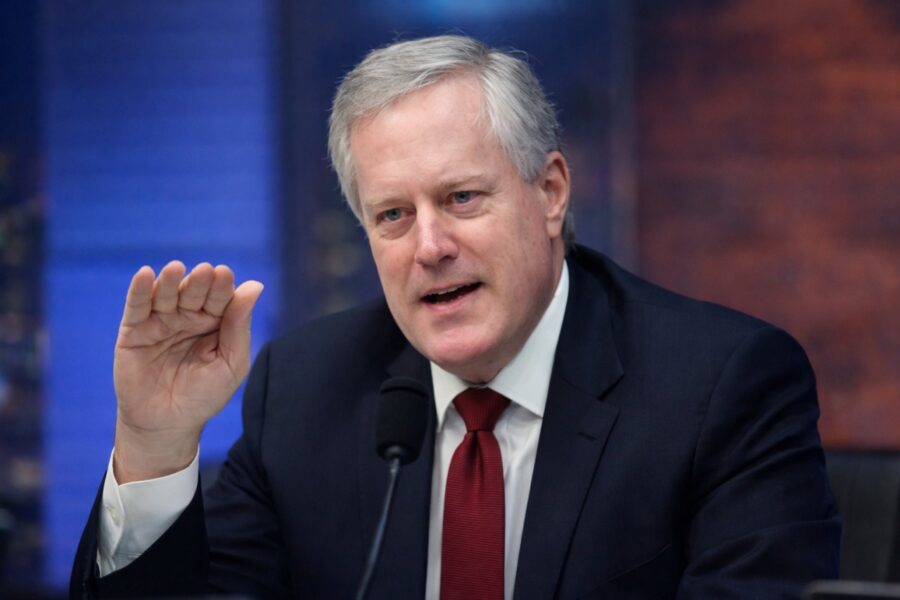

Mark Meadows, Donald Trump’s former White House chief of staff, is asking the Justice Department to reimburse legal fees tied to multiple Trump-related investigations, opening a fresh fight over how far the federal government should go in covering the private defense costs of former senior officials.
CBS News reported that Meadows’ lawyer submitted the request to the department in early February 2026, though the amount being sought has not been made public.
The request lands in politically charged territory, but the legal question is narrower than the politics. Federal regulations do permit DOJ, in certain cases, to provide representation, hire private counsel at government expense, or reimburse legal fees for current or former federal employees who were sued, subpoenaed, or charged in their individual capacities.
The two key tests are whether the conduct at issue reasonably appears to have occurred within the scope of the employee’s federal job and whether paying for that defense would be “in the interest of the United States.”
That language gives the department discretion, not an automatic obligation. In other words, Meadows can ask, but DOJ does not have to say yes.
Table of Contents
ToggleThe Argument Meadows Is Likely Making
Any reimbursement push by Meadows is likely to rest on a familiar claim: that much of the conduct scrutinized by investigators happened while he was serving as White House chief of staff, one of the most senior jobs in the executive branch.
If DOJ accepts that framing, Meadows’ lawyers could argue that the legal exposure grew out of official duties rather than purely private political activity. The regulation is broad enough to allow that argument to be made.
There is also precedent for reimbursement in politically explosive investigations.
In a 2020 opinion, DOJ’s Office of Legal Counsel concluded that current and former federal employees interviewed as witnesses in Special Counsel Robert Mueller’s Russia investigation could, on a case-by-case basis, be reimbursed for attorney’s fees when their testimony related to information obtained through government service.
Why Meadows’ Case Is Harder
Still, Meadows’ position appears more complicated than the Mueller-era witness cases. The OLC opinion highlighted witnesses, not necessarily people facing direct criminal exposure.
Meadows was not charged in Jack Smith’s federal election case, according to CBS News, but he was charged in both Georgia and Arizona in cases tied to efforts to overturn Trump’s 2020 loss.
That matters because DOJ may view fee reimbursement more skeptically when the legal work is tied to defending a person as a charged defendant, especially in state prosecutions, rather than assisting a federal employee drawn in as a witness.
The Stakes Beyond Meadows
CBS also reported that Meadows is pursuing reimbursement in Georgia under a separate state-law pathway and is among defendants seeking millions in combined legal-fee recovery there.
That makes the DOJ request more than a personal financial dispute. It could become an early signal of how the federal government, under Trump’s return to office, interprets the boundary between official presidential work and conduct tied to election challenges.
For now, the strongest conclusion is also the simplest one: the rules give Meadows a real opening, but not a guaranteed victory. Whether DOJ sees his legal bills as a public obligation or a private burden will decide the case.
Related Posts:
- Best Places to Retire Abroad in 2026: An Honest…
- Safest Cities in California in 2026: An Honest,…
- 25 Most Dangerous Cities in US - Updated Statistics for 2026
- The 100 Most Dangerous Cities in America (2026):…
- Social Issues in America: 45 Real Examples, 2026…
- How Much Does It Cost to Hire an Attorney in the US?