
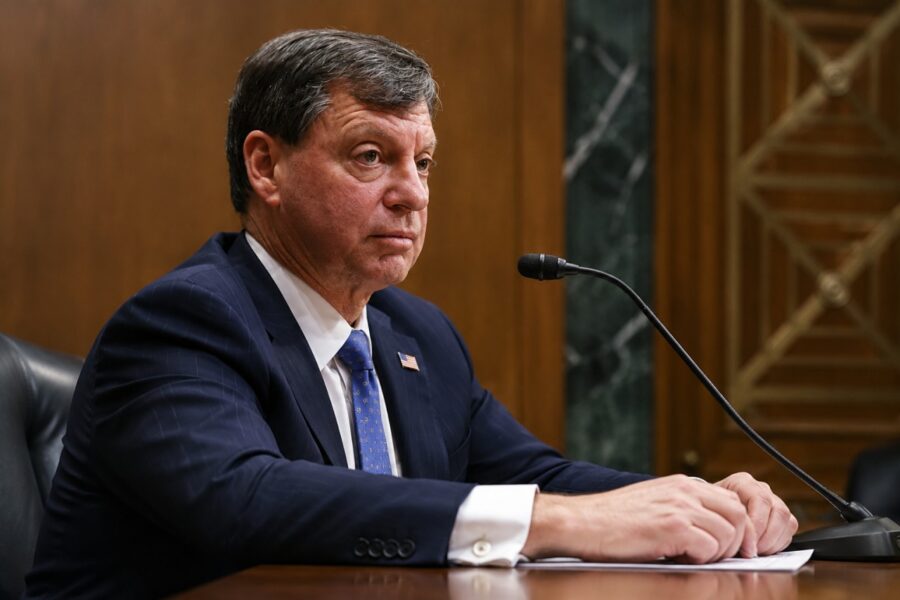

A July 2, 2026, email from Social Security Administration Commissioner Frank Bisignano is facing scrutiny in Washington after five Democratic senators said the official communication praised President Donald Trump and overstated the financial value of a new tax deduction for older Americans.
The dispute matters because Social Security recipients rely on the agency for accurate information about benefits and tax obligations. The number of people who received the message and the cost of distributing it have not been publicly disclosed, according to CBS News reporting.
Table of Contents
ToggleWhat the Frank Bisignano Social Security email said
The email, titled “Making Life More Affordable for America’s Seniors,” said more than 35 million older Americans had received an average of $7,500 in relief during the 2026 tax season. It credited Trump with protecting Social Security and providing immediate financial relief.
Bisignano also used the message to promote reported improvements in Social Security Administration phone service, field-office waiting times and disability-claim processing.
A July 21 Senate letter challenged the communication. It was signed by Senators Elizabeth Warren of Massachusetts, Ron Wyden of Oregon, Tammy Baldwin of Wisconsin, Sheldon Whitehouse of Rhode Island and Ben Ray Luján of New Mexico.
The senators described the $7,500 figure as misleading and accused Bisignano of using email addresses collected for Social Security services to distribute partisan material.
Why the $7,500 Figure Is Disputed
The central issue is the difference between a tax deduction and an actual tax saving. The Treasury Department reported in April that more than 30 million seniors had claimed the enhanced senior deduction, with an average deduction above $7,500, according to Treasury Department figures.
A deduction reduces taxable income. It does not provide an equivalent refund or reduce a person’s tax bill dollar for dollar.
Under the law, qualifying taxpayers aged 65 and older may deduct as much as $6,000 each, or $12,000 for a married couple when both spouses qualify. The deduction applies from tax years 2025 through 2028.
The benefit begins phasing out when modified adjusted gross income exceeds $75,000 for single filers or $150,000 for joint filers, as explained in official IRS guidance.
The legislation did not repeal the federal rules governing taxation of Social Security benefits. The IRS continues to determine whether benefits are taxable by examining a taxpayer’s other income and part of their Social Security payments.
Depending on income and filing status, as much as 85 percent of a recipient’s benefits can remain taxable under existing federal tax rules.
Tax Policy Center analysis indicates that the benefit varies sharply by income. The organization estimated that fewer than half of older adults would receive any benefit from the deduction.
Its analysis projected an average tax reduction of about $1,100 for seniors in the roughly $80,000 to $130,000 income range, where the provision’s largest gains were concentrated.
Latest Verified Update
The newest verified development is the senators’ letter, publicly released on July 22, 2026. Lawmakers asked Bisignano to disclose how many people received the July 2 email, how the recipient list was assembled and how much the message cost to prepare and distribute.
They also asked whether the White House participated in developing or approving the email. A response was requested by August 11, 2026, according to Senator Warren’s office.
The letter cited Bisignano’s written pledge during his 2025 confirmation process to run the Social Security Administration in an “independent and nonpartisan manner.” That commitment appears in his Senate confirmation responses.
The correspondence requests documents and explanations. It does not announce an enforcement action or establish a formal finding that Bisignano or the agency violated the law.
A Repeat of the 2025 Dispute
The latest controversy follows a similar episode in July 2025. After Congress passed the One Big Beautiful Bill Act, the Social Security Administration said the measure would eliminate federal income taxes on Social Security benefits for most beneficiaries.
The agency later revised part of its public wording, although its explanation continued to connect the separate senior deduction with eliminating benefit taxes for many recipients. The original claim remains visible in an SSA press release.
Tax analysts said the description blurred two separate questions: whether Social Security benefits are legally subject to federal tax and whether a broader deduction lowers a senior’s total income-tax bill.
Confusion between those issues can affect expectations about refunds, tax-filing obligations and the actual financial value of the deduction.
What Happens Next
Bisignano’s response will determine whether lawmakers receive details about the scale, financing and approval process behind the email. Further hearings, document demands or an inspector-general referral would require additional action by Congress or another oversight authority.
For beneficiaries, the practical distinction remains important. The enhanced senior deduction may reduce taxable income for eligible filers, but it is not a guaranteed $7,500 payment.
The provision also does not automatically make Social Security benefits tax-free. Eligibility requirements are outlined on the IRS eligibility page.
Related Posts:
- Best Places to Retire Abroad in 2026: An Honest…
- The 100 Most Dangerous Cities in America (2026):…
- Safest Cities in California in 2026: An Honest,…
- 25 Most Dangerous Cities in US - Updated Statistics for 2026
- Most Expensive States to Live in the US in 2026…
- Texas Governor Election 2026: Abbott vs Hinojosa Guide