
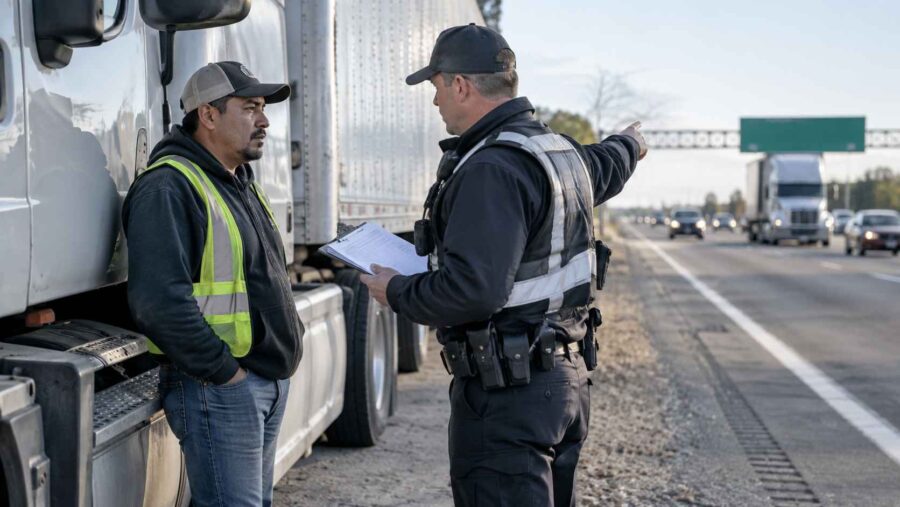

Federal regulators are moving to put the consequences for failing an English proficiency check directly into commercial driver regulations.
The Federal Motor Carrier Safety Administration published a proposed rule on August 10, 2026 that would require most interstate commercial drivers who violate the federal English language requirement to be placed out of service immediately.
Drivers are already being removed from service under enforcement guidance that took effect in June 2025. The new proposal would write that consequence into the Federal Motor Carrier Safety Regulations, making the policy harder to change through enforcement guidance alone.
As of October 7, 2026, the proposal is not yet a final rule. The public comment period closes on October 9.
The English Requirement Is Already Federal Law
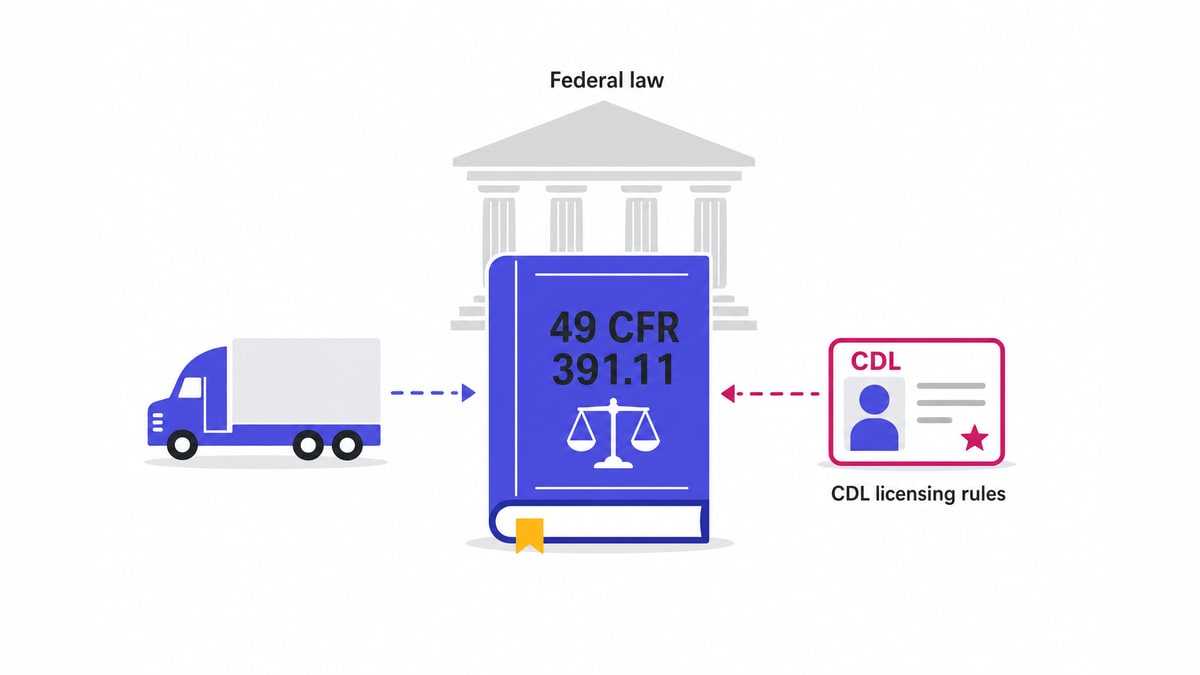
The federal government is not creating a new requirement for truck drivers to know English. Commercial drivers in interstate commerce have been subject to an English language qualification for decades.
Under 49 CFR 391.11, a driver must have enough English ability to communicate with the public, understand highway traffic signs and signals, respond to official questions and complete required reports and records.
FMCSA traces the federal requirement back to rules adopted in 1936. The original regulation took effect in 1937, and an early exception for some existing drivers was removed in 1939.
The part that changed more recently was enforcement.
Federal policy adopted in 2016 directed inspectors to cite drivers who violated the English requirement without automatically placing them out of service. That approach changed in 2025 after FMCSA issued new enforcement instructions and the Commercial Vehicle Safety Alliance added English proficiency violations back to its North American Standard Out-of-Service Criteria.
The English proficiency proposal arrives during a period of wider federal scrutiny of commercial driver qualifications. We recently covered the new federal CDL licensing rules, which also changed who can qualify for certain commercial credentials and are now being challenged in federal court.
Drivers Have Been Subject to Out-of-Service Orders Since June 2025
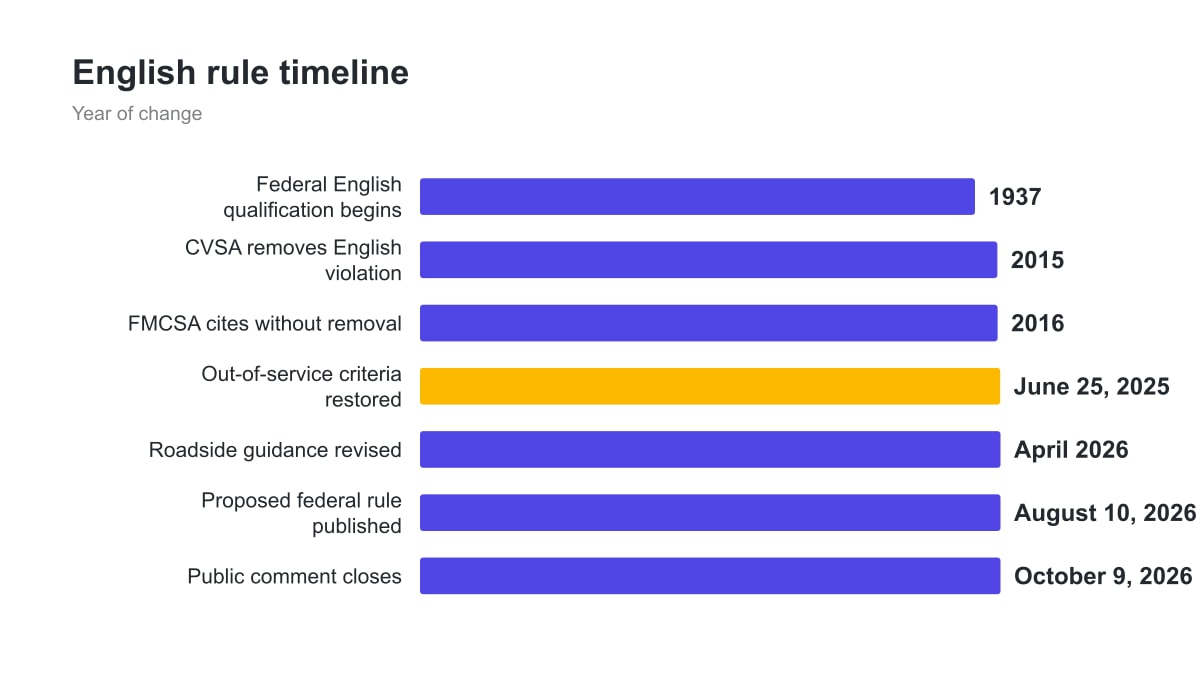
The current enforcement system started on June 25, 2025.
Since that date, most drivers who fail an English language proficiency assessment during an eligible roadside inspection can receive an out-of-service order. FMCSA uses specific violation codes so qualifying English proficiency violations are recorded as out-of-service violations.
The Department of Transportation reported in August 2026 that more than 26,000 commercial drivers had already been taken out of service for failing English proficiency assessments since the enforcement change.
| Date | Change |
| 1937 | Federal English qualification begins for covered commercial drivers |
| 2015 | CVSA removes the English violation from its out-of-service criteria |
| 2016 | FMCSA guidance directs inspectors to cite violations without automatic removal from service |
| June 25, 2025 | English violations return to the CVSA out-of-service criteria |
| April 2026 | FMCSA issues revised roadside enforcement guidance |
| August 10, 2026 | FMCSA publishes proposed federal rule |
| October 9, 2026 | Public comment period closes |
The August proposal therefore does not introduce roadside English assessments for the first time. It would place the existing out-of-service consequence directly into federal regulations.
The Roadside Assessment Has Two Main Parts
FMCSA enforcement guidance gives inspectors a defined procedure for assessing English proficiency during roadside inspections.
The process starts with an interaction in English. If the initial contact gives the inspector reason to believe the driver cannot understand the instructions, the inspector can begin the formal English language proficiency assessment.
The current FMCSA enforcement policy divides the assessment into two stages.
1. Driver Interview
The first stage tests the drivers ability to respond sufficiently to official questions and directions in English.
FMCSA tells inspectors not to use interpreters, translation applications, cue cards, telephone interpretation services or similar communication aids during the interview. Regulators say those tools could hide an inability to communicate independently in English.
If a driver cannot respond sufficiently during the interview, the inspector can cite the English proficiency violation without moving to the second stage.
2. Highway Traffic Sign Assessment
A driver who passes the interview proceeds to a traffic sign assessment.
The inspector evaluates the drivers ability to understand US highway signs that contain English words. The assessment can include standard signs as well as electronic changeable-message signs.
A driver who cannot demonstrate enough English comprehension to understand the tested signs can also receive an English proficiency violation.
The Proposed Rule Would Put Immediate Removal Into Federal Regulations
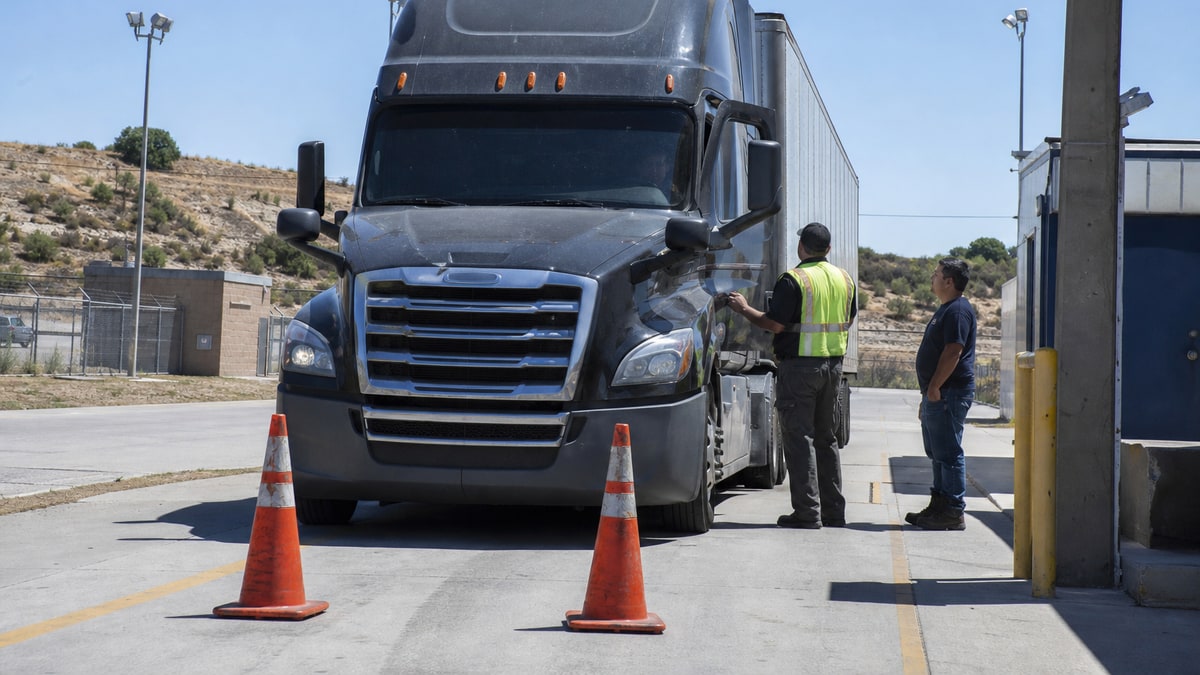
The August proposal would add a new paragraph to 49 CFR 391.11.
Under the proposed text, a person found violating the English qualification while operating a commercial vehicle in interstate commerce would be placed out of service immediately, subject to a limited provision for certain operations near the US-Mexico border.
FMCSA says codifying the policy would align the federal regulations with the enforcement criteria inspectors already use.
The practical difference is regulatory permanence. Current roadside enforcement relies partly on agency policy and CVSA criteria. A final federal rule would place the out-of-service consequence directly in the Code of Federal Regulations.
Failing the Test Does Not Automatically Cancel a CDL
An out-of-service order and the cancellation of a commercial drivers license are not the same action.
An out-of-service order prevents the driver from continuing commercial vehicle operations under the conditions covered by the order. FMCSA guidance also allows additional enforcement action when circumstances support it, including action related to driver qualification.
The immediate roadside result is still significant. A truck may be unable to continue its trip with the same driver, leaving the carrier to arrange a qualified replacement.
FMCSA tells motor carriers that they are responsible for making sure a driver satisfies federal qualifications before allowing that person to operate a commercial vehicle.
Carriers Are Expected to Check English Skills Before Dispatch

Federal rules prohibit motor carriers from requiring or permitting an unqualified person to drive a covered commercial vehicle.
FMCSA therefore advises carriers to assess English ability during the hiring and driver qualification process instead of waiting for a roadside inspection.
The agency recommends an English interview that covers subjects a driver could encounter during an inspection, including trip information, shipping documents, vehicle records and other questions from enforcement personnel.
Carriers can also assess the drivers ability to understand highway signs containing written English.
FMCSA does not require trucking companies to provide English classes. A carrier remains responsible for determining that its drivers satisfy the qualification before dispatch.
A Failed Assessment Can Leave Freight Waiting for Another Driver
The effect of an out-of-service order extends past the individual driver.
A carrier whose driver cannot continue may need to find another qualified driver, transport that person to the truck and deal with a delayed shipment.
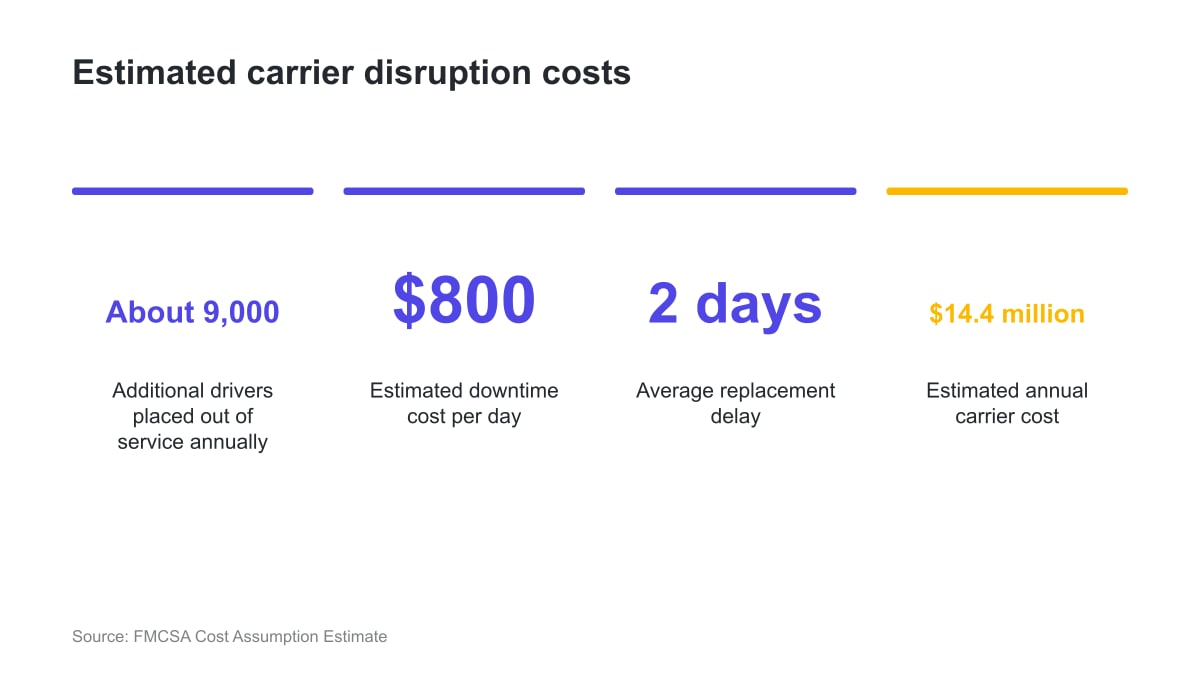
FMCSA estimated that the proposed change involving US-Mexico border commercial zones could create about $14.4 million in annual carrier costs. The agency based that figure on an estimated 9,000 additional out-of-service orders per year, $800 in daily downtime costs and an average two-day delay while a replacement driver is found and dispatched.
| FMCSA Cost Assumption | Estimate |
| Additional drivers placed out of service annually | About 9,000 |
| Estimated downtime cost per day | $800 |
| Average replacement delay | 2 days |
| Estimated annual carrier cost | $14.4 million |
FMCSA presented those numbers as regulatory estimates rather than recorded annual losses. The agency is asking for public feedback on replacement times, delay costs and other effects before completing the rulemaking.
Driver Qualification Can Also Become Relevant After a Serious Truck Crash
A roadside English violation and responsibility for a crash are separate questions. Failing an English assessment does not by itself establish that a driver caused a collision.
After a serious semi-truck crash, records concerning driver qualifications, inspections, carrier practices and the events leading to the collision can become part of the investigation. Someone injured in a Missouri trucking collision may speak with a St. Louis Semi-Truck Accident Lawyer about the records and legal issues connected with the individual crash.
The same distinction applies when regulators enforce the English requirement. FMCSA treats English proficiency as a driver qualification standard, but investigators still need evidence connecting any specific violation to the circumstances of a collision before drawing conclusions about causation.

The US-Mexico Border Has a Limited Exception
The proposed rule contains a specific provision for commercial zones along the US-Mexico border.
A driver operating inside one of those zones would not automatically receive an out-of-service order for an English violation if the current trip remains inside the commercial zone.
The exception would end when evidence shows that the driver has operated, or intends to operate, in the United States outside the permitted border commercial zones.
FMCSA revised its enforcement policy in April 2026 to clarify the same issue.
Agency analysis found 41,563 English proficiency violations issued inside border commercial zones between June 25, 2025 and March 19, 2026. Based on shipment origin and destination information, FMCSA estimated that 16% of those cases involved trips that would also have qualified for an out-of-service order under the proposed approach.
FMCSA Estimates About 9,000 Additional Border-Zone Out-of-Service Orders a Year
The border provision produces the largest measurable change identified in the proposed rule.
FMCSA estimates about 56,575 English proficiency violations would occur annually within the covered border commercial zones under its projection.
About 16% could result in an out-of-service order because the trip extended, or was intended to extend, outside those zones. That produces an estimate of roughly 9,052 cases per year, which the agency rounded to about 9,000 for its economic analysis.
FMCSA acknowledges that the calculation is indirect. Inspectors had information about freight origins and destinations, but those details do not always establish the exact route or final destination of an individual driver.
Hearing-Impaired Drivers Have Separate Federal Guidance
The English qualification is not applied in exactly the same way to every driver.
FMCSA guidance addresses drivers with hearing exemptions who cannot communicate orally but can read and write English sufficiently.
A hearing-impaired driver with the applicable federal exemption does not fail the English requirement solely because the driver cannot speak English orally. The agency states that sufficient written English can satisfy the requirement in that circumstance.
That guidance has been in place since 2014 and remains effective.
The Proposed Rule Does Not Create a New Language Training Mandate
FMCSA repeatedly describes English proficiency as an existing driver qualification rather than a new training requirement.
Motor carriers would not have to operate English courses under the proposed regulation. They would still have to make sure drivers meet the qualification before operating commercial vehicles covered by the federal rules.
Companies remain free to provide training or use outside training resources if they choose.
For a carrier, the financial incentive is direct. Discovering a problem before dispatch avoids the possibility of a loaded truck being stopped until another qualified driver arrives.
The Federal Proposal Is Still Open for Public Comment
FMCSA published the proposed rule in the Federal Register on August 10, 2026 under docket FMCSA-2026-0826.
The agency is accepting public comments through October 9, 2026. More than 2,100 comments had been submitted to the Federal Register docket by October 7.
After the comment period closes, FMCSA can review the submissions and decide how to proceed. The agency could publish a final rule with the proposed language, change parts of the proposal or take another regulatory action.
Until a final rule appears, the August document remains a proposal. Current roadside enforcement does not disappear in the meantime because inspectors are already applying the English proficiency policy and CVSA out-of-service criteria adopted in 2025 and revised in 2026.
What Has Changed Since the Earlier Enforcement Policy
The timeline explains why reports about the policy can sound contradictory.
The English qualification itself is old. The major change since 2025 is the consequence inspectors apply when a driver fails the assessment.
| Period | Federal Enforcement Approach |
| Before 2015 | English violations were included in CVSA out-of-service criteria |
| 2015 to 2025 | Drivers could be cited without automatic removal from service under the later FMCSA policy |
| From June 25, 2025 | Qualifying English violations again became out-of-service violations |
| April 2026 | FMCSA revised roadside guidance and clarified border-zone enforcement |
| August 2026 proposal | FMCSA seeks to write the out-of-service consequence directly into federal regulations |
A final version of the August proposal would therefore codify an enforcement result that thousands of drivers have already faced at roadside inspections.
The most immediate date now is October 9, when the public comment period ends. Until FMCSA completes the rulemaking process, the proposed regulatory language should not be described as a final federal rule.