
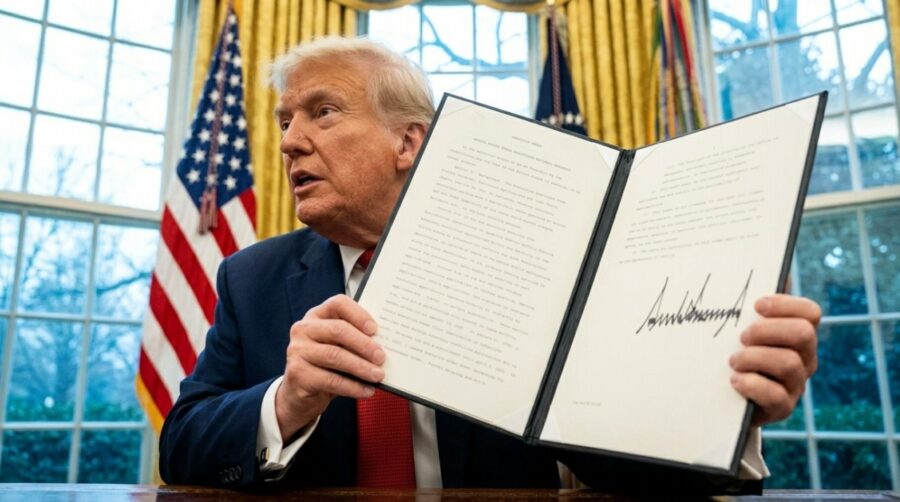

President Donald Trump said on July 8, 2026, that he would ask the U.S. Supreme Court to reconsider its decision protecting birthright citizenship for children born in the United States to parents who are undocumented or temporarily present.
The planned request targets Trump v. Barbara, a major constitutional ruling issued on June 30.
In its June 30 opinion, the court affirmed a nationwide injunction against Trump’s executive order and held that the Fourteenth Amendment grants citizenship at birth to children born on U.S. soil, with narrow historical exceptions.
No rehearing petition had appeared on the Supreme Court docket as of July 10.
Table of Contents
ToggleWhat Trump Is Asking the Court to Reconsider
Trump announced his plan on Truth Social, calling the ruling a “miscarriage of justice” and arguing that U.S. citizenship should not be available through what he described as birth tourism. His comments followed reports about a Texas hospital marketing maternity services in Mexico.
The president has said he will seek a rehearing “immediately,” although his administration must still submit a formal petition before the justices can consider the request. Reuters reported that Trump’s challenge is aimed at reversing one of the most significant legal defeats of his second-term immigration agenda.
Trump signed Executive Order 14160 on January 20, 2025. It directed federal agencies not to recognize citizenship for certain U.S.-born children when neither parent was a citizen or lawful permanent resident, and the parents were unlawfully or temporarily in the country.
Supreme Court Rejected the Executive Order
In its June 30 ruling, the Supreme Court concluded that children born in the United States to parents who are unlawfully or temporarily present are “subject to the jurisdiction” of the United States and therefore citizens at birth.
Chief Justice John Roberts wrote the main opinion, joined by Justices Sonia Sotomayor, Elena Kagan, Amy Coney Barrett and Ketanji Brown Jackson. Justice Brett Kavanaugh agreed that the executive order could not take effect because it conflicted with federal law, although he disagreed with the majority’s full constitutional analysis.
The result was a 6-3 judgment against the administration, supported by a five-justice constitutional majority. Justices Clarence Thomas, Samuel Alito and Neil Gorsuch dissented from the judgment.
Roberts relied partly on the court’s 1898 decision in United States v. Wong Kim Ark, which recognized citizenship for a child born in San Francisco to Chinese parents. The majority said the historical rule covered children born to foreign parents even when their presence in the country was temporary, apart from limited categories such as children of foreign diplomats.
Latest Verified Update
The Supreme Court docket for Trump v. Barbara, case number 25-365, did not list a petition for rehearing by July 10. The most recent public development remained Trump’s statement that his administration intended to file one.
Under Supreme Court Rule 44, a merits rehearing petition generally must be filed within 25 days of the judgment. It must identify significant intervening circumstances or substantial grounds that were not previously presented. A rehearing requires majority approval and must be initiated by a justice who joined the original judgment, according to the court’s official procedural rules.
That requirement creates a difficult procedural hurdle. At least one justice who supported the June 30 result would have to vote to reopen the case before the court could change its ruling.
Why the Case Matters
The decision resolved the constitutional question left unanswered by the court’s 2025 ruling in Trump v. CASA. In that earlier case, the justices limited the use of nationwide injunctions but did not decide whether Trump’s citizenship order itself was lawful.
The later class-action case brought by parents, including a plaintiff identified as Barbara, gave the court a direct opportunity to assess the order under the Fourteenth Amendment and the Immigration and Nationality Act. The justices heard arguments on April 1, 2026, after granting review before the First Circuit Court of Appeals had issued a final judgment.
What Happens Next
The administration may file its rehearing petition before the 25-day deadline. The justices can deny it without seeking a response, request further briefing or, in an exceptional outcome, grant rehearing.
Unless the court changes its judgment, Executive Order 14160 remains blocked. Children covered by the order continue to be recognized as citizens at birth under the Supreme Court’s interpretation of the Fourteenth Amendment and federal law.