
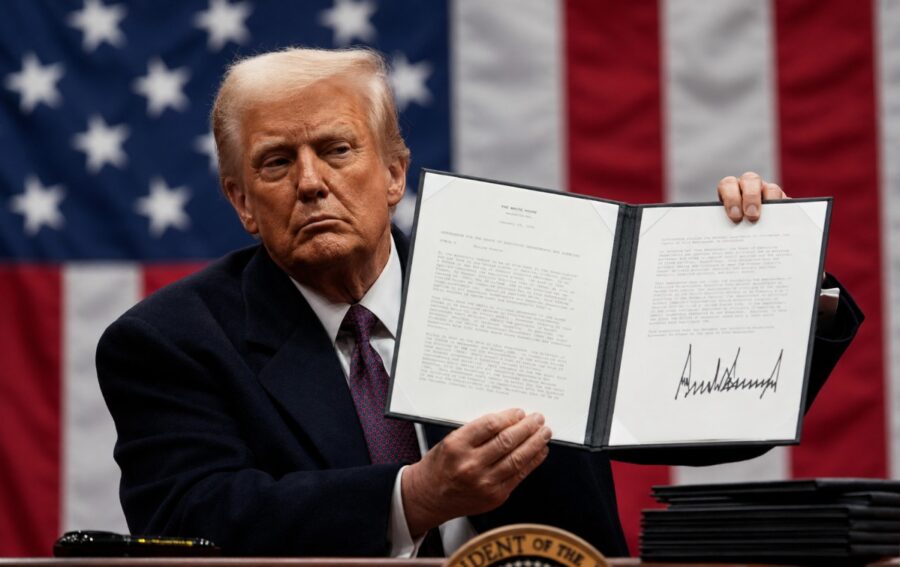

The U.S. Supreme Court’s final stretch of the term has put President Donald Trump’s legal fortunes under renewed scrutiny, with the birthright citizenship case emerging as the clearest test of whether the conservative-majority court is broadly backing his second-term agenda or drawing constitutional limits.
The central dispute is Trump v. Barbara, No. 25-365, a challenge to Executive Order 14160, which seeks to deny automatic U.S. citizenship to some children born in the United States to undocumented immigrants or temporary visa holders, according to the Supreme Court docket.
The case matters because birthright citizenship is rooted in the first sentence of the 14th Amendment: “All persons born or naturalized in the United States, and subject to the jurisdiction thereof, are citizens.” A ruling for Trump would mark a major shift in how that clause has long been applied. A ruling against him would be a high-profile limit on one of his signature immigration policies.
Table of Contents
ToggleKey Facts
The Supreme Court will hand down all of its remaining opinions from this term Tuesday, setting the stage for a blockbuster day with decisions expected on birthright citizenship, transgender athlete bans and campaign finance.
Read more: https://t.co/HRGjGnlvKM #SupremeCourt… pic.twitter.com/Q0yRrT9WKg
— The Hill (@thehill) June 29, 2026
Trump signed Executive Order 14160 on January 20, 2025, directing federal agencies not to recognize citizenship for U.S.-born children in two categories: when the mother was unlawfully present and the father was neither a U.S. citizen nor lawful permanent resident, or when the mother was in the country lawfully but temporarily and the father lacked citizenship or permanent residency.
The administration argues that those children are not “subject to the jurisdiction” of the United States in the constitutional sense. Challengers, including civil rights and immigrant-rights groups, argue the order conflicts with the 14th Amendment, federal citizenship law and Supreme Court precedent. The administration’s position is laid out in its government merits brief.
The Supreme Court agreed on December 5, 2025, to hear Trump v. Barbara before final judgment in the lower courts. Oral argument took place on April 1, 2026, with Solicitor General D. John Sauer arguing for the Trump administration and Cecillia D. Wang arguing for the respondents.
Latest Verified Update
As of the latest verified court and news records reviewed, the merits decision in Trump v. Barbara was still pending at the end of June. Reuters reported on June 29, 2026, that the Supreme Court was set to issue final rulings of the term on Tuesday, including cases involving Trump’s bid to limit birthright citizenship, campaign finance limits and transgender athletes. The update came in a Reuters Supreme Court report.
The State Department’s current public guidance says the federal government remains enjoined from enforcing Executive Order 14160, while one guidance-related section of the order has been allowed to take effect. That position is stated in the department’s passport guidance.
Background and Why It Matters
President Trump said Monday he would accept the Supreme Court’s scheduled ruling on his bid to roll back automatic birthright citizenship.
“In terms of for the good of the country, it would be great if they didn’t allow it,” he said https://t.co/isgz5JytXE pic.twitter.com/Bxp1IIPfji
— Bloomberg (@business) June 29, 2026
The court already gave Trump a partial procedural victory in the earlier birthright citizenship litigation, Trump v. CASA, Inc., on June 27, 2025. In that decision, the justices limited the ability of lower courts to issue universal injunctions, but the majority explicitly said it was not deciding whether the citizenship order violated the 14th Amendment or federal law, according to the Supreme Court opinion.
That distinction is important. The 2025 ruling concerned judicial remedies. Trump v. Barbara concerns the substance: whether the president can change, by executive order, who receives citizenship at birth. The court’s answer could affect federal documents, passports, Social Security records, immigration enforcement and state benefit systems for affected children.
Sky News framed the wider question as whether the Supreme Court is “on Trump’s side” after a mixed run of rulings. Its June 30 podcast summary noted Trump’s defeat in the E. Jean Carroll appeal, a mail-in ballot setback, recent immigration wins and the pending birthright citizenship decision. The discussion appeared in a Sky News analysis.
Reuters separately described the court as having backed Trump in multiple emergency rulings while also handing him notable losses, including on tariffs. That pattern, outlined in a Reuters legal preview, shows why the birthright citizenship case has become a sharper test than the broader political question of whether the court is simply favoring one president.
What Happens Next
The next step is the Supreme Court’s merits ruling in Trump v. Barbara. The court could uphold the executive order, strike it down, or issue a narrower decision focused on statutory or procedural grounds. Until that decision is released, the legal status of Trump’s citizenship policy remains blocked in practice, with agency guidance limited by existing injunctions.
The case is now less a simple referendum on Trump than a test of how far the court’s conservative majority is willing to let presidential power reach into a constitutional rule that has defined American citizenship since Reconstruction.