


Updated November 2026
Short answer: no, crime in Miami is not increasing. The City of Miami recorded 27 homicides in 2024, close to its all-time low, homicides fell about 20% in the first half of 2025, and by mid-2026 they were down another 50% compared with the same period a year earlier, according to Axios. Robberies, aggravated assaults and car thefts have been falling too.
That doesn’t mean every part of Miami is equally safe. Crime is still concentrated in a few neighborhoods, and Miami Beach has much higher property crime per resident because of its huge tourist population.
When comparing Miami’s crime rate with the state and national averages, it’s crucial to consider both violent and property crimes. Violent crimes include offenses like murder, rape, robbery, and assault, while property crimes encompass burglary, theft, and motor vehicle theft.
Here is what the numbers show for the city, its neighborhoods and Miami Beach.
Crime in 2025 and 2026
In the first half of 2025, the Miami Police Department reported a 20% drop in homicides, a 17% drop in robberies, a 19% drop in aggravated assaults and a 37% drop in auto thefts compared with the same period in 2024, according to the Miami Herald. The trend continued into 2026: preliminary Major Cities Chiefs Association data showed Miami homicides down 50% in the first half of the year.
Countywide, the Miami-Dade Sheriff’s Office reported similar declines.
According to MiamiDade, During the timeframe between January and February of 2025, there has been an 18.06% decrease in crimes compared to the same period in 2024.
Notably, violent crimes have decreased by 14.59%, and non-violent crimes have seen an 18.62% reduction. Specific declines include an 80% drop in homicides and a 42.44% decrease in motor vehicle thefts.
The City’s Crime Rate

According to NeighborhoodScout, Miami’s total crime index is 11. This means that Miami is safer than 8% of U.S. cities. This index is a measure that takes into account both violent and property crimes. It’s a sobering statistic that underscores the challenges Miami faces in terms of crime.
The annual number of crimes in Miami is reported to be 13,390, with a crime rate of 29.79 per 1,000 residents. This includes both violent crimes, which are reported to be 1,743, and property crimes, which are significantly higher at 11,647.
The chances of becoming a victim of a violent crime in Miami are 1 in 285, while the chances of becoming a victim of a property crime are 1 in 39. These figures highlight the prevalence of property crimes in the city, which is a common trend in urban areas with high population densities.
AreaVibes, on the other hand, reports that Miami’s total crime rate is 10% lower than the national average.
The two sources measure crime differently, which is why one makes Miami look worse than the other. Either way, the direction of travel since 2022 has been clearly downward.
Back in January, Miami Police Department’s Assistant Chief Armando Aguilar stated that:
”In 2023, the department reported a 40% reduction in murders and non-fatal shootings compared to 2022.”
Overall Drop In Crime in 2024
Also, the City of North Miami achieved historic crime reductions in 2024, marking one of the safest periods in its history.
The North Miami Police Department reported a 13% decrease in overall crime, a remarkable 41% reduction in violent crime, and a 100% reduction in homicides, with zero homicides recorded for the first time in over 48 years.
Miami Neighborhoods

The next thing we want to point out is discussing the situation in Miami’s neighborhoods. Once again, we will consult AreaVibes.
The public often compares the safety of Miami to that of the more dangerous areas in Chicago, however it’s clear that, based on the statistics that are available, Chicago is much more dangerous.
As far as Miami goes, we’ll start with the safest ones, by comparing them to the national average:
| Neighborhood | Total crime | Violent crime | Property crime |
|---|---|---|---|
| Sunny Isles Beach | 45% lower | 77% lower | 39% lower |
| Coral Way | 45% lower | 46% lower | 39% lower |
| Downtown | 64% lower | 46% lower | 63% lower |
| Coral Gables | 64% lower | 68% lower | 63% lower |
| Key Biscayne | 70% lower | 73% lower | 69% lower |
What About Miami Beach?
Since Miami Beach is a part of the Miami metropolitan area, it is important to take a look at the situation there.
According to stats outlined by the local government officials, it looked like this between 2019 and 2022:

In 2023 and 2024, we can see that Miami Beach has a significantly higher crime rate than Miami and the state of Florida’s median level.
Once again, Neighborhoodscout helps by stating that the violent crime rate in Miami Beach is 10.62, which is significantly higher than the median level in the state, which lies just at 2.59.
On the other side, the property crime rate in Miami Beach is way more common than in Miami, with 84.62 per 1,000, which means that the chances of being a victim of property crime amount to 1 in 12. You will certainly agree that this rate is extremely high.
Unsurprisingly, tourists are the most common target of crimes in Miami Beach.
Causes for Crime in Miami Beach
Employment Opportunities

Limited employment opportunities or the prevalence of low-wage jobs can lead to higher rates of unemployment and underemployment. Areas where people struggle with joblessness or low wages are more vulnerable to increased crime due to financial instability.
In Florida, the minimum wage has seen incremental increases over recent years, which aims to alleviate some of the financial pressure on low-income workers.
Conversely, regions with strong employment rates typically experience a reduction in overall crime. For example, the Miami area’s unemployment rate has generally run below the national average in recent years. This lower unemployment rate can contribute to a decrease in crime, as stable employment often leads to financial stability and reduced criminal activity.
Law Enforcement and Community Policing
The effectiveness of law enforcement and community policing initiatives can greatly influence crime rates. A strong, collaborative relationship between the police and the community can deter criminal activity and enhance safety. In Miami Beach, there are 5.49 police officers per 1,000 residents, compared to the national average of 3.25.
However, it’s not just about the number of officers; how they engage with the community is equally important. Effective community policing strategies that emphasize building trust and cooperation between the police and residents can lead to significant improvements in public safety.
Housing Affordability

In cities facing housing affordability challenges, crime can become a significant issue. When individuals and families are forced to live in cramped or substandard housing conditions, stress levels can rise, potentially leading to domestic conflicts and related criminal incidents.
Miami Beach home prices are far above the national median. This large disparity in housing costs can impact the well-being of residents, making it harder for some to find affordable housing, which can, in turn, contribute to higher crime rates within the community.
Dangerous Neighborhoods in Miami
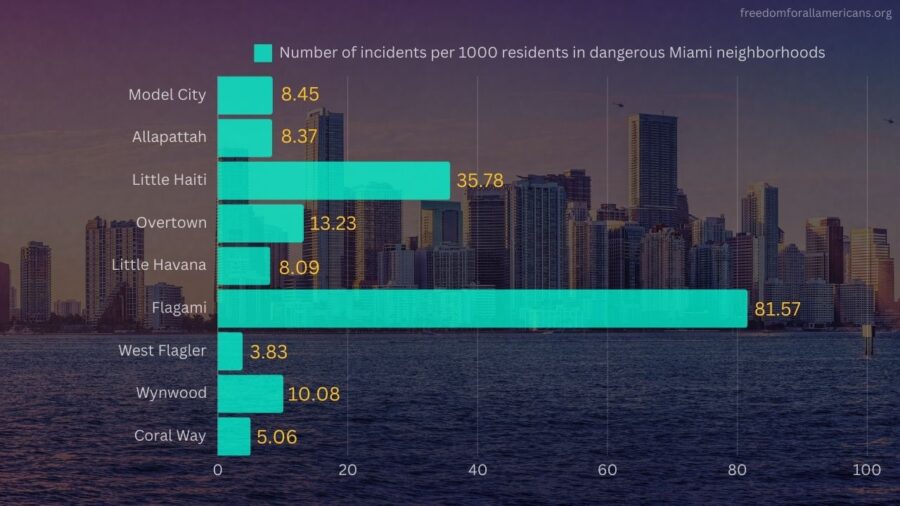
Using neighborhood crime data, we compiled a list of Miami neighborhoods where crime is most concentrated. These rankings are based on the number of incidents per 1000 residents in each neighborhood, relative to the city’s overall violent crime average.
I used similar methods when comparing dangerous neighborhoods in New York City to reveal comparable patterns of crime that demand attention.
Model City
| Metric | Value |
|---|---|
| Population | 25,023 |
| Violent Crimes | 8.45 incidents / 1k residents |
Model City, with a population of 25,023, stands out as one of the most dangerous neighborhoods in Miami. The area reports 8.45 incidents per 1000 residents, making safety a significant concern for locals and visitors alike, as Crime Grade reports.
Known for its tight-knit community, the neighborhood faces challenges that include economic disparities and limited opportunities, which contribute to the crime rates. Efforts to improve safety in Model City focus on community programs, economic development, and enhancing police-community relations.
Gun Violence Trends
According to American Progress, there has been a noted decline in gun-related crimes in 2024, with a year-to-date decrease of 38.8% in gun victimizations in the Miami area, reflecting broader efforts to control gun violence.
Allapattah
| Metric | Value |
|---|---|
| Population | 47,224 |
| Violent Crimes | 8.37 incidents / 1k residents |
Home to 47,224 residents, Allapattah experiences 8.37 incidents per 1000 people. According to Crime Grade, this diverse and vibrant neighborhood is rich in culture and history but grapples with safety issues.
The community’s efforts to reduce crime include fostering better employment opportunities, enhancing educational resources, and strengthening neighborhood watch programs. Addressing these challenges requires a multi-faceted approach that targets the underlying socio-economic factors.
Crime Comparison to National Average
According to AreaVibes statistics, Allapattah’s overall crime rate is 35% higher than the national average, and violent crimes in Allapattah are 20% higher than the national average.
Little Haiti
| Metric | Value |
|---|---|
| Population | 32,894 |
| Violent Crimes | 35.78 incidents / 1k people |
According to Crime Grade, Little Haiti, with a population of 32,894, records 35.78 incidents per 1000 residents. Known for its cultural vibrancy and as a hub for the Haitian diaspora, the area faces significant safety challenges.
Community leaders are actively working to create safe spaces through youth engagement programs, economic development initiatives, and cultural preservation efforts. The goal is to ensure that Little Haiti can thrive while improving its safety and security.
Overtown
| Metric | Value |
|---|---|
| Population | 12,917 |
| Violent Crimes | 13.23 incidents / 1k people |
With a population of 12,917, Overtown reports 13.23 incidents per 1000 residents. Historically rich and culturally significant, this neighborhood faces high crime rates that impact daily life.
Local organizations and residents are collaborating on initiatives to revitalize the area, focusing on housing, education, and economic opportunities to create a safer environment for everyone.
Comparison With the National Average
According to the statistics, crime rates in Overtown are 29% higher than the national average, and violent crimes specifically are 15% higher.
Little Havana
| Metric | Value |
|---|---|
| Population | 58,188 |
| Violent Crimes | 8.09 incidents / 1k people |
Little Havana, home to 58,188 people, experiences 8.09 incidents per 1000 residents, as per the latest statistics. Famous for its Cuban influence and vibrant cultural scene, the neighborhood also struggles with safety issues.
Efforts to enhance security include community policing, neighborhood watch programs, and initiatives to boost local businesses and provide more jobs. These steps aim to reduce crime and improve the quality of life for residents.
Flagami
| Metric | Value |
|---|---|
| Population | 59,848 |
| Violent Crimes | 81.57 incidents / 1k people (all crime types) |
Flagami, with a population of 59,848, records 81.57 incidents per 1000 people across all crime types, Crime Grade reports. This residential neighborhood is known for its family-friendly environment but faces safety concerns that impact its community. Local efforts to reduce crime focus on enhancing public services, supporting local schools, and fostering economic growth to provide more opportunities for residents.
General Crime Risk
AreaVibes statistics show that residents in Flagami face a 1 in 36 chance of being a victim of a crime, making it one of the more crime-prone neighborhoods in Miami.
West Flagler
| Metric | Value |
|---|---|
| Population | 49,734 |
| Violent Crimes | 3.83 incidents / 1k people |
Home to 49,734 residents, West Flagler reports 3.85 incidents per 1000 people, and these stats indicate a moderate level of violent crime. This neighborhood, characterized by its residential areas and local businesses, works towards improving safety through community engagement and economic development. Initiatives include improving infrastructure, supporting small businesses, and increasing police presence to deter crime and ensure a safer community.
The total crime rate in West Flagler is about 4% higher than the national average, factoring in both violent and non-violent crimes. – AreaVibes
Wynwood
| Metric | Value |
|---|---|
| Population | 17,923 |
| Violent Crimes | 10.08 crimes / 1k people |
Wynwood, with a population of 17,923, experiences 10.08 incidents per 1000 residents, statistics show. Known for its art scene and trendy vibe, the neighborhood also faces significant safety challenges. Community efforts focus on balancing cultural growth with safety improvements, including better lighting, increased police patrols, and community-driven safety programs to protect residents and visitors.
Coral Way
| Metric | Value |
|---|---|
| Population | 42,946 |
| Violent Crimes | 5.06 incidents / 1k people |
Coral Way, home to 42,946 people, shows 5.06 violent incidents per 1000 residents. This neighborhood, known for its tree-lined streets and historic homes, maintains a relatively lower crime rate compared to other areas. Efforts to sustain and improve safety include community events, neighborhood watch programs, and collaboration between residents and law enforcement to address any emerging issues.
Miami Compared to Other Major Cities

When comparing Miami to other major cities, the findings are mixed. The Council on Criminal Justice report shows carjacking rates in U.S. cities rose by 7% from 2022 to 2023. However, Miami’s specific situation is unique and it is slower by 1% than the national average.
NeighborhoodScout data puts Miami’s total crime rate at 29.79 per 1,000 residents, which is relatively high but lower than in cities such as Baltimore or Detroit. Property crime is notably more frequent, occurring at a rate of 26 per thousand residents. Therefore, Miami fits into a complex spectrum of crime rates among major U.S. cities, with certain areas outperforming others.
Crime Rate Comparisons With Past Decades
In the early 2000s, Miami’s crime rate was relatively high compared to national averages.
According to City-Data, the crime index in 2022 was 137, which is significantly lower than past years. The early 2010s saw gradual improvements, with violent crime rates starting to decline.
During the 2020s, substantial progress was evident. For instance, the number of homicides in 2022 decreased by 42 compared to 2020. Total crime rates in Miami were also 1.8 times lower than the U.S. average in 2022. This period marked a consistent decline in both violent and property crimes.
Notable Trends and Pattern Changes
One notable trend in Miami is the substantial decline in violent crimes over the past five years. Reports from Macrotrends show that offenses like homicide, aggravated assault, and robbery have seen significant drops. The number of homicides stood at just 19 in 2022.
Police efforts combined with advanced technology have been credited with this improvement.
Miami’s crime landscape has evolved significantly. These changes highlight the city’s progress from high crime rates in the early 2000s to a city with a decreasing crime index in recent years.
Beginning of Cybercrime
Despite advancements in crime prediction, Miami faces new challenges that could impact future crime rates. Cybercrime is a growing concern, with increased incidents of hacking and online fraud.
Miami’s diverse population also presents unique policing challenges. Communication barriers and cultural differences can complicate law enforcement efforts.
However, community engagement initiatives offer opportunities to build trust and cooperation between residents and the police. Miami is also leveraging these initiatives to address root causes of crime, such as poverty and lack of education.
Investments in technology and community programs are crucial for Miami’s ongoing effort to reduce crime and improve safety for all residents.
Methodology
For analysis of crime rates in Miami, FL, I rely on the crime data annually published by the FBI and city police as also other online sources. This data is released in two key segments: a preliminary overview focused on the nation’s largest cities, followed by a detailed year-end report.
Our investigative approach centered around two principal metrics:
- Per Capita Violent Crime Rates
- Per Capita Property Crime Rates
In pursuing a nuanced examination, our study predominantly concentrated on Miami while also integrating comparative data from other Florida cities for a more rounded state-wide perspective.
FAQs
Final Words

While Miami has made strides in reducing certain types of crime, the city’s overall crime rate remains a concern. Continuous efforts from law enforcement, community programs, and policy-makers are crucial in addressing the root causes of crime and ensuring a safer environment for all residents.
By focusing on economic development, education, and community-police relationships, Miami can work towards a future where every neighborhood is safe and thriving. The key to reducing Miami’s crime rate lies in a holistic approach that addresses socio-economic disparities and fosters a strong sense of community.
Heading into 2027, Miami is in a much better place than it was a few years ago. The city’s crime rate shows both areas of improvement and ongoing challenges. The answer to whether Miami’s crime rate is increasing or not lies in the specifics: while certain crimes have decreased, the overall rate necessitates continued vigilance and proactive measures to ensure lasting safety improvements across the city.
References
- miamidade.gov – MIAMI DADE Sheriff’s Office 85B – Part 1 Crimes YTD Comparison – Automated Date Range Jan 1, 2025 – Jan 26, 2025
- neighborhoodscout.com – Miami, FL Crime Rates
- areavibes.com – Miami, FL Crime Rates
- local10.com – ‘Miami is the safest it’s ever been’: Police chief credits officers, technology for lower crime rate
- local10.com – Cybercrime: ‘Sophisticated’ hackers target police officers, prosecutors in Miami-Dade
- northmiamifl.gov – Historic Crime Reductions in the City of North Miami: 2024 Marks Record-Breaking Achievements
- miamibeachfl.gov – Crime Statistics
- ycharts.com – Miami, FL Unemployment Rate
- realtor.com – What are the best neighborhoods in Miami Beach?
- crimegrade.com – Violent Crime In Miami
- americanprogress.org – 2024 Sees Smallest Summer Surge in Gun Violence Rates in 6 Years
- counciloncj.org – Crime Trends in U.S. Cities
- city-data.com – Crime rate in Miami, Florida (FL)
- macrotrends.net – Miami FL Crime Rate
- Miami Herald via Officer.com – Miami Police report 20% decrease in homicides for first half of 2025
- axios.com – Violent crime keeps falling in Miami, other big U.S. cities (August 2026)