


Finding another business with the name you want does not automatically mean the name is unavailable for trademark registration.
U.S. trademark law looks at more than the words themselves. The goods or services connected to each name, the similarity between the marks, where they are used, who used the mark first, and the risk that customers could confuse the businesses all play a role.
Two companies can sometimes legally use identical or similar names when they operate in unrelated markets. A local company that used a name first can also have trademark rights without ever registering the name with the federal government.
For a new business owner, the important question is not simply, “Does someone else use this name?” The real question is how that existing use affects the trademark rights you want to claim.
Someone Else Using the Name Does Not Automatically End Your Trademark Application
Trademark protection is tied to the source of particular goods or services. The United States Patent and Trademark Office does not treat every matching business name as an automatic conflict.
Imagine one company uses the name Blue Harbor for accounting services and another wants to use Blue Harbor for gardening tools. The names are identical, but the products and services are far apart. Consumer confusion may be much less likely than it would be if both companies offered accounting services.
A proper search therefore needs to go further than checking for an exact name. Business owners can use the USPTO trademark search system directly and can also use trademark search and filing services such as Trademark Engine during the research and application process.
The search should cover similar spellings, pronunciations and meanings as well. The USPTO can refuse a trademark even when another mark is not identical.
A name such as “Sun Rite” could potentially conflict with “Sun Right” if both are used for related products and customers are likely to view them as coming from the same source. Changing one letter or adding a generic word does not automatically remove the problem.
The USPTO Focuses Heavily on Likelihood of Confusion
View this post on Instagram
One of the most common reasons the USPTO refuses trademark registration is likelihood of confusion.
According to the USPTO guidance on likelihood of confusion, examiners look closely at two main areas. They compare the marks themselves and examine the relationship between the goods or services connected to them.
Marks can create a conflict because they look alike, sound alike, have similar meanings or create a similar overall impression.
The goods or services do not need to be identical either. Products can still be considered related when customers would reasonably expect them to come from the same company.
For example, a company selling running shoes and another selling athletic socks are closer commercially than a shoe company and a plumbing contractor. A similar brand name across the first pair would create a greater risk of customer confusion.
The international trademark class listed on an application does not settle the issue by itself. The USPTO specifically warns that goods and services can be considered related even when they appear in different classes.
Using a Business Name First Can Create Rights Without Registration
Federal registration is valuable, but trademark rights in the United States can begin before a business receives a federal registration.
The USPTO explains that trademark ownership can begin through actual use of a mark with goods or services. An unregistered business can therefore develop common law trademark rights through commercial use.
Geography becomes important with those rights.
A restaurant that has operated under the same name in one city for 15 years may have enforceable rights in the area where customers recognize the name, even if the owner never filed a federal trademark application.
A later company should not assume the name is clear simply because nothing appears in the federal trademark database.
The USPTO itself recommends searching beyond its own records. A full trademark clearance search can include federal applications and registrations, state databases, business records, websites, news results and other evidence of real-world use.

Federal Registration Gives Much Wider Protection
Common law rights are generally connected to the geographic area where the business has established use and recognition.
Federal registration provides much stronger national protection. A registered owner receives a legal presumption of ownership and the right to use the trademark nationally in connection with the goods or services covered by the registration, subject to existing rights and other legal limits.
Registration also places the mark in the public USPTO database and allows the owner to use the federal registration symbol.
The USPTO lists additional benefits of federal registration, including access to federal court for trademark claims and the ability to record a registration with U.S. Customs and Border Protection.
An earlier local user is not automatically erased when somebody else later obtains a federal registration. Earlier common law use can affect the scope of the registered owner’s rights.
Priority disputes can become fact-heavy because both sides may need records showing when and where the name was actually used.
Registering an LLC Does Not Give You Federal Trademark Rights

Business owners sometimes assume that approval of an LLC or corporation name means they own the brand. State business registration and federal trademark registration perform different jobs.
A state may allow a company to form under a particular legal name because no conflicting entity name appears in its own corporate records. That approval does not mean the state has conducted a national trademark clearance search.
The U.S. Small Business Administration explains the difference between entity names, trademarks, DBA registrations and domain names. Each system serves a separate purpose.
For example, a business could successfully register “North Star Media LLC” with its state and later discover that another company already owns strong trademark rights in NORTH STAR for closely related media services.
The state filing does not remove the trademark conflict.
The same warning applies to DBA registrations. Filing an assumed business name does not by itself create nationwide trademark protection.
Owning the Domain Name Does Not Give You the Trademark
A domain registration is also separate from trademark ownership.
Buying a domain before another company does gives you control of that web address under the registrar’s rules. It does not automatically give you the right to use the wording as a trademark.
A company can therefore own a domain and still face a claim from an earlier trademark owner.
The reverse situation can occur as well. A trademark owner might discover that another person already registered the most obvious domain name connected to the brand.
Entrepreneurs preparing a new company should check business entity records, domains and trademarks separately. Our article on starting a business in Delaware also explains why forming a company is only one part of establishing its legal structure.
Who Used the Trademark First Can Become Crucial

Trademark disputes can turn heavily on priority.
If Business A has sold products under a mark for years and Business B later files a federal application for the same mark covering closely related products, Business A’s earlier use can create serious problems for Business B.
Evidence of first use can include dated invoices, product packaging, advertisements, website records, sales documents and other material showing how the mark was presented to customers.
An earlier federal filing can also become important.
Businesses that have not launched yet can file an intent-to-use application when they have a genuine plan to use the trademark in commerce. The USPTO says an intent-to-use filing can provide an earlier application date that later supports priority if the application meets the requirements and reaches registration.
Earlier users and earlier applicants can still have superior rights, so filing an application does not automatically defeat everyone who appears later in a database search.
Two Businesses Can Sometimes Use the Same Name
Trademark law does not create absolute ownership of a word across every industry.
Companies with similar marks can coexist when their goods, services and markets are sufficiently separated and consumers are unlikely to assume that the businesses are connected.
- The companies sell unrelated goods or services.
- The businesses serve very different customer groups.
- An earlier unregistered user operates within a limited geographic area.
- The marks include additional elements that significantly change their overall commercial impression.
- The parties enter into an agreement addressing their respective use of the names.
No single factor guarantees that the USPTO will approve an application. The complete commercial context remains important.
A Consent Agreement Can Sometimes Help

Businesses occasionally decide that their trademarks can coexist and enter into a written agreement setting boundaries between them.
A detailed agreement might address the products each business sells, geographic areas, logos, marketing channels or other steps intended to reduce customer confusion.
A consent agreement can be relevant during USPTO examination, but the existence of an agreement does not guarantee registration. The USPTO still has responsibility for determining if the proposed trademark meets federal requirements.
Businesses considering an agreement should also think beyond the immediate application. Expansion into new products, ecommerce, franchising or national advertising can change how closely two brands encounter each other later.
An Existing Federal Registration Creates a Larger Obstacle
Finding an active federal registration for the same or a very similar name in a closely related field deserves serious attention.
The USPTO examining attorney searches existing federal registrations and pending applications after a new application is filed.
If the examiner concludes that the new mark creates a likelihood of confusion with an existing registration, the USPTO can issue an Office Action refusing registration.
An applicant gets an opportunity to respond, but simply arguing that the businesses have different legal company names is rarely enough. The trademark comparison focuses on the marks customers encounter and the goods or services connected to them.
A pending application with an earlier filing date can also hold up a newer application. The USPTO may wait to see if the earlier application becomes registered before deciding the later case.
Getting a Registration Does Not Guarantee There Will Never Be a Dispute

USPTO approval is significant, but federal registration does not prevent another party from challenging the mark.
Trademark applications approved by an examiner generally go through publication, giving qualifying third parties an opportunity to oppose registration.
A registered mark can also face a cancellation proceeding under certain circumstances.
Outside the USPTO, trademark owners can bring infringement claims in court. Disputes can become expensive when the parties disagree about priority, customer confusion, geographic rights or years of previous use.
Local businesses also operate under rules that can vary by jurisdiction, including requirements connected to corporate responsibility and local projects.
Our guide to attorney costs in the United States explains how legal fees vary considerably once a dispute moves from a simple consultation into contested litigation.
Legal disputes can also move outside traditional court litigation, as seen in recent changes involving arbitration for disputes involving public companies.
Searching Only the Exact Name Is a Common Mistake
A search for the exact wording is a useful first step. It is not a complete trademark clearance search.
The USPTO warns applicants that marks can conflict because of similarities in appearance, pronunciation, meaning or overall commercial impression.
Suppose a business wants to register “Klear Peak” for outdoor clothing. Searching only that exact phrase could miss an existing “Clear Peak” brand selling closely related apparel.
A stronger search includes spelling variations, phonetic equivalents, shortened versions, plural forms and marks that communicate a similar idea.
Business owners should also search the goods and services around the proposed mark. Finding a similar name used by an unrelated company is different from finding one used by a direct competitor.
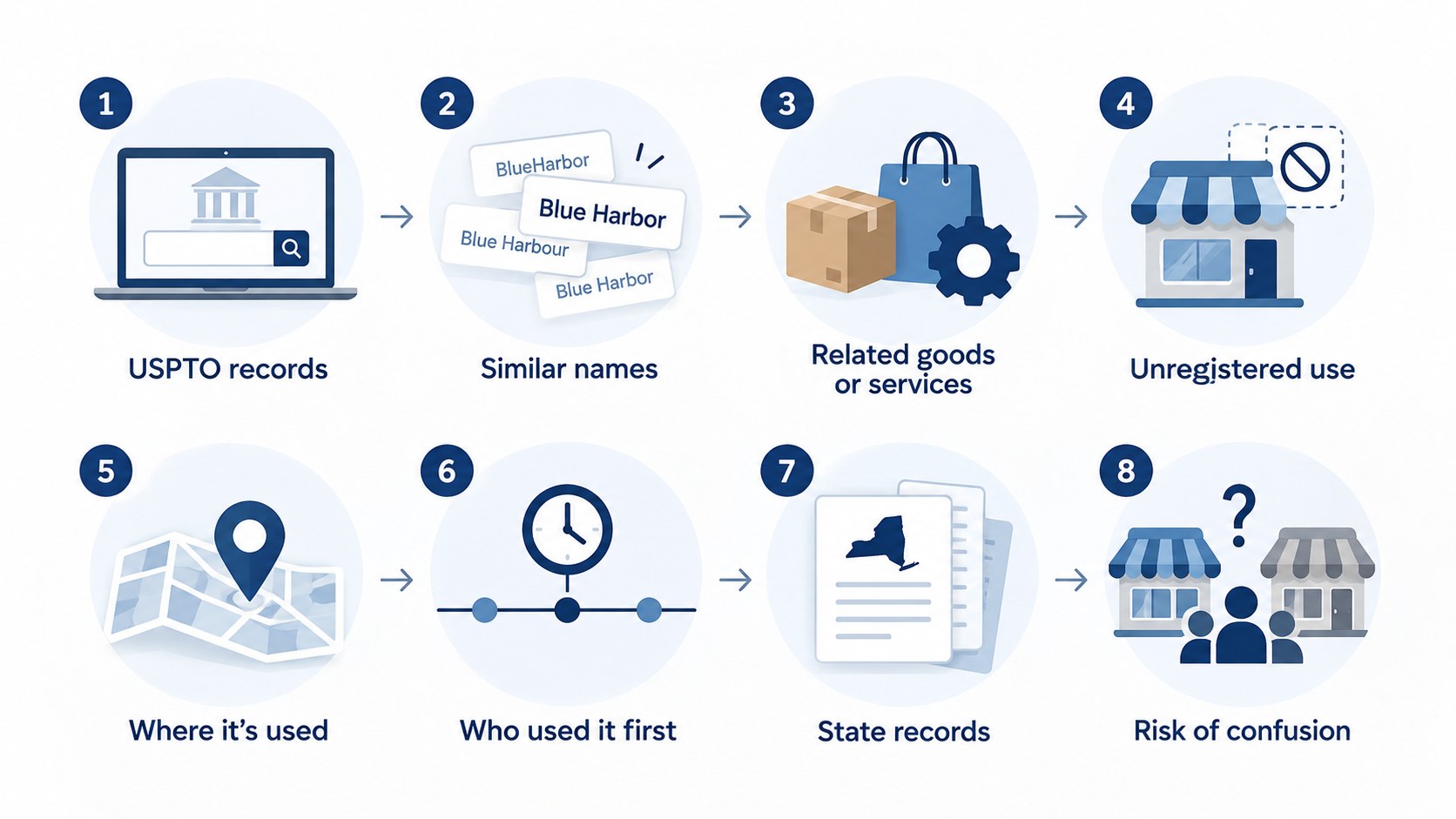
What to Check Before Filing for the Name
- Is the exact name already registered or pending with the USPTO?
- Are there similar names that look, sound or mean nearly the same thing?
- What products or services are connected to those marks?
- Is another business already using the name without federal registration?
- Where has the other business used the name?
- Which business began using the mark first?
- Are state business or trademark records showing additional users?
- Could customers reasonably believe the two businesses come from the same source?
Answers can range from a clearly available name to a serious conflict that requires legal analysis.
So Can You Trademark a Business Name Someone Else Uses?
Yes, in some situations.
Another business using the same or a similar name does not automatically prevent federal trademark registration. Two companies can coexist when their goods or services are sufficiently different and customer confusion is unlikely.
The situation becomes much harder when the other company used the mark first for similar goods or services, owns an earlier federal registration or application, or has established common law rights that overlap with your planned business.
Checking only an LLC database or domain registrar is not enough. Trademark clearance should include federal records, similar marks, state records and businesses already using the name in the marketplace.
A careful search before launching can reveal conflicts before money goes into signs, packaging, advertising, websites and product inventory. Rebranding early is far simpler than changing a name after customers already know it.