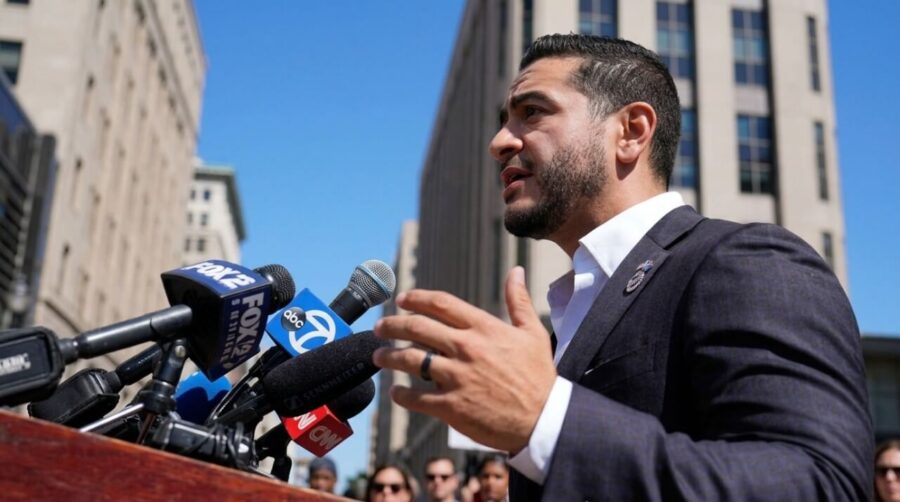

President Donald Trump attacked Democratic Senate nominee Abdul El-Sayed on Wednesday, calling him a “communist” and a “loser who hates Jews and Israel” hours after the progressive candidate secured the party’s nomination in Michigan’s closely watched primary.
The president’s comments came after El-Sayed narrowly defeated U.S. Representative Haley Stevens in a race that highlighted deep divisions among Michigan Democrats over policy and campaign spending. The former Detroit health commissioner will face Republican Mike Rogers in November for the seat being vacated by retiring Senator Gary Peters.
Table of Contents
ToggleTrump Claims El-Sayed Victory Helps Republicans
The president took to Truth Social to celebrate El-Sayed’s nomination as “great news for the Republican Party,” while simultaneously alleging without evidence that “Wayne County (Detroit) in Michigan is one of the most corrupt voting areas in the United States.”
Trump urged supporters to “get ready for another Rigged Election” and called on Republicans to rally behind Rogers, who received the president’s endorsement in the GOP primary. The former congressman ran unopposed for the Republican nomination.
In separate remarks to reporters, Trump made especially charged comments about El-Sayed’s position on Israel, stating: “He doesn’t love Jewish people. He hates them. He hates them with a passion that burns in his heart.”
El-Sayed Rejects Antisemitism Accusations
El-Sayed forcefully pushed back against the president’s attacks, calling them distractions from substantive policy debates. “My commitment to Jewish safety is the same commitment to the safety of my own daughters,” El-Sayed said Wednesday morning.
In a CNN interview, the Democratic nominee invited Trump to focus on policy issues. “I invite the president to focus on what I’m saying. I want to get money out of politics, put money in your pocket, and pass Medicare for all,” El-Sayed said.
The candidate also addressed Jewish voters directly in his victory remarks, thanking them for the opportunity to “share the bread with you at the Seder, to pray with you at the synagogue, to be welcomed with open arms.” He also criticized AIPAC’s influence in American politics, stating: “I understand that the self-determination of one people cannot come at the expense of that of another.”
Primary Exposed Democratic Divisions
The primary contest became a national test of Democratic views on Israel and campaign spending. Stevens received substantial support from pro-Israel political groups, with affiliates reportedly spending more than $30 million to support her campaign.
El-Sayed campaigned as an economic populist backed by Senator Bernie Sanders and Representative Alexandria Ocasio-Cortez, while criticizing U.S. military aid to Israel and the influence of outside money.
El-Sayed won with approximately 48.5 percent of the vote to Stevens’ 47.5 percent—a margin of fewer than 15,000 votes out of more than 1.5 million ballots cast. He performed strongly in Washtenaw County and Kent County, while Stevens narrowed the gap in Wayne County.
What Happens Next
El-Sayed and Stevens both emphasized the need for party unity during their election-night speeches. Stevens formally conceded Wednesday morning, pledging her support for the nominee. “This was a thorough and rigorous campaign that brought out the full span of views within the Democratic Party,” Stevens said.
The Michigan Senate race is now poised to be one of the most consequential contests in the 2026 midterm elections, with control of the Senate potentially hanging in the balance. El-Sayed has pledged to focus on lowering costs, expanding health care access, and addressing Michigan’s housing crisis in the general election campaign.
The nominees chosen in Michigan’s primary will advance to the November 3, 2026, general election, with the state’s Senate, governor and competitive House races making it one of the country’s most closely watched political battlegrounds through the fall. Official information about Michigan voting and elections is available from the secretary of state.