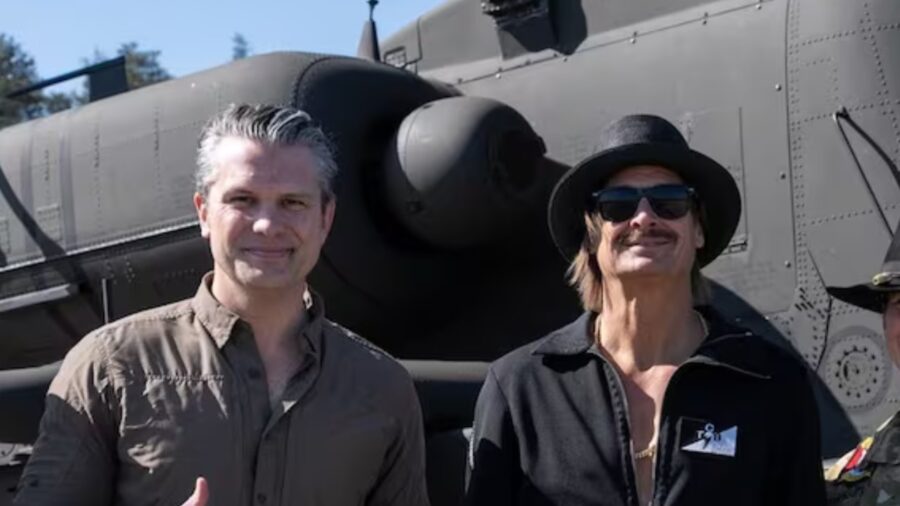

Defense Secretary Pete Hegseth and musician Kid Rock flew in U.S. Army AH-64 Apache attack helicopters at Fort Belvoir, Virginia, on Monday, turning what the Pentagon described as a community relations event into another flashpoint over the Trump administration’s use of military imagery and access.
The flight came less than a month after Army helicopter crews drew scrutiny for flying near Kid Rock’s Tennessee home and over a Nashville “No Kings” protest against the Trump administration.
That earlier episode prompted an Army review before Hegseth publicly intervened, lifted the pilots’ suspension, and declared there would be “No punishment. No investigation.”
Table of Contents
TogglePentagon Defends The Event
@cnn US Defense Secretary Pete Hegseth said he and Kid Rock went “for a ride” with US Army Apache helicopter pilots, less than a month after a military flyover near the singer’s Nashville-area home drew criticism. #CNN #News #Politics
Pentagon spokesman Sean Parnell said Monday’s flights supported a Freedom 250 community relations event tied to America’s 250th anniversary.
According to AP, Parnell said Robert “Kid Rock” Ritchie met service members and filmed videos for Memorial Day, the national anniversary commemoration, and his Freedom 250 tour.
Fox News also reported Parnell’s defense of the event, including the claim that Kid Rock had pledged 1,000 free tickets for military members and veterans at each stop on his tour.
The Pentagon’s message was clear: the ride was framed as military appreciation, troop engagement, and patriotic outreach.
That public embrace sharpened questions over whether the Pentagon was promoting service members or offering rare military access to a politically aligned celebrity.
Why The Previous Apache Incident Matters
The controversy did not begin at Fort Belvoir. Reuters reported in March that Army pilots had been suspended after attack helicopters flew near Kid Rock’s Nashville-area home. The helicopters were also seen near anti-Trump demonstrators in Nashville, raising concerns about flight safety and the military’s political neutrality.
Reuters noted that the U.S. military is expected to remain apolitical, loyal to the Constitution, and independent of any party or political movement.
That standard is why the sequence has drawn attention: first, a disputed Apache flyby involving Kid Rock; then Hegseth’s decision to shut down the inquiry; then another Apache appearance with the same celebrity weeks later.
Cost And Accountability Questions
The cost issue has also become part of the story. AP reported that an Army official said an Apache costs about $7,000 per flight hour to operate. Open-source flight data cited by AP showed Kid Rock’s private jet landed at Fort Belvoir early Monday, and that an Apache later flew loops over the base for about 10 minutes.
California Gov. Gavin Newsom’s office criticized the episode online, asking why taxpayers were paying to fly Kid Rock around on expensive military helicopters. Democratic Rep. Jason Crow of Colorado, a former Army Ranger, also questioned why Hegseth was using taxpayer resources for what critics called “joy rides.”
Military officials often argue that public flights and flyovers can count toward regular pilot training requirements, meaning they do not necessarily create a separate taxpayer cost. That argument may answer part of the budget question, but it does not resolve the broader concern over judgment, access, and political symbolism.
A Symbolic Fight Over The Military
For Hegseth, the Kid Rock flight fits a broader style of leadership that leans heavily into culture-war signaling, patriotic spectacle, and direct appeals to Trump’s political base. For critics, the concern is that the Pentagon’s power and prestige are being used in ways that blur the line between military outreach and partisan theater.
The central issue is no longer a 10-minute helicopter ride. It is whether the Defense Department can convincingly separate morale-building from favoritism when the same celebrity has already been at the center of an unresolved aviation controversy.
Related Posts:
- Armed Forces Organizations, 500+ Veterans Announce…
- The 100 Most Dangerous Cities in America (2026):…
- Best Places to Retire Abroad in 2026: An Honest…
- Safest Cities in California in 2026: An Honest,…
- Tennessee Crime Rate in 2026 - A Closer Look at the Numbers
- America’s Murder Capitals - Updated 2026 Rankings of…