

Table of Contents
ToggleKey Facts
Watch | Venezuela: Two powerful earthquakes measuring 7.2 and 7.5 struck the country within less than a minute. The epicentre was reported near the Morón area of Carabobo State.
Strong tremors were felt in several regions, including the capital Caracas, as well as Miranda, La… pic.twitter.com/OFFMVOV1hs
— United News of India (@uniindianews) June 25, 2026
The U.S. Geological Survey recorded a magnitude 7.2 quake west of Morón on Venezuela’s Caribbean coast, followed less than a minute later by a magnitude 7.5 earthquake southwest of Morón. AP reported the first quake had a depth of about 22 km, while the second had a depth of about 10 km.
Damage was reported across several states, including Caracas and La Guaira. Rodríguez said Simón Bolívar International Airport near Caracas had been damaged and closed, and that Caracas subway and natural gas services were suspended. Schools were also closed for several days, with some school buildings expected to be used as shelters and donation centers.
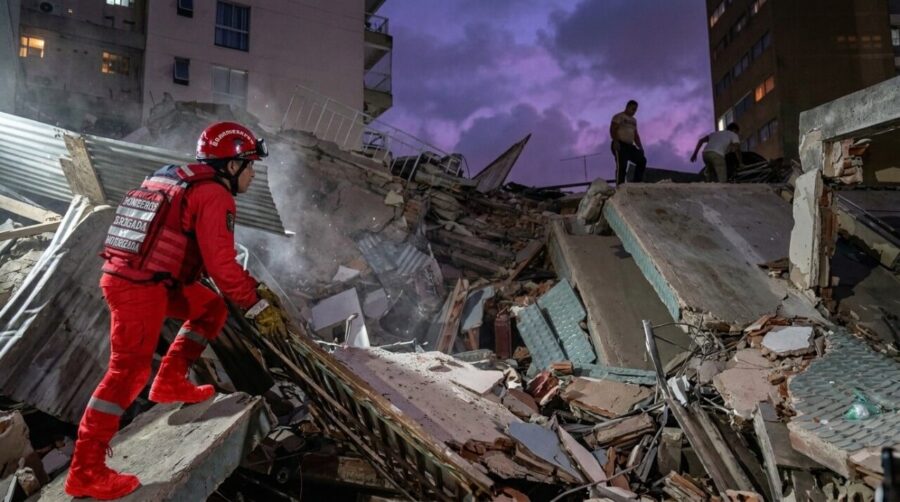
The initial toll remains provisional. Reuters reported that three people were killed in Caracas’ Baruta district after two buildings collapsed, while one person died in Chacao, where the mayor said four buildings had completely collapsed. In Falcón state, Governor Víctor Clark said 32 people had been hospitalized and 15 people were trapped in the hours after the earthquakes.
Latest Verified Update
By early Thursday, June 25, international aid offers had begun to turn into planned deployments. U.S. Secretary of State Marco Rubio said the United States was immediately deploying search and rescue teams, medical resources and humanitarian assistance, while AP reported that a State Department disaster assistance team and task force had been mobilized.
Rodríguez said rescuers from Qatar were expected in Venezuela the following day, along with rescue personnel from Mexico and El Salvador. Governments including the United States, Argentina, Bolivia, Brazil, Chile, Ecuador, El Salvador, Mexico, Panama and Uruguay had offered help.
A tsunami advisory was issued after the first major quake for areas including Puerto Rico and the Virgin Islands, with the U.S. Tsunami Warning Centers listing the earthquake near the coast of Venezuela at 22:04 UTC. Reuters later reported that the warning was swiftly canceled after the danger passed. The advisory was documented by the U.S. tsunami center.
Background and Why the Risk Remains High
USGS predictive modeling indicated that the death toll would most likely run into the thousands, with a substantial probability of exceeding 10,000, according to Reuters. That model is not an official casualty count, but it signals the scale of risk while rescue teams assess collapsed buildings, blocked streets and damaged infrastructure.
Venezuela sits in a seismically active zone where the Caribbean Plate meets the South American Plate. Reuters noted that Caracas was also struck by a deadly magnitude 6.3 earthquake in 1967, and that an estimated 30,000 people were killed when a powerful quake caused widespread destruction in Mérida and Caracas in 1812, citing USGS records.
What Happens Next
🚨 7.2 and 7.5 magnitude earthquakes strike Venezuela back-to-back
➡️ The powerful twin quakes caused widespread destruction, prompting a national state of emergency as authorities deployed rescue and emergency response agencies nationwide https://t.co/vINdK2bLuk pic.twitter.com/ElQJkQfxeJ
— Anadolu English (@anadoluagency) June 25, 2026
The immediate priority is search and rescue, especially in La Guaira and collapsed building sites in Caracas. Authorities must also determine whether damaged hospitals, roads, airports, schools, gas lines and residential blocks can safely function as aftershocks continue. Interior Minister Diosdado Cabello urged people to remain outside because aftershocks could further damage structures.
The next verified update is expected to clarify three issues: the casualty count from La Guaira, the number of people still trapped, and whether international rescue teams can reach the worst-hit areas quickly. Until those assessments are complete, the official death toll should be treated as an early minimum, not a final measure of the disaster.
Related Posts:
- How Many International Airports Are There In The US in 2026?
- What Is the Biggest Airport in the US in 2026?
- The 100 Most Dangerous Cities in America (2026):…
- Safest Cities in California in 2026: An Honest,…
- America’s Murder Capitals - Updated 2026 Rankings of…
- Best Places to Retire Abroad in 2026: An Honest…