
A federal judge has dismissed a lawsuit brought by two police officers who defended the U.S. Capitol on January 6, 2021, ruling that they lacked the legal standing required to challenge how a congressionally mandated commemorative plaque was installed.
U.S. District Judge Dabney L. Friedrich of the District of Columbia dismissed the case on September 30, 2026. Former U.S. Capitol Police officer Harry Dunn and Metropolitan Police Department officer Daniel Hodges had sued the Architect of the Capitol and Architect Thomas Austin, seeking enforcement of a 2022 law requiring a plaque honoring officers who responded to the Capitol attack.
The ruling resolves the case on jurisdictional grounds. Friedrich did not decide whether the plaque’s design, placement or omission of officers’ names from its physical face complies with the law passed by Congress.
Table of Contents
ToggleWhy the Judge Dismissed the Case
Dunn and Hodges argued that the government’s handling of the memorial contributed to psychological harm and diminished recognition of officers who defended the Capitol. Their June 2025 complaint said the failure to install the plaque as Congress directed compounded injuries stemming from January 6 and contributed to an environment in which the officers continued to face harassment.
Friedrich concluded that those allegations did not establish the concrete injury required for Article III standing.
The judge acknowledged that Dunn and Hodges had a direct personal connection to the memorial because they were among the officers Congress intended to honor. Still, she ruled that a strong personal interest in government action is not itself enough to create standing in federal court. She also found that the complaint did not adequately establish that the Architect of the Capitol’s conduct caused or materially worsened the officers’ mental-health injuries, according to reporting on the ruling.
Because standing is required for a federal court to exercise jurisdiction, Friedrich dismissed the lawsuit without deciding the underlying statutory dispute.
Latest Verified Court Update
As of October 2, 2026, the September 30 dismissal remains the latest verified court action identified in reporting and available case information reviewed for this article. No public announcement of an appeal by Dunn and Hodges had been identified. An appeal to the U.S. Court of Appeals for the District of Columbia Circuit remains procedurally possible.
The decision leaves the plaque in place without a federal court ruling on whether its current form satisfies Congress’s instructions.
Congress Ordered the Plaque in 2022
Congress created the memorial requirement in Section 214 of the Consolidated Appropriations Act of 2022. The law directed the Architect of the Capitol to obtain a plaque listing the names of officers who responded on January 6 and place it at a permanent location on the western front of the Capitol within one year. Friedrich summarized those requirements in an earlier court ruling.
The original deadline passed without the plaque being installed.
On January 8, 2026, the Senate approved a bipartisan resolution directing the Architect to prominently display the completed plaque in a publicly accessible location in the Senate wing until it could be moved to its permanent location on the western front, according to the Congressional Record.
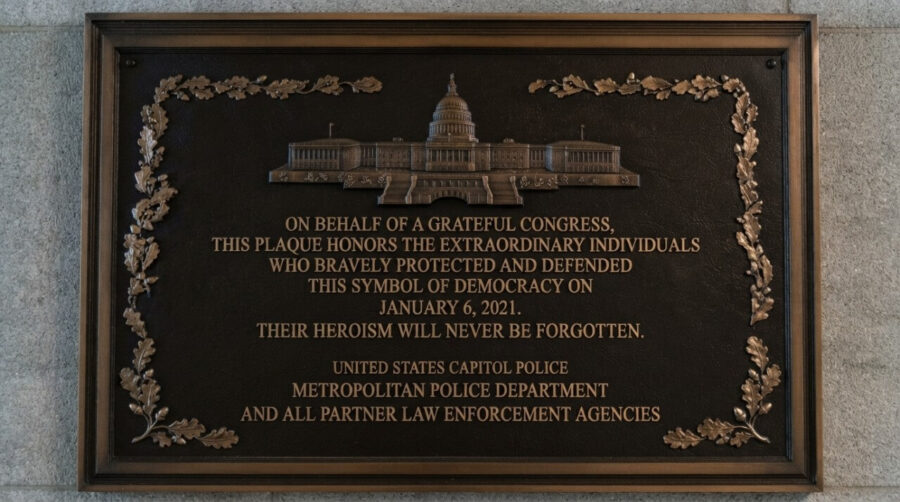
The plaque was installed in March 2026. The physical memorial names the participating law-enforcement agencies rather than printing every individual officer’s name, while a QR code directs visitors to the names. The Architect of the Capitol’s official plaque page lists the U.S. Capitol Police, Metropolitan Police Department and numerous federal, state and local agencies represented on the memorial.
Dunn and Hodges maintained that the installation still fell short because the plaque was placed in an area outside the normal public tour route rather than in the prominent, publicly accessible location they said Congress required. The dispute over its placement was detailed in March 2026 reporting.
The Compliance Question Remains Open
The September 30 decision is significant for what it did not decide. Friedrich’s ruling addressed whether Dunn and Hodges were legally entitled to bring the challenge, not whether the Architect of the Capitol fully complied with the 2022 statute or the Senate’s 2026 resolution.
That leaves the future location and presentation of the January 6 plaque primarily in the hands of Congress and the Architect of the Capitol unless an appeal or another legal action changes the situation.
For now, the memorial remains installed, while the dispute over whether it provides the recognition Congress originally prescribed has ended at the district-court level.
Related Posts:
- Trump Reveals Rep. Neal Dunn’s Terminal Diagnosis -…
- 25 Most Dangerous Cities in US - Updated Statistics for 2026
- The 100 Most Dangerous Cities in America (2026):…
- America’s Murder Capitals - Updated 2026 Rankings of…
- Safest Cities in California in 2026: An Honest,…
- Ivy League Schools - Opportunities and Admission…