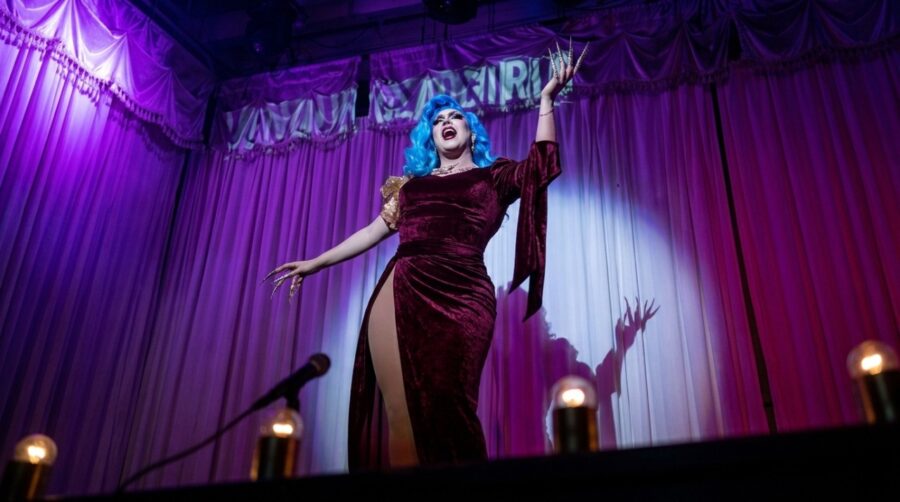

A federal judge in Houston has declared Texas Senate Bill 12 unconstitutional for a second time, immediately and permanently barring Texas Attorney General Ken Paxton from enforcing the 2023 measure.
U.S. District Judge David Hittner ruled on August 25, 2026, that the law violates First Amendment speech protections and is facially vague under the Fourteenth Amendment’s Due Process Clause. The decision appears in the court’s August 25 order.
The decision in Extragrams LLC v. Paxton matters beyond drag events. Hittner found that the statute’s wording could expose a wide range of protected performances to penalties, including dance, theater, comedy, cheerleading and musical productions. The ruling followed a federal appeals court’s instruction to reassess the law under newer First Amendment precedent.
Table of Contents
ToggleWhat Texas Senate Bill 12 Prohibited
Governor Greg Abbott signed SB 12 on June 18, 2023. The law defines a “sexually oriented performance” as a visual performance featuring nudity or listed forms of sexual conduct that also “appeals to the prurient interest in sex.”
A business controlling a venue could face a civil penalty of up to $10,000 for allowing such a performance with a person younger than 18 present. Performers could face a Class A misdemeanor for covered conduct in front of a minor or on public property where a child could reasonably see it. The enrolled text of SB 12 also authorized counties and municipalities to regulate covered performances.
The final version does not expressly use the word “drag.” Hittner nevertheless found that terms including “visual performance,” “prurient interest” and who “controls” a venue lacked sufficient clarity. He said the language could reach a gymnast whose leotard shifts, a provocative costume at a comic convention, or Dolly Parton and Elvis Presley impersonators using prosthetics. Local reporting on the ruling detailed the court’s overbreadth concerns.
Applying the U.S. Supreme Court’s framework in Moody v. NetChoice, Hittner concluded that SB 12’s unconstitutional applications substantially outweighed any lawful ones. He ended the order with a short response for people offended by the performances: “just don’t go.”
Current Status After the Ruling
As of August 27, 2026, the amended final judgment directly restrains Paxton, the sole remaining defendant, from enforcing SB 12. Hittner also denied Paxton’s request for a new or supplemental trial and further discovery.
Three plaintiffs remain: Austin-based Extragrams LLC, San Antonio-area 360 Queen Entertainment LLC and drag performer Brigitte Bandit. The ACLU of Texas, which represents the challengers with Baker Botts LLP, called the decision confirmation that the Legislature’s effort was unconstitutional.
How the Case Returned to Hittner
Hittner first blocked SB 12 on September 26, 2023. Texas appealed. On February 25, 2026, the U.S. Court of Appeals for the Fifth Circuit vacated most of that injunction and directed Hittner to reconsider the facial challenge under Moody and the vagueness precedent Roy v. City of Monroe.
The Fifth Circuit opinion found that The Woodlands Pride and Abilene Pride Alliance lacked standing because their family-friendly performances were not arguably covered by SB 12. It found that 360 Queen Entertainment had standing against Paxton.
SB 12 subsequently took effect on March 18 while the district court conducted the required review. The Fifth Circuit did not decide whether the restrictions on sexually oriented performances were constitutional at that stage, according to the February case update.
An Appeal Is Expected
Paxton called Hittner’s ruling “profoundly flawed,” said it endangered children and pledged an immediate appeal, according to Reuters. No later appellate decision had been reported as of August 27.
A new appeal would return the dispute to the Fifth Circuit, which could review whether Hittner correctly applied its remand instructions. The judgment leaves existing Texas laws on obscenity and indecent exposure unchanged. The remaining question is whether SB 12’s language can survive federal constitutional review in its present form.
Related Posts:
- The 100 Most Dangerous Cities in America (2026):…
- Texas Governor Election 2026: Abbott vs Hinojosa Guide
- Safest Countries in the World in 2025 - GPI…
- The List of Free Speech Supreme Court Cases in The…
- 25 Most Dangerous Cities in US - Updated Statistics for 2026
- The Hidden Boundaries of Free Speech in Modern Democracies