
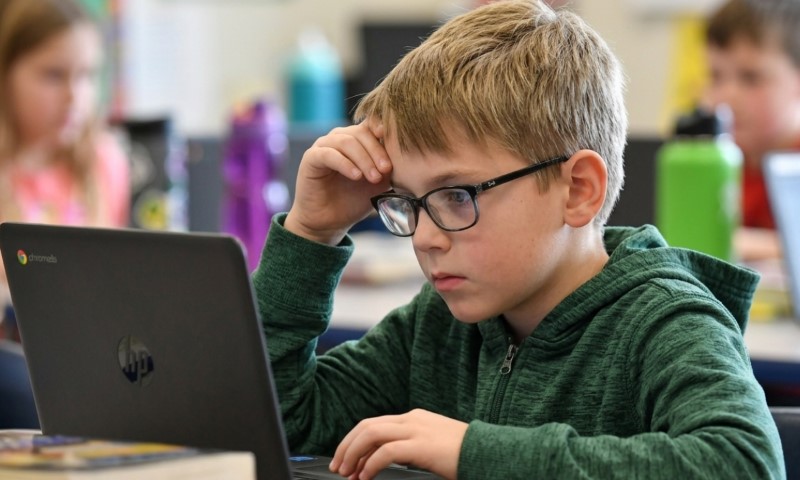

Teachers are increasingly asking schools to keep generative AI away from young children, especially during the primary years. On May 27, 2026, American Federation of Teachers president Randi Weingarten called for an end to student-facing AI in elementary schools, alongside screen-free learning from pre-K through second grade.
The proposal is not a rejection of every educational use of AI. It draws a firm line between teachers using software to prepare lessons and children relying on chatbots before they have secure literacy, numeracy and independent reasoning skills.
The issue has become urgent because AI use has expanded faster than school rules, staff training and reliable evidence about developmental effects.
Why Do Teachers Want Young Children Kept Away From AI?
Teachers mainly fear that chatbots can remove the productive struggle required for learning. A child who asks a chatbot to compose a paragraph, solve a word problem or suggest an entire project may receive an answer without practising the mental steps the assignment was meant to develop.
A national NPR/Ipsos poll of 545 US K-12 teachers, conducted from April 27 to May 5, 2026, found that 54% believed AI was making critical thinking harder to learn.
Another 55% regarded it mainly as a shortcut, while 59% said AI was eroding trust between students and teachers. Only 33% reported a formal school policy governing student use.
Schools may employ AI writing detectors such as GPTZero to screen student work for possible AI assistance, but any flagged result should be considered a prompt for further investigation rather than evidence of misconduct.
RAND has described the central distinction as cognitive offloading versus augmentation. Offloading occurs when software performs the thinking for a pupil. Augmentation occurs when a tool prompts deeper work, such as asking a student to compare two explanations and defend which one is stronger.
Younger pupils are less able to judge when an answer is unreliable, biased or incomplete, making independent chatbot use harder to justify.
What Limits Are Educators and Governments Proposing?
Current proposals vary, but several major policies use age and developmental stage rather than treating every student alike.
| Organisation or System | Proposed Limit | What Remains Possible |
| American Federation of Teachers | No student-facing AI in elementary school; no screens from pre-K through grade 2 | Teacher use and later AI education with safeguards |
| Norway | Pupils in grades 1 to 7 should generally have no direct AI access | Careful introduction in grades 8 to 10; appropriate use in upper secondary school |
| UNESCO | Minimum age of 13 for independent classroom conversations with generative AI | Age-appropriate, human-led use under regulated conditions |
| Los Angeles Unified | Remove student devices for the youngest learners and set wider screen-time guardrails | Purposeful technology use guided by educators |
The AFT position comes from a union representing 1.8 million members and includes a separate proposed ban on social-companion chatbots for children under 16.
Norway announced its national age-based recommendations on June 19, 2026, with implementation planned for the new school year. UNESCO has long urged governments to set age thresholds, protect data privacy and validate educational tools before adoption.
Los Angeles Unified approved its screen-time resolution in April 2026 and also ordered a public review of classroom technology contracts.
Are Teachers Asking for a Permanent AI Ban?
View this post on Instagram
No. Most teachers appear to favour delayed, supervised and clearly defined use rather than permanent exclusion.
The NPR/Ipsos poll found that 78% believed responsible AI use should become part of the school curriculum. The tension is therefore about timing. Many educators want children to build knowledge and judgement before using a system capable of producing fluent answers on demand.
Norway offers a practical staged model. Primary pupils are generally shielded from direct use, lower-secondary students may begin cautious experimentation after teachers receive sufficient training, and older students are expected to learn appropriate use for further education and employment.
The Norwegian government guidance also allows exceptions where AI-based tools can support language learning or individually adapted instruction.
Commercial age rules already point in a similar direction. OpenAI’s current terms of use require users to be at least 13, or the minimum age of digital consent in their country, while anyone under 18 needs permission from a parent or legal guardian.
A school-managed product may operate under separate institutional arrangements, but an approved account does not prove that a tool is developmentally suitable for every lesson.
Why Can Teachers Use AI While Pupils Cannot?
Teacher-facing and student-facing use create different educational risks. A teacher may use AI to draft quiz questions, adapt a reading passage or produce a first version of a lesson plan, then check every output before it reaches the class.
A seven-year-old using a chatbot directly may not recognise an invented fact or notice that the software has completed the core task.
Permitting teacher use still requires boundaries. Schools need rules covering confidential student information, human review, copyright, approved platforms and accountability for mistakes. Adult supervision reduces risk, but it does not remove the need for procurement checks or clear data practices.
What Should Schools Do in 2026?
A workable policy should state exactly who may use AI, for which tasks and under whose supervision. Vague advice such as “use AI responsibly” leaves teachers to improvise and gives families little idea about what happens in class.
Schools can adopt several practical measures:
- Set a clear age floor for independent chatbot use.
- Define “student-facing AI” so embedded tools are covered, rather than naming individual products such as ChatGPT or Gemini.
- Separate teacher preparation from pupil interaction in policy documents.
- Publish approved products, data rules and evidence used to justify adoption.
- Preserve documented exceptions for accessibility, language support and special education.
Assignment rules also need precision. “AI prohibited” should mean no prompting, rewriting or answer generation. “AI allowed for feedback” should require the student to produce an original attempt first, save the prompt and verify every factual claim.
Younger pupils can learn what AI is through teacher demonstrations without holding private conversations with a chatbot.
Schools Need an Age-Appropriate AI Strategy
The strongest case from teachers is not that children should remain technologically unaware. Early education should protect the work that builds attention, memory, language and judgement. AI literacy can begin with discussion, examples and teacher-led demonstrations long before independent chatbot access.
By 2026, school systems have enough evidence to stop treating AI adoption as an automatic upgrade. A defensible policy delays direct use for younger pupils, trains teachers before classroom rollout, publishes clear safeguards and introduces AI gradually when students can question its answers rather than simply accept them.