
Donald Trump has long treated provocation as political fuel. But his decision to post an AI-generated image that appeared to depict him in a Christ-like role, just after publicly attacking Pope Leo XIV, pushed that instinct into riskier territory.
What might have been intended as another viral show of dominance instead opened a sharper fight over religion, symbolism, and the limits of spectacle in American politics.
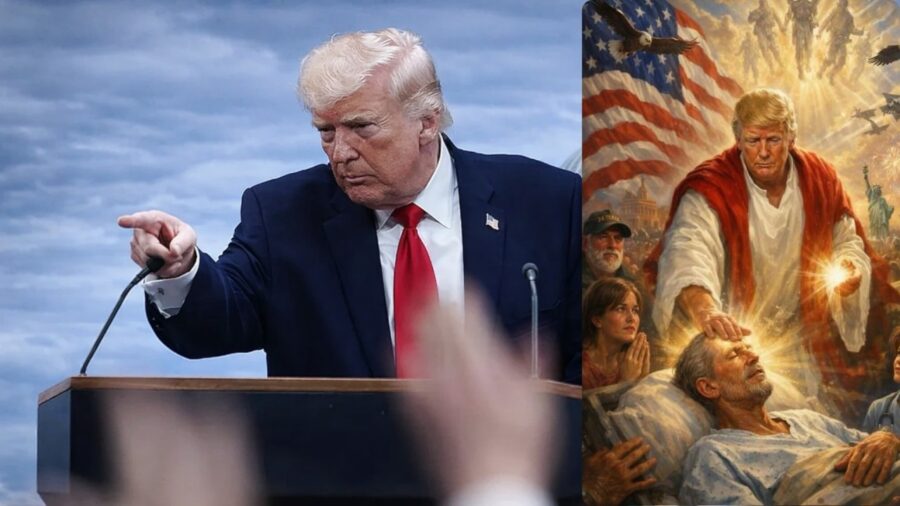
The image, posted on Truth Social on April 12, showed Trump in a white robe, haloed by divine-style light, touching the head of an apparently ill man. Patriotic symbols filled the scene, including an eagle and other national imagery.
Reuters and The Washington Post reported that many viewers, including conservative Christians, read it not as a metaphor but as a visual imitation of Jesus healing the sick.
Table of Contents
ToggleA Post That Landed at the Worst Moment
The uproar did not emerge in a vacuum. Hours earlier, Trump had lashed out at Pope Leo, calling him “weak on crime” and “terrible for foreign policy,” after the pontiff criticized the war in Iran and continued urging peace.
Leo, the first U.S.-born pope, responded that he did not fear Trump and would keep speaking against war because his position flowed from the Gospel, not politics.
That sequence turned a bizarre social media post into something larger: a confrontation between presidential power and religious authority.
By pairing a direct attack on the pope with imagery many believers saw as sacred, Trump transformed a culture-war stunt into a test of how far symbolic politics can go before even loyal constituencies recoil.
Backlash From the Right
What made the episode politically significant was not criticism from Trump’s usual opponents. It was the reaction from within the broader religious right.
Reuters and The Washington Post reported condemnation from evangelical commentators and conservative Catholics, some of whom called the image blasphemous and urged that it be removed.
For a president whose electoral strength has depended heavily on Christian conservatives, that kind of backlash carries more weight than a routine media outcry.
Trump later tried to explain the image away. He said he believed it portrayed him as a doctor, or a Red Cross-style healer, and accused the press of distorting its meaning.
That defense failed to calm the controversy, in part because the image’s religious visual language was so overt. By late Monday morning, the post had been deleted.
A Wider Diplomatic and Political Cost
The fallout quickly spread beyond the United States. Reuters reported that Italian Prime Minister Giorgia Meloni, usually one of Trump’s friendliest counterparts in Europe, called his attack on the pope “unacceptable.” That response suggested the damage was not merely cultural or domestic. It had become diplomatic.
In the end, the story was not really about one grotesque image. It was about the hazards of political self-mythology in an era of AI manipulation, and about what happens when spectacle collides with symbols many voters still treat as holy.
Trump has often survived by forcing attention onto himself. In this case, attention came with a cost, and even some of his own supporters seemed to recognize it.
Related Posts:
- The 100 Most Dangerous Cities in America (2026):…
- Safest Cities in California in 2026: An Honest,…
- Best Places to Retire Abroad in 2026: An Honest…
- How Asmongold Cashed In on Political Attention After Gaming
- Trump Backs Jake Paul for “Whatever Office” He Wants…
- Why Modern Political Portraits Today Feel More Human…