
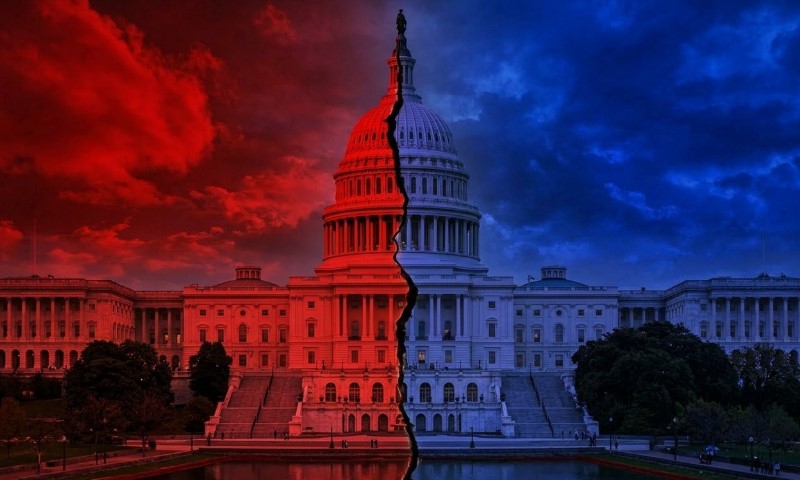

To understand the modern American map, one must look past the broad strokes of solid color and see it instead as a living quilt. In the vast stretches of “red” states, the dominant fabric is Republican, yet stitched deep into that landscape are bright blue patches – vibrant, dense urban centers of Democratic energy that pulse with a different rhythm.
These cities serve as the beating hearts of their respective regions, often attempting to pump liberal policy initiatives through a body politic that remains fundamentally conservative. As we navigate 2026, from the plains of Texas to the Florida coast, we see statehouses leaning decisively to the right while the urban cores beneath them push ever more firmly to the left.
This durable geography gap is no mere illusion of the eye; it is a structural reality. Pew Research Center data confirms this great sorting, showing urban voters leaning Democratic by a margin of 60% to 37%, while their rural counterparts have moved sharply into the GOP column.
Deciphering the Three-Layered Puzzle
 You will find more infographics at Statista
The dynamic of “Red States with Blue Cities” is best understood as a three-layered puzzle. At the surface, there is the electoral layer: a state may reliably deliver its electoral votes to a Republican president, yet its largest city remains a Democratic fortress, unyielding in its partisan loyalty.
Below that sits the governing layer. While Republicans may command the statehouse, Democrats often hold the keys to city hall and local school boards. This layering of power creates an inevitable, constant friction, as two different visions for society attempt to occupy the same geographic space.
Finally, there is the cultural layer. From housing priorities to educational philosophy, the urban experience often clashes with statewide mandates, leading to a world where two neighbors under the same state flag may be pointing in entirely different directions.
While shorthand like “red” and “blue” is convenient for analysts, it can sometimes mask the true complexity of the ground game. A blue city is not a monolith; it might still prefer moderate council members who focus on pragmatism over ideology.
In the same vein, a red state might feature a Democratic governor or a suburban ring that is split down the middle. In my years watching these maps, I’ve learned that politics is rarely as solid as the colors on a television screen would suggest.
Ultimately, the vital question isn’t just the partisan lean of the state. It is about which level of government holds the reins of daily life for the citizens living within the city limits.
| Term | Practical Meaning | Why It Matters |
| Red state | Republican presidential vote, Republican state control, or both | State law often controls abortion policy, voting rules, gun policy, education rules, and LGBTQ protections |
| Blue city | Democratic voting pattern, Democratic local officials, or liberal local policy priorities | City government shapes policing, zoning, transit, shelters, libraries, local hiring, and municipal services |
| Purple metro | Urban core votes Democratic, suburbs split or lean Republican | Many statewide elections are won or lost in outer suburbs, not downtown |
| State preemption | State law overrides local policy | A blue city may pass a protection that a red legislature can limit or erase |
A Sharper Fault Line in 2026
FACT: there are no blue states, just blue cities. pic.twitter.com/s1yy5ihc2T
— Nick Adams (@NickAdamsinUSA) August 10, 2021
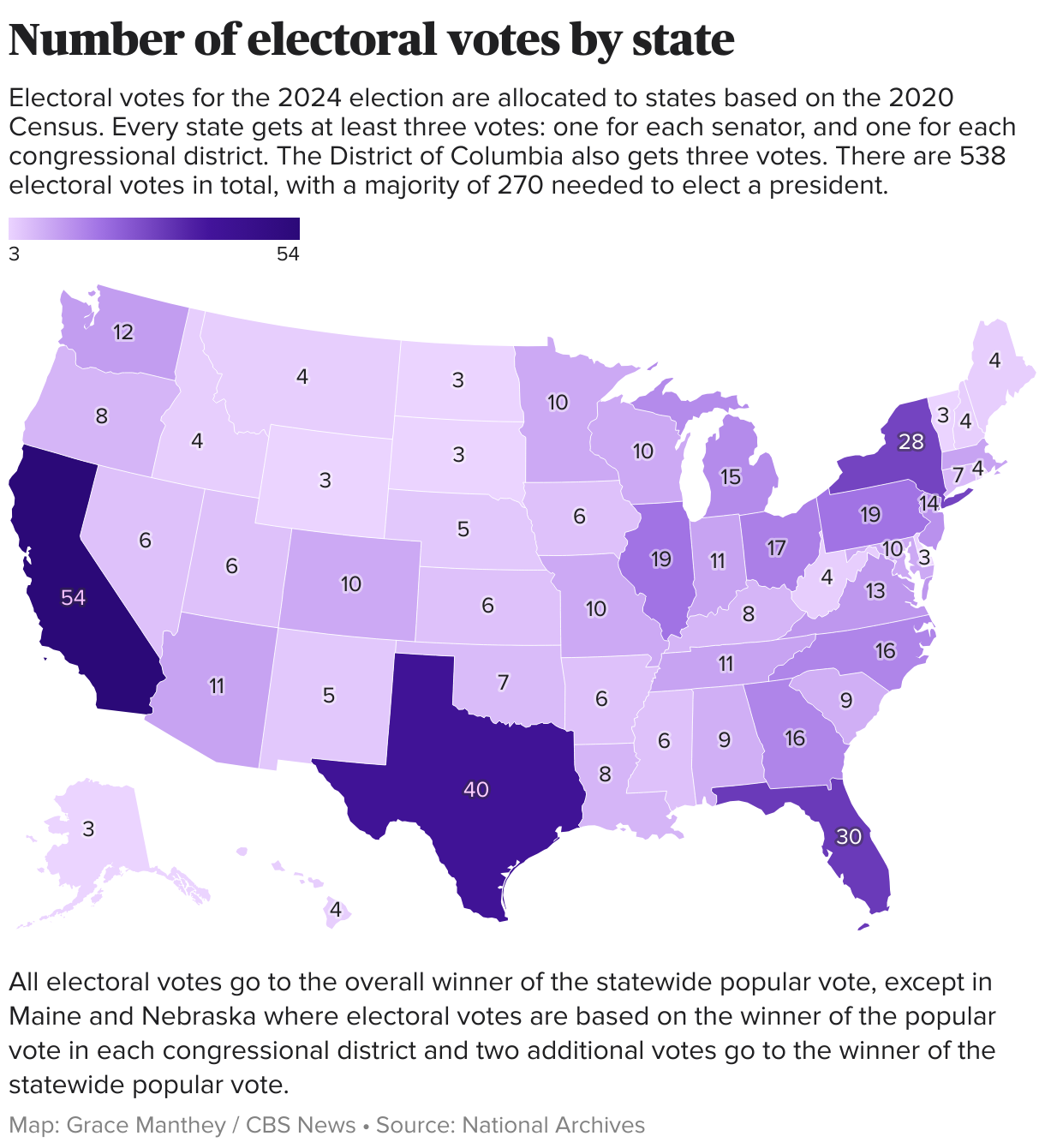
The political tectonic plates have continued to shift following the 2024 election, where Donald Trump secured 312 electoral votes. His victory in states like Texas and Georgia, homes to massive Democratic hubs, has sharpened the divide between the state capital and the city street.
The official 2024 table from the FEC highlights this split with clarity. While Trump dominated the broad state maps, Democratic strength remained deeply concentrated in the dense soil of urban counties, refusing to yield.
Legislative control underscores this divergence. By May 2026, the NCSL count showed 23 states under total GOP control, with Republicans commanding 58 of the 98 partisan legislative chambers nationwide.
Yet, if you look at city halls, you see a mirror image. Ballotpedia mayoral data reveals that 67 of the 100 largest cities are led by Democratic mayors.
Even in nonpartisan races, the pattern is unmistakable: big cities remain the most resilient governing bases for the Democratic Party. This creates a map defined by a state of constant tension.
State leaders find their path to victory by leaning into rural margins and small-town values, while city leaders mobilize a diverse, urban coalition. The two groups rarely speak the same political language.
In this landscape, the suburbs act as the ultimate deciders, the swing vote that determines if this gap remains a permanent standoff or evolves into a governing majority for one side.
Case Studies in Urban-Rural Friction
The most striking examples of this phenomenon aren’t found in simple voting totals, but in places where local and state power frequently collide like grinding tectonic plates, reshaping the lives of those on the fault line.
| State | Red-State Signal | Blue-City or Blue-Metro Signal | What to Watch |
| Texas | Trump won Texas by about 13.7 points in 2024, and Republicans control state government | Houston, Dallas, Austin, San Antonio, and El Paso remain central Democratic urban bases | Suburban movement around Dallas, Austin, Houston, and San Antonio decides whether Texas stays safely red or becomes more competitive |
| Florida | Trump won Florida’s 30 electoral votes in 2024, and the state has moved from swing-state status to Republican advantage | Orlando, Broward County, Palm Beach County, Gainesville, and Tallahassee remain Democratic or Democratic-leaning pockets | Miami-Dade can no longer be treated as reliably blue after Trump won it in 2024 |
| Tennessee | Republican statewide dominance is overwhelming | Nashville’s Davidson County and Memphis’s Shelby County remain Democratic anchors | Nashville has strong local Democratic vote totals, but surrounding counties keep statewide results red |
| Missouri | Trump won 58.5% of Missouri’s 2024 presidential vote | St. Louis and Kansas City remain the main Democratic poles | Rural margins and smaller cities overpower Democratic metro votes statewide |
| Ohio | Ohio has moved firmly Republican in presidential and statewide races | Cleveland, Columbus, Cincinnati, and Toledo remain Democratic urban centers | Democrats need urban margins plus suburban recovery, not urban turnout alone |
| Georgia | Trump carried Georgia in 2024, while Republicans retained major state power | Atlanta and its core metro counties remain essential Democratic territory | Georgia is more competitive than classic red states, so suburbs matter more than labels |
| Kentucky | Republicans dominate state legislative politics | Louisville and Lexington are Democratic or Democratic-leaning urban centers | A Democratic governor can win statewide under the right conditions, but legislative control stays heavily red |
| Louisiana | Republican state politics dominate | New Orleans is a deep Democratic city | State policy often clashes with local priorities on criminal justice, culture, and civil rights |
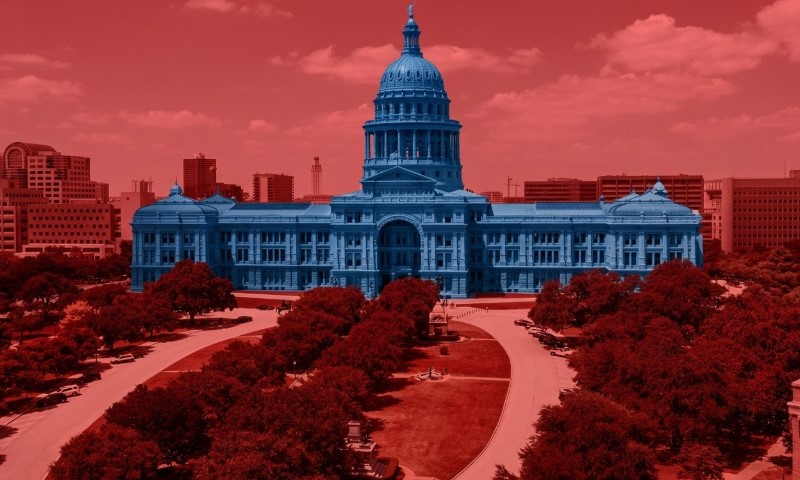
Texas remains our clearest lens. The Texas Tribune results show Trump winning by 13.7 points, even as Houston and Dallas stand as massive Democratic anchors in a red sea.
Tennessee reveals an even sharper split. In the Davidson County results, Kamala Harris won convincingly, while the state as a whole marched firmly in the opposite direction.
When Nashville voters approved a major transit ordinance, they proved that local policy coalitions are often broader and more nuanced than national party labels would suggest, focusing on the practicalities of city life.
Missouri offers a classic study in contrast. The Missouri official returns gave Trump 58.5%. While St. Louis and Kansas City shape Democratic hopes, rural margins consistently overpower them.
Florida, however, serves as a warning against using outdated scripts. Florida county results show Trump winning Miami-Dade, shattering a decades-long Democratic streak in that urban hub.
While Orlando and Broward remain blue, the rightward shift in Miami proves that urban diversity is not a guarantee of a Democratic vote; it is a landscape that must be constantly tended.
The Structural Roots of the Divide
Why do cities consistently vote blue? It is often because residents live close to the machinery of government. Transit, housing, and schools aren’t abstract concepts, as they are immediate, daily concerns in dense places.
Voters who rely on shared infrastructure respond differently to fiscal policy than those in low-density areas. The very experience of the city shapes the political mind, fostering a reliance on collective solutions.
Pew’s 2024 data highlights this structural divide: urban voters lean Democratic by 23 points, while rural voters give Republicans a 25-point lead. It is a fundamental difference in how Americans live.
The real drama, however, unfolds in the suburbs. While the city provides the base, the suburbs decide if that base can reach a statewide majority or remains isolated.
Places like Collin County, Texas, or Cobb County, Georgia, are the true battlegrounds. They determine if the urban pulse can transform into a statewide victory or a quiet defeat.
The Pragmatism of the Blue City
The biggest myth I encounter is that every blue city is inherently progressive. In reality, many are governed by practical, bread-and-butter concerns that transcend ideology.
City politics is frequently about the visible: police staffing and road repairs. A Democratic mayor in a red state often governs with a centrist pragmatism that might surprise national observers.
They must balance local progressive aspirations with the harsh realities of urban management, often leading to a more moderate approach than their party’s national platform might suggest.
Turnout and local coalitions also differ; a voter might back a Democrat for the White House but choose a conservative for city council based on local development issues.
Nonpartisan ballots further blur these lines, allowing local interests, like the quality of schools, to override national party loyalty in the voting booth.
Miami-Dade remains our cautionary tale. It proves that diversity doesn’t guarantee a blue future; voters there are increasingly focused on safety and business over partisan identity.
When Tectonic Authority Grinds: Policy Battles
The divide becomes most tangible when state power overrides local will. This is where the tectonic plates of authority truly grind against one another.
The National League of Cities defines this as “preemption,” warning that state interference can strip local control over everything from broadband to tax rates.
On LGBTQ rights, the gap is concrete. The Movement Advancement Project tracks 18 states with negative policy scores as we move through 2026.
In these states, cities often attempt to fill the void with their own local protections, creating municipal ordinances that act as shields against restrictive statewide legislation.
The human impact of this friction is significant. Specific policy clashes often center on:
- LGBTQ protections and municipal non-discrimination ordinances.
- Local minimum wage increases being blocked by state legislatures.
- Abortion access and the deprioritization of enforcement by city officials.
A blue city can provide symbolism, but it cannot always shield its residents from the legal force of a red statehouse. The ACLU 2026 tracker notes this intensifying struggle.
The ACLU 2026 tracker notes that state bills are increasingly limiting local protections.
MAP reports over 400 anti-LGBTQ bills are being tracked across 43 states. The struggle between local values and state law has never been more acute.
Whether it’s reproductive rights or voting access, local officials try to carve out space for their constituents, but the state’s legal weight remains the dominant force.
The Safety Debate – A Political Weapon

Crime often turns these states into national talking points. Conservatives use city disorder as a political weapon, while Democrats point to poverty and state gun laws as the roots of the issue.
This debate frequently overlooks the regional reality: the city and the state are inextricably linked in their successes and failures. They rise and fall together.
A wise analyst avoids lazy arguments. Cities concentrate the challenges of density, making public safety issues far more visible than they are in the quiet of rural areas.
City governments must handle these high-density problems at a scale that others rarely see, creating a unique and difficult management burden for local leaders.
For a true analysis, one must focus on rates and three-year trends. Look at violent crime per capita to see the real story of safety behind the viral videos.
Political consequences follow the data. If cities seem dismissive of disorder, Republicans mobilize; if state leaders block local tools, Democrats argue for autonomy.
At the end of the day, voters in the city simply want to know if their sidewalks are safe and if their calls for help will be answered.
Economic Dependency
Despite the political rhetoric, red states depend on their blue cities for their economic lifeblood. From tax bases to airports, state economies rely on urban growth.
The Census city estimates show Houston and San Antonio gaining thousands of residents, bringing massive needs for infrastructure and public health.
These cities are the engines of the Texas economy. A state cannot thrive if its most productive centers are struggling or neglected by the capital.
The Brookings analysis confirms this: rural areas form the GOP foundation, while metros drive the nation’s GDP and economic future.
This creates an uneasy bargain. States need urban growth to fund their budgets, yet campaigns benefit from criticizing urban life. It is a structural embrace from which neither can escape.
In 2026, this dependency defines the landscape. They are locked together—mutually reliant and perpetually at odds.
Reading the Map for the 2026 Midterms
For those tracking the 2026 climate, the best approach is local and layered. You must look past the broad strokes to see the underlying architecture of power.
Start with statewide control; it tells you who writes the rules on education and civil rights. The statehouse remains the primary source of legal authority in America.
Then study urban counties. A city name is just a label; understand the specific geography of a metro to truly grasp its political leanings and future potential.
Watch the suburbs above all else. They are the true deciders of statewide races, determining if an urban margin can ever become a statewide victory.
Separate culture from enforcement. A city resolution is often symbolic, whereas the actual legal effect depends on state law and the discretion of local prosecutors.
Follow ballot measures closely. They reveal voter attitudes that party labels often hide, showing where local policy can transcend the national partisan divide.
Defining the States of 2026
Texas, Tennessee, and Missouri remain the strongest examples of this dynamic in 2026, each with durable GOP strength anchored by major Democratic urban counties.
Florida fits the label, but assumptions are risky. The shift in Miami-Dade proves the landscape is never static; it is always in a state of flux.
Georgia and North Carolina are better viewed as competitive. Their urban metros have the power to alter statewide outcomes in ways that hubs in Missouri simply cannot.
They are the true battlegrounds where every suburban shift matters. They represent the most fluid version of the red-state-blue-city dynamic we see today.
Other states, like Alabama, feature blue pockets, but their urban base is currently too small to threaten GOP dominance. They remain firmly in the Republican column.
The Bottom Line
Red States with Blue Cities are the very architecture of American politics today. They are not the exception; they have become the rule for how power is distributed.
This divide explains why state laws can feel hostile to city dwellers, and why city leaders often seem out of step with the rural voters who dominate the statehouse.
National maps often hide this lived reality. A red state is rarely red everywhere, and a blue city is rarely blue in every neighborhood.
The smartest reading of America is layered. By looking at state power and metro growth together, we see the true nature of power in 2026.