
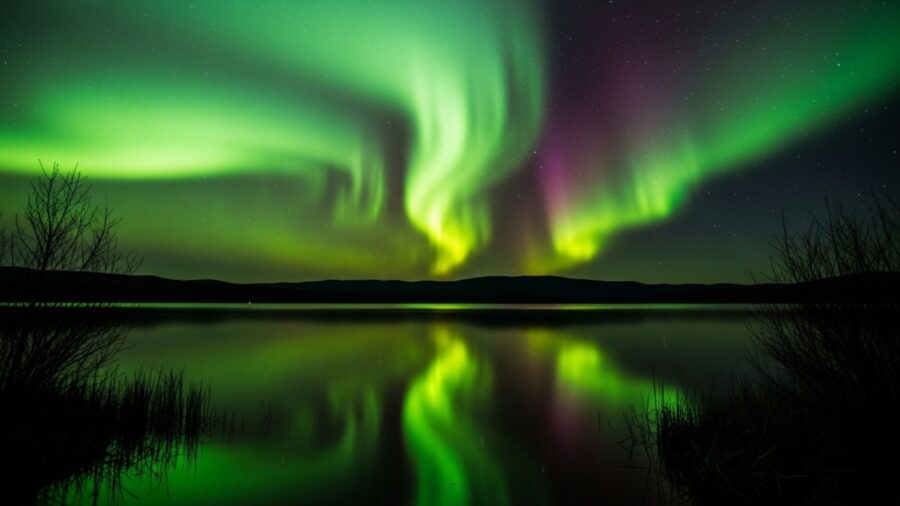

A fresh wave of aurora coverage swept across the U.S. after People reported that the northern lights could be visible from 18 states on the night of April 15, with another possible viewing window on April 16.
The outlet, citing NOAA’s Space Weather Prediction Center, said the best chance would come between 10 p.m. and 2 a.m. local time, with the strongest viewing potential in northern parts of the country.
According to that report, the states in the possible visibility zone included Alaska, Washington, Oregon, Idaho, Montana, North Dakota, South Dakota, Nebraska, Minnesota, Iowa, Wisconsin, Illinois, Michigan, New York, Pennsylvania, Vermont, New Hampshire, and Maine.
That kind of map naturally draws attention because aurora displays rarely push far enough south to put so many U.S. states on notice at once.
Table of Contents
ToggleWhat NOAA’s Forecast Actually Says
NOAA’s own aurora products add a necessary warning to the excitement. The agency’s “Aurora Viewline for Tonight and Tomorrow Night” is an experimental forecast product, and NOAA explicitly describes it as a prediction of likely aurora intensity and location, not a promise that the lights will be visible everywhere inside the shaded area.
NOAA also says its short-range aurora forecast products are designed to help users track fast-changing conditions, which is why same-day headlines can quickly become outdated.
That distinction matters because aurora visibility depends on more than geomagnetic activity alone. Even with favorable solar conditions, cloud cover, light pollution, terrain, and timing can all erase what looks promising on paper.
NOAA’s 30-minute aurora forecast exists for exactly that reason: short-term shifts in solar wind and Earth’s magnetic response can change the viewing picture in a hurry.
Stronger Aurora Potential May Come Later
The bigger story, based on NOAA’s latest guidance, may actually be what comes after the night that generated the headlines.
NOAA issued G2, or moderate, geomagnetic storm watches for April 17 to April 18, citing anticipated effects from a coronal-hole high-speed stream. That is a stronger and more clearly defined alert than the softer visibility framing attached to April 15 and April 16.
In practical terms, stronger storm-watch language from NOAA usually means a better chance that observers outside the far north could catch something worth seeing.
What Skywatchers Should Do
For anyone hoping to catch the display, the advice is straightforward. Go somewhere dark. Face north. Stay away from city glow. Then check NOAA’s near-real-time aurora tools shortly before heading out, because the most accurate picture often comes much closer to the event than an early media write-up.
What You Need to Know
The reports about possible northern lights visibility across 18 states were not invented, but they came with more uncertainty than the headline suggested. NOAA’s own materials support aurora monitoring, but they also indicate that the stronger setup is expected on April 17 and April 18, not necessarily on the first night that grabbed attention. For skywatchers, that is the real takeaway.
Related Posts:
- The 100 Most Dangerous Cities in America (2026):…
- Why Is Alaska So Dangerous - Deadliest Risks in 2026
- Safest Cities in California in 2026: An Honest,…
- Is Idaho Safe in 2026 - Crime Rates, Traffic…
- America’s Murder Capitals - Updated 2026 Rankings of…
- 25 Most Dangerous Cities in US - Updated Statistics for 2026