
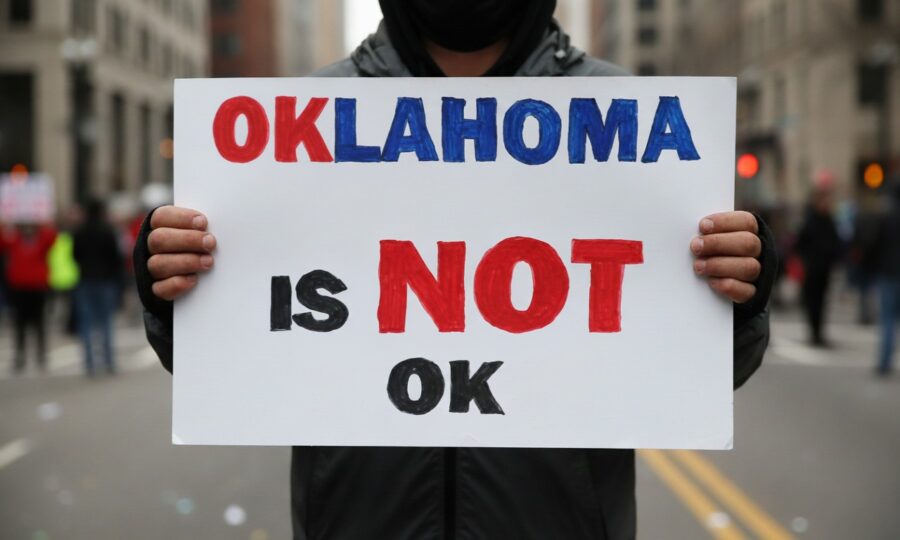

The Oklahoma House has advanced 2 measures that sharpen the state’s clash over LGBTQ rights, approving one bill that would further restrict changes to birth certificates and another that would block state agencies from promoting Pride Month while limiting which flags may be flown on state property. Both measures have now moved to the Senate.
One of the bills, House Bill 1225, passed the House on March 11 by a 73-18 vote. The bill would amend Oklahoma’s vital-records law to bar changes to the “biological sex designation” on a birth certificate. Oklahoma’s legislative records show the measure cleared the House that day and was sent to the Senate on March 12.
The second bill, House Bill 1219, cleared the House on the same day and was engrossed and sent to the Senate on March 12.
Oklahoma’s bill text shows the proposal would prohibit agencies from using funds to “develop, organize, administer, engage in, promote, or endorse” Pride Month or similar events, and would allow only flags authorized by federal or state law to be displayed by an agency on state property or grounds.
A legislative tracking record reflecting Oklahoma state sources lists the House vote as 74-17.
Table of Contents
ToggleWhat The Birth Certificate Bill Would Change
HB 1225 is written as an amendment to Oklahoma’s existing vital-records statute. The bill text says the sex designation on a birth certificate “shall be either male or female” and that the designation “shall not be amended.” The measure is scheduled to take effect November 1, 2026, if enacted.
That language matters because Oklahoma already has a history of restricting gender-marker changes on birth records.
In 2022, Governor Kevin Stitt signed a law prohibiting nonbinary markers on birth certificates after first issuing an executive order on the issue. The Associated Press described that law as the first of its kind in the nation.
But the legal fight over Oklahoma’s policy did not end there. In June 2024, the 10th U.S. Circuit Court of Appeals revived a challenge to Oklahoma’s ban on changing birth certificates, ruling that a lower court had wrongly dismissed the case.
Reuters reported that the appeals panel said the law discriminates against transgender people without a rational basis, while leaving open the possibility that the state could still try to justify it.
That puts HB 1225 at the center of a larger conflict, one that is no longer only political. It is also constitutional, and still being tested in court.
What The Pride Bill Would Do
The second proposal, HB 1219, reaches beyond flags alone. The House floor version says no agency funds may be used for activities that promote or recognize LGBTQI Pride Month or “any event with a similar theme.”
The bill’s wording specifically includes events, initiatives, official communications, social media posts, educational programs, and public campaigns.
Its flag provision is also broader, and in one sense narrower, than some headlines suggest.
Rather than naming Pride flags directly in the latest House floor text, the bill says only flags authorized under federal and state law may be displayed by an agency on state property. In practice, that would exclude Pride flags from state agencies unless separately authorized.
Earlier reporting on the bill, from when it moved through committee in 2025, quoted sponsor Rep. Kevin West as saying he brought the legislation forward because some constituents wanted agencies focused on their core missions rather than “promoting something not all Oklahomans agree with.” That same report noted West said the bill initially had no specific enforcement mechanism.
The Broader Political Meaning
Taken together, the 2 bills show how Republican-led states continue to move LGBTQ policy fights away from abstract rhetoric and into state records, government speech, and public symbolism.
In Oklahoma, the conflict now touches both the content of official documents and the visibility of LGBTQ expression in public institutions.
The birth-certificate measure is especially notable because it comes after Oklahoma had already codified restrictions in 2022 and after a federal appeals court reopened the legal dispute in 2024.
The new bill appears designed to further cement the state’s position in statute even as courts continue to examine whether the underlying policy can survive constitutional scrutiny.
HB 1219, meanwhile, illustrates a different strategy. Rather than regulating identity documents, it regulates state institutions themselves, what they can fund, what they can say, and what symbols they can display.
Its practical effect would likely be felt across state agencies, and potentially public schools or other government bodies depending on how “agency” is interpreted and applied. The bill defines an agency broadly as any board, commission, department, or other state government entity created under the Oklahoma Constitution or statutes.
Oklahoma Is Not Acting In Isolation
Oklahoma’s action fits into a wider national push by some states to restrict gender-marker changes and curb official LGBTQ recognition.
Human Rights Watch reported this month that, as of February 2026, Oklahoma was among the states that do not allow people to update the gender marker on their birth certificate.
That broader pattern gives the Oklahoma bills significance beyond the state Capitol. Supporters frame such measures as guarding the integrity of public records and keeping government neutral.
Opponents see them as a targeted effort to erase transgender identity from official life and to push LGBTQ expression out of public institutions.
The legal and political fight now turns to the Oklahoma Senate, where both bills must still clear another chamber before reaching the governor’s desk.
What Happens Next
As of March 13, 2026, both HB 1225 and HB 1219 had passed the Oklahoma House and been sent to the Senate for further consideration. Neither measure was law yet at the time of reporting.
Related Posts:
- The 100 Most Dangerous Cities in America (2026):…
- Legislative Tracker: Pro-LGBTQ Nondiscrimination Legislation
- Best Places to Retire Abroad in 2026: An Honest…
- Safest Countries in the World in 2025 - GPI…
- Safest Cities in California in 2026: An Honest,…
- 25 Most Dangerous Cities in US - Updated Statistics for 2026