
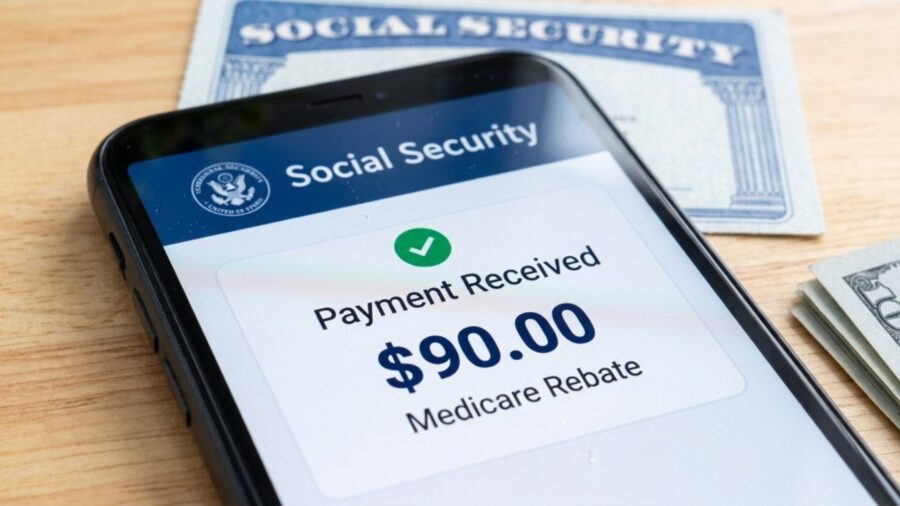

Millions of Americans enrolled in Medicare are receiving an unexpected $90 payment in October, with most deposits arriving through the Social Security Administration. Despite how the transaction may appear on a bank statement, the money is not a new Social Security benefit, bonus or cost-of-living adjustment.
The payment is a one-time Medicare Part B premium rebate announced by President Donald Trump on October 2, 2026. The Centers for Medicare & Medicaid Services, or CMS, says 20.8 million people enrolled in Original Medicare Part B qualify.
Most eligible beneficiaries are scheduled to receive the money by direct deposit on or around October 8, with paper checks arriving later in October for people without direct deposit, according to the CMS rebate guidance.
Table of Contents
ToggleWho Qualifies for the $90 Medicare Payment?
Eligibility is narrower than simply having Medicare.
CMS says the rebate is available to people who live in the United States and are enrolled in Original Medicare Part B, provided they do not receive Medicaid assistance with their Medicare premium and do not pay an Income-Related Monthly Adjustment Amount, or IRMAA. People enrolled in private Medicare Advantage plans are excluded.
That leaves roughly 40 million Part B enrollees outside the program, according to CBS News reporting. Medicare Advantage members make up a significant share of that group, even though many Medicare Advantage beneficiaries also pay the regular Part B premium.
Higher-income beneficiaries who pay IRMAA are also excluded. In 2026, the standard Part B premium is $202.90 per month, although higher-income enrollees can pay substantially more, according to Medicare’s official cost information.
Most Payments Are Due Around October 8
As of October 7, CMS continues to say that most eligible beneficiaries should receive one $90 direct deposit on or around October 8. The Social Security Administration is handling most of those electronic payments.
People without direct deposit will instead receive a Treasury check later in October. CMS says the check will identify itself as a Medicare Improvement Fund payment intended to offset the October premium.
CBS News reported on October 6 that some beneficiaries were already seeing deposits or pending transactions. Anyone unsure whether they qualify can contact 1-800-MEDICARE. CMS says beneficiaries seeking the status of a missing payment should contact Social Security beginning October 15.
The Money Comes From the Medicare Improvement Fund
The rebate is financed through the Medicare Improvement Fund, which Congress established in 2008 to support improvements to Original Medicare Parts A and B. It is not being paid from the Social Security trust funds.
KFF, the nonprofit health-policy research organization, estimates the fund currently contains slightly more than $2 billion. Paying $90 to about 20.8 million beneficiaries would use roughly $1.87 billion and therefore consume most of the available money. KFF said CMS had not previously used the fund to make direct payments of this kind to beneficiaries, according to its analysis of the rebate.
The administration announced the rebates about a month before the November 3 midterm elections. The Associated Press and Reuters noted the political timing, although CMS describes the initiative as a way to make Medicare coverage more affordable. The Associated Press report also placed the announcement in the broader political context.
The Rebate Covers Less Than Half of One Monthly Premium
The $90 payment offsets about 44% of the standard $202.90 Medicare Part B premium in 2026.
Medicare costs are also expected to rise again. The 2026 Medicare Trustees Report projects the standard Part B premium at $209.50 per month in 2027, an increase of $6.60 per month, or $79.20 over a full year. That figure remains a projection. CMS has not yet announced the final 2027 Part B premium. The projection appears in the 2026 Medicare Trustees Report.
KFF noted that the projected annual premium increase alone would consume most of the one-time $90 rebate.
For recipients, the most important distinction is straightforward. An unexpected $90 deposit from Social Security this month does not mean monthly Social Security benefits have permanently increased. It is a separate, one-time Medicare payment for a limited group of Original Medicare beneficiaries.