Skip to content

The U.S. Air Force is changing course, again, on one of the most visible symbols of American power: the paint scheme on presidential and senior-leader aircraft.
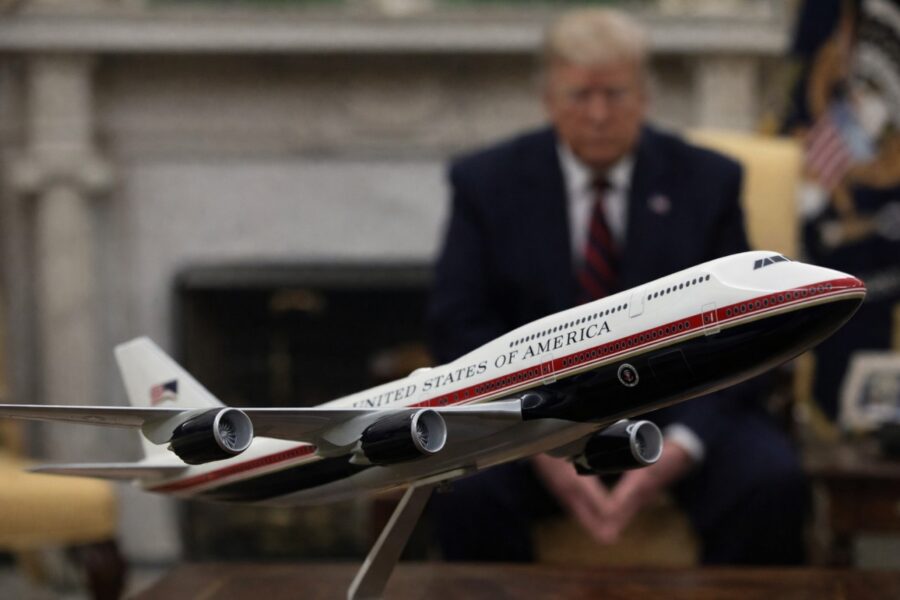
After years of back-and-forth, the service has now confirmed it is rolling out a new palette across the executive airlift fleet, including the next-generation presidential aircraft, in red, white, dark blue, and gold, a look closely associated with Donald Trump’s preferred design.
The decision revives a plan that was previously shelved after technical concerns were raised about darker colors increasing heat load on the aircraft, a problem that officials said could translate into added engineering work, additional time, and higher cost.
Table of Contents
ToggleWhat the Air Force Says Is Changing
According to Reuters, the Air Force’s updated requirement applies not only to the two VC-25B aircraft (the military designation for the modified Boeing 747-8s intended to replace the current presidential jets), but also to other aircraft used to move the vice president and senior officials.
CBS News reported that at least one of the 757-based VIP aircraft has already gone through repainting as part of scheduled maintenance cycles, suggesting the rollout is already underway in a practical, incremental way rather than a single, all-at-once switch.
Industry-focused outlets tracking executive aircraft movements have also documented the first visible signs of the new scheme appearing on a C-32A, the military variant of the 757 that often serves as “Air Force Two” when the vice president is aboard.
The Kennedy-Era Look, and Why It Became a Fight
The current blue-and-white livery traces back to the John F. Kennedy era, and it has stayed largely intact for decades because it is instantly recognizable and politically “neutral” by modern standards.
That neutrality is exactly why the paint job debate keeps coming back. A presidential aircraft is both operational hardware and a moving national emblem. A redesign inevitably reads as a statement of style and ownership, even when the Air Force frames it as a straightforward requirements change.
Under the Joe Biden administration, the Air Force moved away from the Trump-era design after an internal review concluded the darker paint scheme could raise thermal issues and potentially increase cost and delay.
Now the service is reversing that decision, but it is not publicly detailing how the original thermal concerns are being resolved in the new plan.
The Bigger Issue Behind the Paint: A Delayed, Expensive Replacement Program
The paint job is the headline because it is visual, but the real pressure point is the schedule.
The VC-25B program has suffered repeated delays, and government reporting shows the Air Force has been planning for extended operations of the current VC-25A aircraft because the replacement jets are arriving later than originally expected.
A Defense Department acquisition report from late 2023 summarized a schedule projection showing delivery targets in 2027 for required asset availability milestones, while also warning that performance lag and program risks could push the program further.
Reuters, citing the Air Force One program’s status, described the effort as years behind schedule and noted that the work stems from a fixed-price deal originally struck in 2018, with Boeing’s costs rising beyond the original contract value.
The Executive Fleet Repaint, and What “Rollout” Really Means
The Air Force is not presenting the new livery as a single repaint event. Instead, it is describing a phased approach that relies on regularly scheduled depot maintenance windows, which is the least disruptive way to change paint across multiple aircraft while keeping mission availability intact.
That detail matters because it hints at how the Air Force is trying to control two risks at once:
- Operational risk: aircraft still need to fly every day for national leadership travel.
- Program risk: a forced, rapid repaint program can create avoidable downtime and cost spikes.
A gradual repaint, however, does not answer the hardest question the earlier review raised: if darker colors increase heat load on critical areas, what engineering changes, materials, or operational mitigations are now assumed, and what do they cost? Reuters reported the Air Force did not provide those details.
The “Bridge” Aircraft, and Why It Is Part of the Same Story
The paint decision is also landing alongside a separate, unusual development: the U.S. government has been pursuing an interim presidential aircraft, sometimes described as a stopgap, to cover capability and timing gaps while the VC-25B program runs late.
Reuters reported that defense contractor L3Harris Technologies is involved in overhauling a 747 previously operated by the government of Qatar for interim use.
That interim effort is politically sensitive, operationally complex, and expensive, because presidential aircraft requirements are not cosmetic. They involve secure communications, survivability measures, and a hardening package that is not comparable to a typical VIP refit.
What Is Known, and What Is Still Not Being Answered
Known, based on multiple reports:
- The Air Force is implementing a new paint scheme requirement in red, white, dark blue, and gold across executive airlift aircraft, including the VC-25B replacements.
- The scheme revives the earlier Trump-preferred concept that had been dropped after thermal and cost concerns were raised.
- At least one C-32A has already emerged in the updated paint scheme, indicating early execution.
- The VC-25B program remains delayed, with official program reporting showing continued schedule risk.
Still not answered in public detail:
- What specific technical changes, if any, are being made to address the heat and thermal concerns that derailed the darker palette previously.
- Whether the repaint requirement creates new test, certification, or sustainment burdens for the fleet beyond routine painting.
Why the Reversal Matters Beyond Aesthetics
A presidential aircraft paint scheme looks like branding, but it operates like a requirements decision. Every requirement change, even one that seems superficial, touches a chain of engineering validation, maintenance planning, and cost control.
For a program already struggling with schedule risk, the burden is on the Air Force to show that the new livery is not reopening the same technical and logistical problems that led to the earlier reversal. Reuters reported the service has not yet provided that explanation publicly.
Related Posts:
- Top 20 Most Dangerous Cities in California for 2026…
- 25 Most Dangerous Cities in US - Updated Statistics for 2026
- Safest Countries in the World in 2025 - GPI…
- Heat Detector vs Smoke Detector - Which One Should…
- Capital Cities in Europe: Top Destinations For You…
- 17 Worst Prisons in the US in 2026 - America's…