Skip to content

A mass shooting in Austin’s West Sixth Street entertainment district is now being investigated by the FBI as a possible act of terrorism, after authorities said they found indicators on the gunman and in his vehicle that suggested a potential terror nexus.
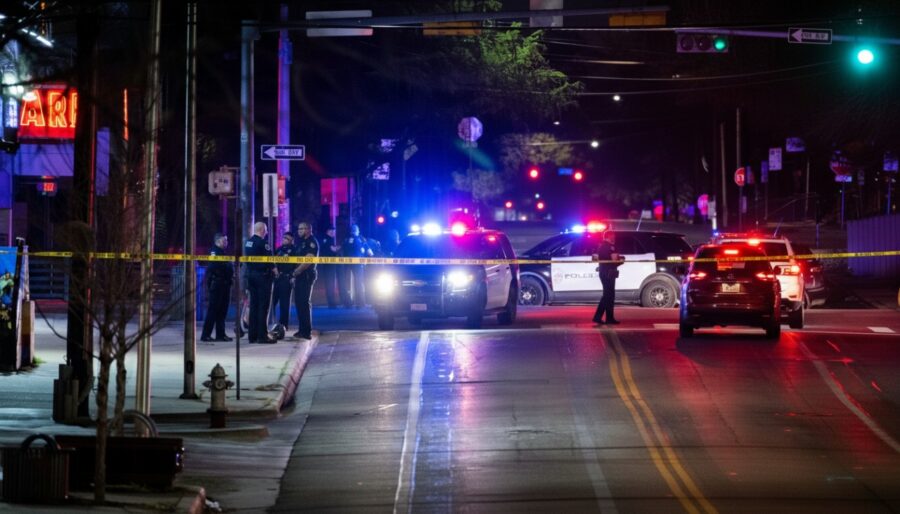
The attack, which unfolded just before 2 a.m. outside Buford’s Backyard Beer Garden, left two civilians dead, 14 people injured, and the suspected shooter dead after police returned fire.
The case has quickly moved beyond a local homicide investigation. Federal agents, including the FBI’s Joint Terrorism Task Force and digital forensics teams, are now working alongside Austin police as investigators try to determine whether the shooter was driven by ideology, grievance, mental health crisis, or some combination of factors.
Reuters reported that officials are examining whether the suspect may have been influenced by the recent U.S.-Israel strike on Iran, but authorities have not announced a confirmed motive.
Table of Contents
ToggleWhat Happened on Sixth Street
According to Austin Police Chief Lisa Davis, the gunman drove an SUV around the block multiple times near Buford’s before opening fire from the vehicle with a pistol at people on the patio and in front of the bar.
Police said he then drove west, parked, exited the vehicle, and continued firing at pedestrians while on foot. Officers in the area confronted him and fatally shot him at a nearby intersection.
Authorities said the suspect never entered the bar. The shooting took place in one of Austin’s busiest nightlife corridors, where bars, music venues, and late-night crowds are common, especially on weekends.
The scene was packed with young people, including University of Texas students, when the gunfire began.
Emergency officials and police credited the rapid response for preventing an even higher death toll. Reuters reported that law enforcement and emergency services were already stationed nearby because of the usual weekend crowds in the district.
Casualties and Condition of the Wounded
The death toll currently stands at three, including the shooter. Two victims were killed in the attack, and the suspect was killed by police at the scene. Fourteen other people were wounded, and authorities said three of the injured were in critical condition in early updates on Sunday.
Victim identities had not been broadly released in the reporting reviewed here at the time of publication. Officials have focused public briefings on scene management, medical response, and the ongoing joint federal-local investigation.
Why the FBI Is Investigating a Possible Terrorism Link
The central reason the case has drawn federal counterterrorism attention is what the FBI described as “indicators” found on the suspect and in his vehicle.
Alex Doran, acting special agent in charge of the FBI’s San Antonio field office, said the evidence suggested a “potential nexus to terrorism,” while cautioning that investigators were still too early in the process to make a definitive determination.
Reuters reported that a law enforcement official said the shooter was wearing clothing that referenced Iran and Islam, including a shirt with an Iranian flag and a sweatshirt reading “Property of Allah.”
Reuters also reported that investigators were examining whether the attack may have been motivated by the recent joint U.S.-Israel strike on Iran. AP separately reported similar details about the attire and noted the timing, one day after that military action.
That is an investigative lead, not a settled conclusion. At this stage, authorities have publicly said they are evaluating possible motive pathways and have not announced evidence that the suspect acted on behalf of an organized foreign or domestic terror group.
The Suspect and What Authorities Have Publicly Said
AP reported that the gunman was identified as 53-year-old Ndiaga Diagne. Reuters also identified the suspect as Ndiaga Diagne, citing an internal counterterrorism update, and described him as a naturalized U.S. citizen from Senegal.
AP further reported, citing the Department of Homeland Security, that Diagne first entered the United States in 2000 on a B-2 tourist visa, became a lawful permanent resident in 2006 after marrying a U.S. citizen, and became a naturalized U.S. citizen in 2013.
Reuters reported that officials were also reviewing a history of mental health issues. That detail matters because in many high-profile violence investigations, law enforcement evaluates behavioral history alongside ideological indicators and current events to assess motive. Public officials, however, have not yet released a final motive assessment.
A City Shaken, a District Under Lockdown
The aftermath extended well beyond the crime scene tape. MySA reported that portions of West Sixth Street remained closed as the investigation continued, with multiple nearby businesses shutting down temporarily while federal and local authorities processed the area.
The outlet also reported that some businesses stayed open with altered access routes, reflecting the uneven return to normal operations in a district built around foot traffic and nightlife.
The closures underscore a familiar reality in mass casualty events, the impact spreads quickly from victims and families to workers, nearby businesses, students, and residents who rely on the district as a social and economic hub.
In Austin, where Sixth Street is both a tourist corridor and a local institution, the disruption is also symbolic.
What Remains Unknown
Investigators still have major unanswered questions:
- Whether the suspect had a clearly articulated political or religious motive.
- Whether he acted entirely alone in planning and execution.
- Whether digital evidence, communications, or search history will support a terrorism classification.
- Whether the attack was primarily ideological, primarily personal, or driven by overlapping factors.
Those distinctions matter legally and publicly. The phrase “potential act of terrorism” signals that authorities have enough evidence to involve counterterrorism investigators, but not enough yet to announce a final conclusion. In fast-moving cases, early labels can shift as forensic and digital evidence is reviewed.
The Broader Context
Reuters, citing Gun Violence Archive data, reported that the Austin attack was the 56th mass shooting in the United States in 2026 and the deadliest of the year so far by number of victims at the time of reporting.
Reuters also reported the archive counted 407 mass shootings in 2025, using its standard definition of four or more people shot, excluding the shooter.
That broader context does not explain motive in Austin, but it does frame why cases like this immediately trigger parallel conversations about public safety, threat assessment, nightlife district policing, and federal-local intelligence coordination. In Austin, officials have emphasized that the heavy police presence in the district likely saved lives.
Where the Investigation Goes Next
The next phase will likely depend on digital forensics, ballistic analysis, recovered items from the suspect’s vehicle and residence, and interviews with witnesses and anyone who knew him.
Reuters reported the FBI’s evidence response and digital forensic teams were part of the active investigation on Sunday, which signals a broad effort to reconstruct intent and planning, not only the shooting sequence.
For now, the clearest facts are the ones already visible in the public record: a crowded Austin nightlife block, a rapid burst of violence, a swift police response, and a federal terrorism inquiry that is still in its early stages.
Related Posts:
- What Is the Most Dangerous Country in the World in 2025
- Safest Countries in the World in 2025 - GPI…
- 25 Most Dangerous Cities in US - Updated Statistics for 2026
- How Many International Airports Are There In The US in 2026?
- Most Dangerous Cities in Georgia for 2026 - 10…
- Capital Cities in Europe: Top Destinations For You…