Skip to content


Talking about school shootings in the United States always comes with a heavy emotional weight. By 2025, the topic also carries a layer of confusion that can feel just as overwhelming as the violence itself.
Headlines often seem to contradict each other. One outlet reports a relatively low number, another cites a figure in the hundreds. Both can be accurate at the same time.
The reason is not spin or carelessness. It is definition.
School shooting data in the U.S. does not live under one federal standard. Different organizations count different things, for specific reasons, using transparent but distinct rules. Any serious look at school shootings in 2025 has to start there, otherwise the conversation goes nowhere fast.
We prepared a numbers-first overview of what 2025 looks like so far, how the major datasets differ, where the real patterns show up, and what those patterns suggest for prevention and policy. Let’s begin.
Why There Is No Single “School Shootings” Number in 2025
When people ask, “How many school shootings happened in 2025?”, they are usually expecting a single, authoritative figure. That figure does not exist.
Counts change based on several choices made by the organization tracking the data, including:
- Whether incidents are limited to K–12 schools or include colleges and universities
- Whether someone has to be injured or killed for the incident to count
- Whether suicides and self-inflicted gunshot wounds are included
- Whether incidents must happen during school hours or at school-sponsored events
- Whether gunfire near school property counts, or only gunfire on campus
Those decisions shape the final number. None of them is neutral, and none of them is wrong by default. They simply answer different questions.
In 2025, that definition gap is the main reason school shooting coverage can feel chaotic or misleading. Knowing the gap makes the rest of the data far more useful.
Two Widely Cited 2025 Counts That Measure Different Realities
By late 2025, two figures appeared most often in national reporting. They are not competing statistics. They measure different phenomena.
Count A: Shootings on K–12 Property During School Activities With Victims Shot
The most restrictive and precise count comes from Education Week. Its 2025 tracker focuses on one narrow question:
How often did a shooting occur on K–12 school property or a school bus, during school or a school-sponsored event, where someone other than the shooter was struck by a bullet?
As of December 12, 2025, Education Week reports:
- 17 K–12 school shootings with injuries or deaths
- 50 people killed or injured
- 7 people killed
- 43 people injured
The criteria are strict by design. Education Week excludes suicides and self-inflicted injuries. It also excludes incidents where no one besides the shooter is shot. They want consistency and clarity, not maximal counting.
According to News8000, the most recent incident included in the 2025 total occurred on December 12, when a student was shot and injured in a high school parking lot in Stewartville, Minnesota, as students and coaches were boarding a bus for a wrestling tournament.
That detail matters. Even within a narrow definition, shootings often happen in transitional spaces like parking lots or loading areas rather than inside classrooms.
Count B: Broader Gun Incidents on K–12 Campuses
A much larger number appears in reporting that takes a wider view of campus gun activity.
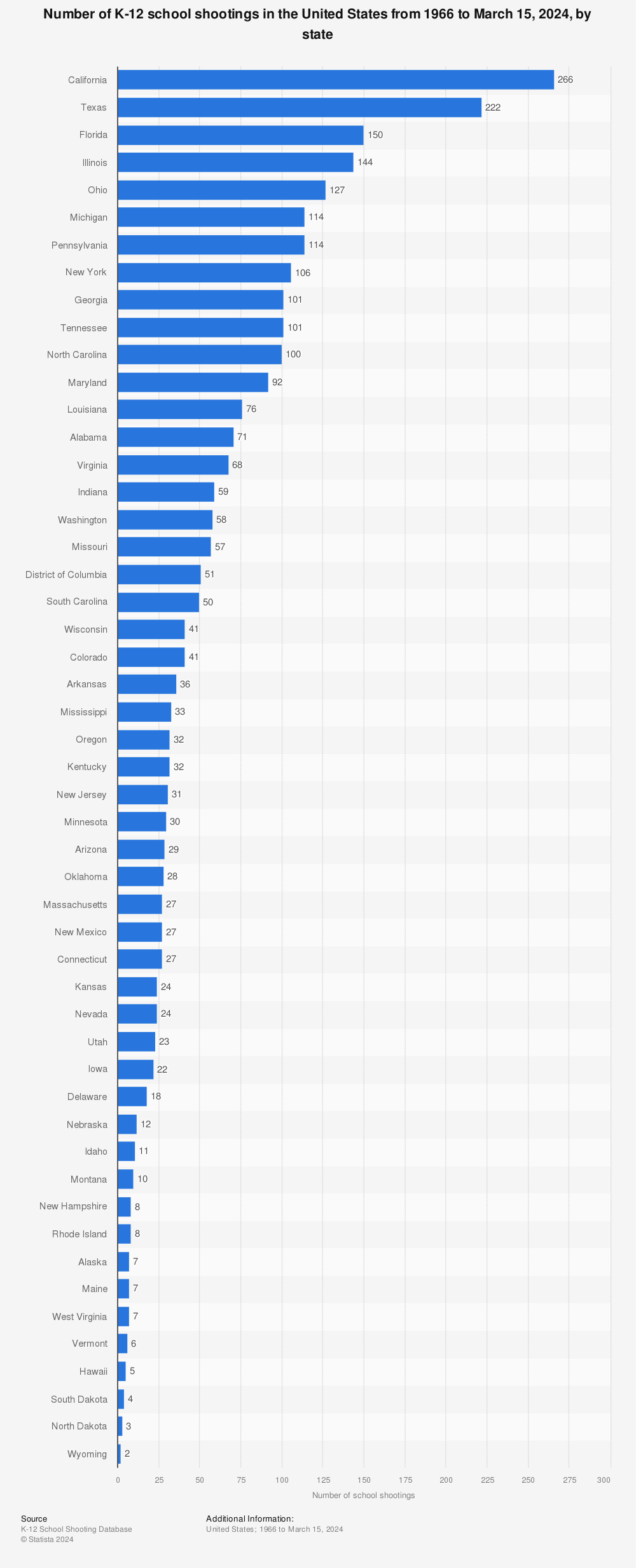
A 2025 report cited by TIME references the K–12 School Shooting Database, which reported 208 school shootings so far in 2025, following 336 incidents in all of 2024.
That number captures a broader category of firearm incidents tied to K–12 campuses. Depending on classification, it can include incidents with no injuries, incidents outside school hours, and gunfire in parking lots or near school buildings.
It is not meant to mirror Education Week’s injury-and-death-only count. TIME uses it to illustrate the scale of gun-related incidents driving safety policies, lockdown drills, and public anxiety, rather than to quantify fatalities alone.
Why Different Trackers Produce Different Totals
A side-by-side comparison helps explain why numbers can look wildly different while still being accurate.
The takeaway here is straightforward. Education Week answers a narrow question about victimized shootings during school activities. Broader databases answer questions about how often guns appear in school environments at all.
Both perspectives matter.
Education Week’s 17 Incidents & What the Number Actually Represents
The Education Week figure is the most concrete and stable number available for 2025 when talking specifically about shootings that injure or kill people during school activities.
Because the criteria are fixed year to year, it allows for meaningful trend comparison.
As of December 12, 2025:
- 17 incidents involved injuries or deaths
- 50 total victims were shot
- 7 of those victims died
Those figures do not imply that schools suddenly became safe. They indicate that fewer incidents met Education Week’s strict threshold, not that gun incidents disappeared.
Trend Context, Where 2025 Fits Historically
Education Week publishes year-by-year data using the same criteria, which helps place 2025 in context.
Several patterns stand out:
- 2022 remains the peak year in this specific series, with 51 incidents
- 2023 and 2024 stayed elevated , both close to 40 incidents
- 2025 is lower at 17 incidents as of mid-December
A lower number in this dataset does not mean fewer guns near schools. It means fewer incidents where a non-suspect was shot during school activities.
That distinction is critical for interpretation.
What Broader 2025 Counts Are Capturing Instead
Find more statistics at Statista
When you see 2025 figures in the hundreds, they usually include categories filtered out by Education Week.
Gunfire With No One Injured
Shots fired into empty spaces, into buildings after hours, or during fights where no one is struck still create lockdowns, police responses, and lasting trauma. Broader trackers count them because they matter for safety planning.
Incidents Outside School Hours
Gunfire on school property at night or on weekends can still signal unsecured access to firearms and unresolved conflict dynamics involving students or community members.
Mixed K–12 and Higher Education Reporting
Some summaries include colleges and universities alongside K–12 schools, which inflates totals if the reader assumes the count applies only to children.
Gunfire as an Environmental Risk
Everytown’s mapping focuses on understanding how often gunfire touches school spaces at all, even when injuries are avoided. That framing treats gun presence itself as a measurable safety failure.
Lockdown Drills, Now Nearly Universal in u.s. Schools
Regardless of which definition one uses, schools operate under the assumption that gun incidents are a realistic threat.
Data from the National Center for Education Statistics shows that in the 2021–22 school year, about 96% of public schools practiced lockdown procedures.
By 2025, lockdown drills became routine.
That reality shapes how students experience school, even in districts that have never experienced a shooting.
Why Drills Became a Major Debate Point in 2025
Reporting in TIME connected two facts that sit in tension:
- Broad datasets show hundreds of gun-related incidents tied to schools
- Nearly all students now participate in lockdown drills
The question shifted from whether to prepare students to how preparation is handled.
A congressionally mandated effort by the National Academies of Sciences, Engineering, and Medicine produced a 2025 report offering guidance on active shooter drills and student well-being.
The direction emerging from research and policy discussion is not about abandoning drills. It is about changing how they are done.
Key principles emphasized in 2025 include:
- Clear announcements before drills
- Calm, standardized procedures
- Avoiding high-intensity simulations or deceptive scenarios
- Prioritizing psychological safety alongside physical preparedness
The goal is readiness without unnecessary harm.
What Prevention Research Actually Points To
Public debate often gravitates toward physical security measures like metal detectors or armed officers. Those tools can play a role, but research on both completed and averted school shootings consistently highlights something else.
Human detection.
A peer-reviewed 2024 study examining school shooting plots found that student reporting of peers’ concerning behavior was one of the strongest predictors that an attack would be stopped before it happened. Threats taken seriously and investigated thoroughly made a measurable difference.
That evidence supports investment in:
- Reporting systems students trust
- Threat assessment teams trained to evaluate behavior rather than stereotypes
- Clear pathways for intervention that include counseling and support services
- Coordination with law enforcement only when warranted
Hardware alone does not prevent violence. Information flow and response quality do.
Incident Patterns That Appear Across 2025 Datasets
View this post on Instagram
Even with different definitions, several patterns repeat across sources.
Most Incidents Are Not Mass-Casualty Events
Education Week’s 17 incidents resulted in 50 victims total. That arithmetic alone shows many incidents involved one or two people being shot. The absence of mass casualties does not reduce harm, but it changes prevention priorities.
Transitional Spaces Remain High-Risk
Parking lots, arrival and dismissal windows, and school-sponsored travel show up repeatedly. The Stewartville, Minnesota incident fits that pattern precisely.
Campus Gun Incidents Outnumber Victimized Shootings
The gap between 208 broader incidents and 17 injury-or-death incidents shows how much gun activity exists outside the narrow subset that produces immediate victims.
Ignoring that broader ecosystem invites false reassurance.
What the 2025 Numbers Tell You, and What They Do Not
The 2025 figures offer useful signals, but only if you read them with care. Some trends are clear, while other questions remain unanswered, and confusing the two leads to false conclusions.
What They Tell You
- Under strict injury-and-death criteria during school activities, 2025 is lower than recent years
- Under broader definitions, gun incidents connected to campuses remain frequent
- Lockdown procedures are now standard practice nationwide
- Policy and research focus is shifting toward reducing drill-related harm
What They Do Not Tell You
- They do not offer a single national census using a unified federal definition
- They do not capture long-term trauma, disruption, or community impact
- They do not explain why some threats escalate while others are intercepted
Numbers describe scope. They do not explain the experience.
Focus Areas for Schools and Policymakers in 2025
Based on the available data and research framing, several priorities stand out.
Separate the Problem Into Measurable Targets
Track victimized shootings during school activities and track all campus gun incidents. Treat them as related but distinct challenges.
Strengthen Reporting and Threat Assessment
Students often see warning signs first. Systems must reward reporting and respond responsibly.
Maintain Drills While Eliminating Harmful Practices
Preparedness does not require fear-based simulations. Clear procedures work better.
Treat Gun Presence as a Broader Public Safety Issue
Many campus incidents reflect unsecured firearms, domestic spillover, or unresolved conflicts. Prevention starts well before a school building is involved.
Our Methodology
- We based the analysis on a direct review of multiple established school shooting datasets, rather than relying on secondary summaries or headline figures, allowing us to compare definitions, scope, and counting rules side by side
- We treated definitions as foundational data, not background context, and explained how inclusion criteria such as injuries, school hours, property boundaries, and victim status materially change reported totals
- We separated narrow, injury-and-death-focused counts from broader campus gun incident tracking to avoid blending datasets that measure fundamentally different realities
- We prioritized primary trackers that publish transparent methodologies and update counts consistently year over year, enabling valid historical trend comparison rather than isolated year snapshots
- We cross-referenced incident examples reported by media outlets with the criteria of the datasets that included them, ensuring that narrative examples matched the numbers being discussed
- We contextualized raw counts using longitudinal data to show how 2025 compares with prior years under the same rules, avoiding misleading conclusions based on single-year fluctuation
- We distinguished clearly between victimized shootings and gun presence or gunfire events, acknowledging that both affect school safety but require different prevention strategies
- We incorporated peer-reviewed research and federally referenced studies only where they directly informed prevention patterns, such as threat reporting and intervention effectiveness, rather than speculative policy claims
Closing Thoughts
School shootings in 2025 cannot be reduced to a single headline number. The reality is layered. Fewer incidents met the strict criteria for victimized shootings during school activities, yet gun-related incidents tied to school spaces remain common enough to shape daily operations across the country.
The data shows progress in some areas and persistent risk in others. It also shows where attention pays off, especially in reporting, early intervention, and thoughtful preparation.
Clarity about what numbers mean does not solve the problem. It does, however, make meaningful solutions easier to pursue.
References
- edweek.org – School Shootings This Year: How Many and Where
- news8000.com – Former Stewartville wrestler identified as shooter in school parking lot incident
- time.com – How to Make Active Shooter Drills Less Traumatizing For Students
- nces.ed.gov – Safety and Security Practices at Public Schools
- nationalacademies.org – School Active Shooter Drills: Mitigating Risks to Mental, Emotional, and Behavioral Health
- pmc.ncbi.nlm.nih.gov – An evaluation of completed and averted school shootings