Skip to content
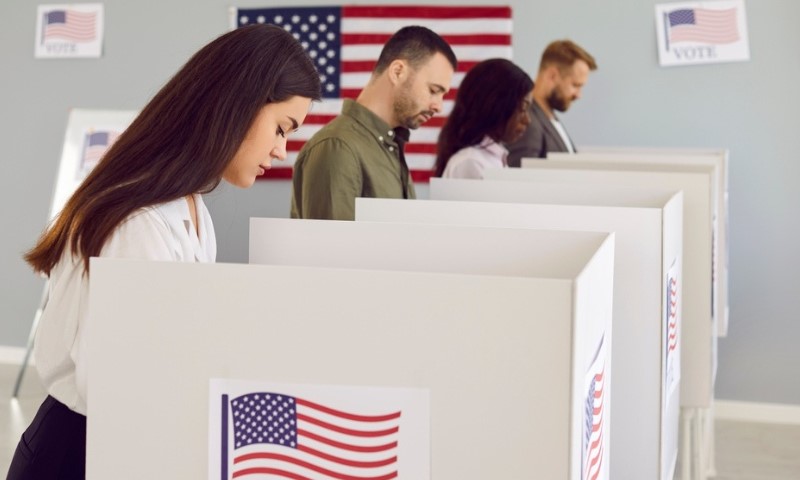

Ask how many American voters have a party affiliation, and you can get very different answers depending on whether you mean formal voter registration, personal political identity, or primary-election status.
In some states, millions of voters pick a party when they register. In others, voters never choose one at all on the registration form. National surveys add another layer, because many people call themselves independents but still lean toward one party in practice.
That gap between registration rules and political behavior explains why party affiliation can look simple on a map and messy in real life.
A voter can be registered with no party, vote regularly in one party’s primary, tell a pollster they are independent, and still behave almost exactly like a partisan voter in November.
In a Rush? Here’s What Matters Most
- Party affiliation depends on how you count it.
- About 2 in 3 voters openly identify with a party.
- Many independents still lean Democratic or Republican.
- State registration rules vary, so no single national number exists.
Party Affiliation Has More Than One Meaning
In everyday conversation, “party affiliation” usually sounds like a single category. Election law does not treat it that way. One meaning is administrative: what a voter selected, if anything, on a state registration form.
Another meaning is psychological, which party a voter says fits them best. A third is behavioral: which party a voter usually supports, even if they reject the label.
A national count becomes hard for one basic reason: the United States does not run elections through one unified national voter file. Election administration is decentralized, and states set their own rules for registration, party labels, and primary participation.
The U.S. Election Assistance Commission notes that election administration is highly decentralized, while the National Conference of State Legislatures shows that primary rules and party-affiliation deadlines vary widely across states.
So when someone asks, “How many voters have a party affiliation?”, the first step is defining the question.
Are you asking how many registered voters are formally enrolled in a party? Are you asking how many identify with a party when surveyed? Or are you asking how many are practically aligned with one side once leaners are counted?
Each measure tells you something real, but none of them is interchangeable.
Most Registered Voters Are Not Pure Independents
View this post on Instagram
Pew Research offers one of the clearest national snapshots. In its 2024 analysis of registered voters, 49% were Democrats or leaned Democratic, while 48% were Republicans or leaned Republican.
Only a small remainder had no partisan lean. In other words, once leaners are included, almost the entire electorate falls into one of the two major coalitions.
Pew also breaks out the narrower self-identification numbers. About two-thirds of registered voters identify directly as partisans, split almost evenly between Democrats at 33% and Republicans at 32%.
Roughly 35% say they are independents or something else, but most in that group still lean toward one of the two major parties. Pew reports 15% leaning Republican and 16% leaning Democratic.
Gallup reaches a similar conclusion from a different angle. Its 2025 yearly average found a record 45% of U.S. adults identifying as independents.
Yet once party leanings were included, 47% identified as Democrats or leaned Democratic, compared with 42% who identified as Republicans or leaned Republican. Independent remains a powerful label, but it does not mean political neutrality for most people.
A simple takeaway follows from both Pew and Gallup. Pure party membership has weakened as a public identity, especially among people who prefer the independent label.
Electoral alignment has not disappeared. Many “independents” behave like reliable partisan voters in surveys, issue preferences, and election choices.
Formal Party Registration Is A Different Question Entirely
Survey identity tells you how voters see themselves. Registration records tell you how states classify them for administrative purposes. Those records matter most in states where party registration affects which primary ballot a voter can receive.
The Election Assistance Commission states that some states require voters to register with a party affiliation to vote in primary elections, while general elections do not work that way.
NCSL’s summary of party-affiliation deadlines shows how varied that system is. In closed, partially closed, and some open-to-unaffiliated systems, joining or changing party affiliation before the primary can be necessary.
Deadlines range from very short windows to more than 100 days before the primary, depending on the state.
A national registration total for party-affiliated voters therefore does not exist in one clean federal spreadsheet. Some states track party enrollment in detail. Some emphasize unaffiliated status. Others structure primaries in ways that reduce the importance of formal party enrollment.
A person who has no listed party in one state may face no real barrier in a primary, while a similar voter elsewhere may be locked out of a party ballot unless the record is changed in advance.
How Big Is The Registered Electorate Overall?
Before counting party affiliation, it helps to know the size of the voter-registration universe. The U.S. Election Assistance Commission’s 2024 Election Administration and Voting Survey reported 204 million active registered voters nationwide.
That figure gives a sense of scale, but it does not mean 204 million voters have a recorded party affiliation. State registration systems do not all capture party in the same way.
That distinction trips up a lot of public discussion. A national active-registration number exists. A national party-registration number, in the way many people imagine it, does not.
You can aggregate some state-level party files, but the result still would not measure the whole country on equal terms because state rules are different from the start.
State Records Show Why National Answers Get Tricky
Florida offers a clean example because state records are reported by party affiliation. As of January 31, 2026, Florida listed 13,363,555 active registered voters.
Among them, 5,523,700 were registered Republicans, 4,044,077 were registered Democrats, 464,457 were in minor parties, and 3,331,321 had no party affiliation. In Florida, most active voters are formally attached to a party, but a very large bloc remains outside party registration.
California looks different. Its February 10, 2025 report showed 22,900,896 registered voters statewide. Democrats accounted for 10,367,321, Republicans for 5,776,356, American Independent for 896,260, Green for 110,649, Libertarian for 233,052, Peace and Freedom for 141,785, other parties for 156,944, and No Party Preference for 5,116,983. So even in a state with formal party registration, more than 5.1 million registered voters chose no party preference.
Pennsylvania also tracks party in its statewide election statistics, including Democratic, Republican, No Affiliation, and Other categories.
Pennsylvania’s public data structure is useful because it reminds you that “no affiliation” is not the same thing as political indifference. It is an administrative category inside a state file, not a full description of how a voter thinks or votes.
Put those examples side by side, and a pattern appears. State records can tell you a lot about party registration inside a state. They cannot, on their own, settle the broader national question about partisan alignment. Survey data and administrative data answer related but different questions.
A Quick Comparison Of The Main Ways To Count Party Affiliation
| Measure | What It Counts | What It Misses | Best Use |
| State party registration | Formal party choice on voter file | States without equivalent reporting, partisan lean among unaffiliated voters | Primary rules, registration trends, state election strategy |
| Survey party identification | What voters say they are | Administrative registration status | Public opinion, coalition identity |
| Survey party identification plus leaners | Which side voters are effectively closer to | Formal enrollment rules for primaries | National partisan balance, election analysis |
Table based on distinctions used by Pew, Gallup, EAC, and NCSL.
Why So Many Voters Call Themselves Independent

Part of the answer is cultural. “Independent” sounds flexible, less tribal, and less bound to party leadership. For many voters, that label feels more comfortable than joining a party in a period of low trust and high polarization. Gallup’s record 45% independent figure fits that pattern.
Part of the answer is strategic. In some states, staying unaffiliated can leave more options open, depending on primary rules.
NCSL notes that primary systems range from closed to partially closed to open and open-to-unaffiliated formats.
In some places, formal party enrollment matters a great deal. In others, it matters less. Voters respond to rules as well as identity.
Part of the answer is emotional distance from party brands. Pew’s 2025 fact sheet and related party-affiliation work show that many people still align with one side while keeping some distance from the party label itself. Leaners are the clearest sign of that. They often vote like partisans even while resisting the name.
Party Affiliation And Primary Elections
Formal party affiliation matters most during the nomination stage. In partisan contests, primaries determine which candidates will represent a party in the general election.
The Election Assistance Commission notes that partisan primaries serve that gatekeeping role, while NCSL shows that deadlines to affiliate or switch parties can come weeks or even months before the primary date.
For voters, practical consequences can be significant:
- In some states, joining a party is required to vote in that party’s primary.
- In some states, unaffiliated voters can choose among party ballots.
- In some states, rules vary by party as well as by law.
- In general elections, party registration does not limit which candidate a voter can support.
That last point is worth stating clearly. A voter registered as a Democrat, Republican, minor-party member, or no-party voter can still vote for any eligible candidate in the general election.
Party registration shapes ballot access in many primaries. It does not legally bind a person’s November vote.
So, How Many Voters Have A Party Affiliation?
View this post on Instagram
A careful answer has to split the question into parts.
If You Mean Formal Registration
There is no single national count that works cleanly across all states. Some states publish detailed party-registration files.
Florida and California do, and both show very large numbers of voters with formal party labels alongside millions with no party affiliation or no party preference. Pennsylvania also reports registration by party categories.
Yet national aggregation remains uneven because election administration is decentralized and party registration rules differ by state.
If You Mean Self-Identification In Surveys
Among registered voters, Pew found that about 65% identify directly as either Democrats or Republicans, while 35% say they are independents or something else. Under that narrow definition, about two-thirds of voters have a clear party identity and about one-third do not.
If You Mean Effective Partisan Alignment
Once leaners are counted, the number rises sharply. Pew found 49% of registered voters are Democratic or lean Democratic, and 48% are Republican or lean Republican.
Gallup found a similar pattern among U.S. adults overall. Under that broader and politically useful definition, nearly all voters sit somewhere inside one of the two major partisan coalitions.
Why Journalists, Campaigns, And Readers Should Care
Campaign professionals care because registration data tells them who can receive which ballot and where party-building work is strongest. Pollsters care because labels like Democrat, Republican, and independent shape sampling, weighting, and trend analysis.
Reporters should care because loose phrasing can mislead readers fast. Saying “most voters are independents” can be true in one narrow survey sense and deeply misleading in an electoral sense.
Readers should care because party affiliation is often treated like a blunt instrument in public debate. Real voter behavior is more layered. A person can reject party branding and still vote consistently for one side.
Another can register with a party for primary access while feeling little loyalty to it. Registration files, survey answers, and election returns each capture a different slice of the same political life.
FAQs
Methodology
- We started by separating three different meanings of party affiliation: formal registration, self-identification, and partisan leaning.
- We relied on primary and high-authority sources, including state election offices, the U.S. Election Assistance Commission, Pew Research, Gallup, and the National Conference of State Legislatures.
- We cross-checked survey findings against official state voter-registration records so the article would reflect both public opinion and election administration reality.
- We used the most recent available figures and clearly distinguished between national data and state-level examples to avoid overstating any one number.
- We paraphrased all source material in our own words and focused on explaining the data in plain language without losing accuracy.
- We built the article around one core reporting principle: define the question carefully first, then match each claim to the right kind of evidence.
Bottom Line
No single national number answers the question in every sense. If you mean direct party identification, about two-thirds of registered voters say they are Democrats or Republicans.
If you include leaners, almost the entire registered electorate falls into one of the two major coalitions. If you mean formal registration, the answer depends heavily on state law and state reporting systems, with some states showing huge party enrollments and millions of no-party voters at the same time.
That is why the best answer is not one number. It is a method: define the kind of affiliation you mean, then use the matching data.