Skip to content
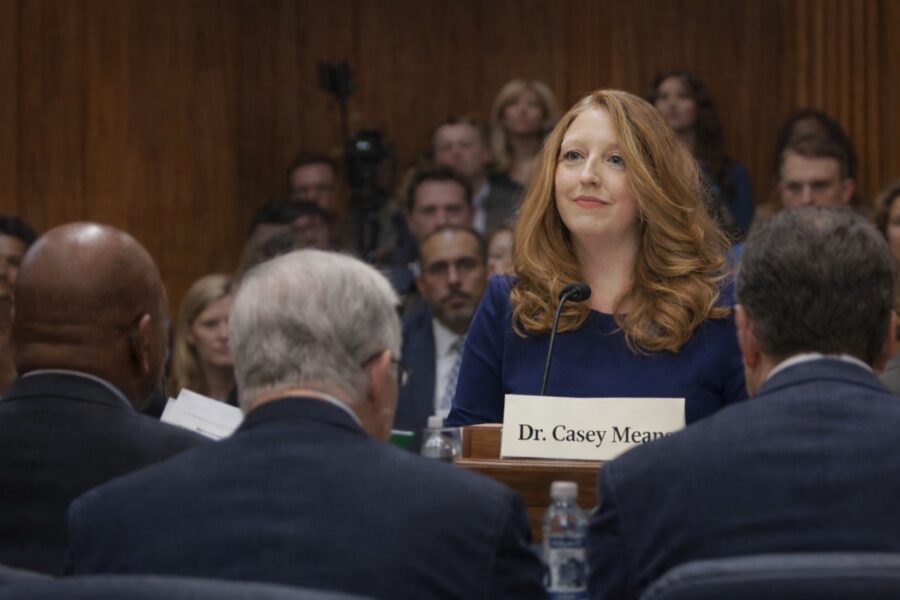

Casey Means, President Donald Trump’s nominee for U.S. surgeon general, faced a contentious Senate confirmation hearing that quickly widened beyond her nomination and into a broader fight over vaccines, public trust, and the direction of federal health messaging.
The Senate HELP Committee hearing was held on February 25, with Means listed as the witness on the committee’s nomination page.
Means entered the hearing with a prevention-first message focused on chronic disease, a theme aligned with Health Secretary Robert F. Kennedy Jr. and the administration’s “Make America Healthy Again” agenda.
AP reported that she framed the U.S. health system as “reactive sick care” and argued for attention to root causes, a message that has found some bipartisan resonance even as her nomination remains deeply polarizing.
Table of Contents
ToggleMeans’ Central Pitch: Chronic Disease, Prevention, and “Root Causes”
At the center of Means’ testimony was a critique of the current health system and a call for a stronger prevention model.
AP described her hearing message as focused on the “root causes of chronic disease,” including the larger environmental and behavioral conditions that shape health outcomes.
That framework also matches the public profile she has built as a wellness entrepreneur, and it is one reason supporters see her as a disruptive pick for a highly visible federal role.
But in the hearing room, senators repeatedly pulled the conversation away from broad health philosophy and toward a narrower question: how would she communicate urgent, evidence-based guidance during active public health threats.
Vaccines Became the Hearing’s Defining Fault Line
The most consequential exchanges involved vaccines.
Reuters reported that Means told senators she supports vaccination, including for measles, while also stressing that parents should speak with pediatricians about medications, including vaccines.
Her statement, as quoted by Reuters, paired support for vaccination with a shared decision-making approach centered on parent-physician conversations.
That answer did not resolve concerns for several senators. AP reported that HELP Chair Bill Cassidy pressed Means on whether she would advise Americans to vaccinate against flu and measles amid outbreaks, and she did not make the direct commitment he sought, instead returning to informed consent and doctor-patient decision-making.
AP also reported that Cassidy asked Means whether she accepts evidence showing vaccines do not cause autism.
She replied that she accepts that evidence, while adding that “science is never settled,” a formulation that drew added scrutiny because of the political and public health context surrounding the nomination.
The Measles Backdrop Raised the Stakes
The vaccine exchanges landed with unusual force because of the national measles situation.
CDC data posted on February 20, 2026 states that, as of February 19, there were 982 confirmed measles cases reported in the United States in 2026, including outbreak-associated cases across multiple jurisdictions.
The CDC page also notes that the figures are preliminary and reflect confirmed cases reported to the CDC as of noon on Thursdays.
Reuters explicitly tied Means’ remarks to that outbreak context, reporting that she voiced support for measles vaccination while lawmakers questioned how clearly she would communicate vaccine guidance if confirmed as the nation’s top public health messenger.
Senators Also Pressed Her on Birth Control and Psychedelics
If you think BIRTH CONTROL pills are “a disrespect of life,” and can’t just say birth control is safe and effective for the overwhelming majority of women with your whole chest, you should NOT be America’s top doctor.
I’m voting NO on Casey Means for Surgeon General. pic.twitter.com/oQmZp1rbo0
— Senator Patty Murray (@PattyMurray) February 25, 2026
The hearing did not stay limited to vaccines. AP reported that Sen. Patty Murray questioned Means about past comments suggesting birth control pills were prescribed “like candy.”
Means responded that oral contraceptives should be available to all women, while raising concerns about side effects in some populations and arguing that doctors often lack time for thorough informed consent discussions.
AP also included medical context in the same section, citing the American College of Obstetricians & Gynecologists that hormonal birth control methods are safe for most people, with a small increased risk of serious cardiovascular events in certain higher-risk groups.
Another exchange centered on psychedelic mushrooms. AP reported that Sen. Susan Collins referenced Means’ past comments and writing on psychedelics.
Means replied that what she would say as a private citizen can differ from what she would say as a public health official, adding that she would not recommend psychedelics for the public.
Qualifications and Experience Drew Sustained Criticism
A separate line of questioning focused on whether Means has the background traditionally associated with a surgeon general.
AP reported that senators raised concerns about her qualifications, her lack of government experience, and the fact that her physician license is not currently active.
It also quoted Sen. Bernie Sanders, the ranking member, saying he had “very serious questions” about her ability to be the kind of surgeon general the country needs.
Reuters, in pre-hearing coverage, reported that Means graduated from Stanford medical school but did not complete her surgical residency, and that her Oregon medical license is listed as inactive, though not expired.
Reuters also noted that Means has said the inactive status is voluntary because she is not currently seeing patients.
Reuters also emphasized the role’s public expectation, describing the surgeon general as “the nation’s doctor,” responsible for communicating the best scientific information available to help Americans reduce risk of illness and injury. That role definition became an implicit standard throughout the hearing.
Conflict-Of-Interest Questions Followed Her Into the Chamber
Ethics and transparency concerns also surfaced repeatedly.
AP reported that senators questioned Means about potential conflicts and her promotion of products in ways that, at times, did not disclose how she could benefit financially.
The report framed that issue as part of the broader concern over how a wellness entrepreneur would handle the boundaries required in a federal public health office.
That concern matters politically and institutionally. A surgeon general’s influence often depends less on formal policymaking power and more on public trust. Questions about undisclosed financial interests, even if not determinative on their own, can become central if the office is expected to issue high-visibility guidance during fast-moving health crises. This is an inference based on the role Reuters described and the lines of questioning documented by AP.
A Hearing About One Nominee, and a Bigger Fight Over Federal Health Messaging
What emerged most clearly from the hearing was a clash between two models of health leadership.
Means presented herself as a reform-minded physician-entrepreneur focused on chronic disease prevention and systemic incentives.
Senators, especially in vaccine questioning, appeared more focused on whether she would deliver direct, conventional, and rapid public health guidance in moments when ambiguity can carry real consequences.
AP’s reporting captures that tension well: some lawmakers agree chronic disease deserves more serious attention, but they remain wary of a nominee whose public record and hearing answers leave open questions about how she would communicate on vaccines and other scientifically contentious topics.
What Happens Next
The nomination now moves to the committee’s next decision point. AP reported that the Senate HELP Committee will consider whether to advance Means’ nomination, which would then proceed to a vote in the full Senate.
For now, the hearing clarified the central stakes. Means’ supporters see a chance to reorient federal health messaging toward prevention and chronic disease. Her critics see a nominee who has not yet convinced them she would meet the surgeon general’s core obligation, clear, trusted communication on urgent public health risks.
Related Posts:
- Safest Countries in the World in 2025 - GPI…
- 25 Most Dangerous Cities in US - Updated Statistics for 2026
- How Many People Die Every Day in US in 2025
- Capital Cities in Europe: Top Destinations For You…
- America's Murder Capitals: A 2026 Ranking of the…
- Legislative Tracker: Pro-LGBTQ Nondiscrimination Legislation