
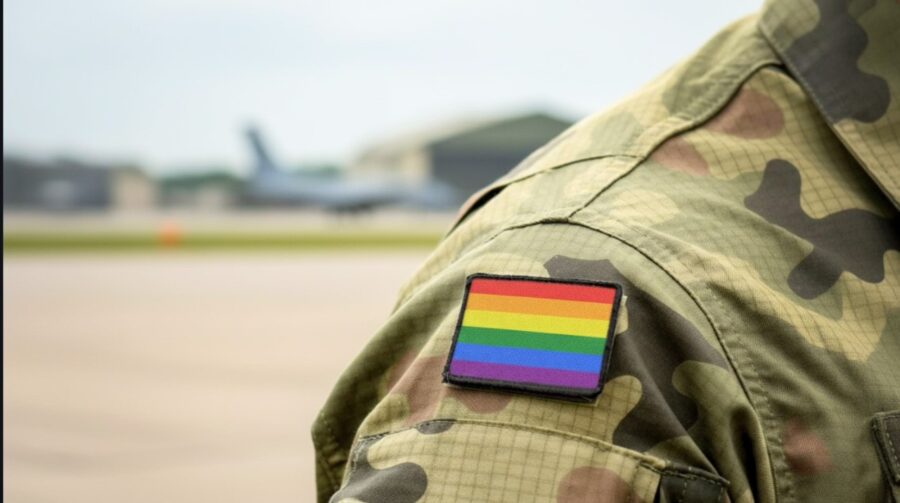

Democrats in Congress have reintroduced legislation that would create a federally appointed commission to investigate decades of anti-LGBTQ policies in the U.S. uniformed services and recommend remedies, including an official apology and steps to make affected veterans whole.
The bill, filed in the House as H.R. 7238 on January 23, 2026, is sponsored by Rep. Mark Takano (D-Calif.) and has been referred to the House Armed Services Committee and the House Veterans’ Affairs Committee.
Table of Contents
ToggleWhat the Bill Would Do
Takano and fellow sponsors describe the legislation as a response to both historical injustice and current policy fights over LGBTQ military service.
Coverage of the reintroduction ties the timing to the one-year mark of President Donald Trump’s 2025 executive order reviving restrictions on transgender military service.
A one-page summary published by Takano’s office says the proposal would establish the “Commission on Equity and Reconciliation in the Uniformed Services,” a congressionally appointed body tasked with investigating “persistent systemic inequalities” faced by LGBTQ servicemembers and veterans, then delivering recommendations to Congress and relevant agencies.
Among the commission’s assigned work, the summary lists:
- Compiling historical and current documentation on policing of sexual orientation and gender identity
- Collecting written and oral testimony from LGBTQ servicemembers and veterans
- Examining personal, professional, and health impacts tied to discriminatory policies and discharges
- Studying disparate impacts on racial minorities and women
- Recommending how harmed veterans could be made whole, and how public recognition of LGBTQ service could be increased
The same summary explicitly calls out an apology track, alongside recommendations on discharge upgrades, record corrections, compensation for lost time and benefits, expanded health services, and training and policy reforms.
Who Would Sit On the Commission
While text for the 2026 House bill was not yet posted on Congress.gov at the time of the reintroduction, earlier legislative language for the same proposal lays out a 15-member structure and a cross-branch appointment scheme.
Under the 2023 Senate text, appointments would come from House and Senate armed services and veterans’ affairs leadership, plus senior officials at the Departments of Defense and Veterans Affairs and other uniformed-service departments.
That architecture signals a commission designed to pull testimony and records across military departments and the veterans benefits system, then produce recommendations with direct operational implications for the Pentagon and VA.
The Numbers Driving the Push
Supporters are leaning on large-scale estimates of how many people were harmed by exclusionary rules over time.
Sponsors cited figures that “approximately 114,000” servicemembers were discharged based on sexual orientation between World War II and 2011, and that an estimated 870,000 LGBTQ servicemembers were impacted by hostility, harassment, assault, or targeting linked to military policy. Those figures appear in reporting that quotes a press release tied to the bill’s rollout.
Independent of those long-range estimates, the Department of Defense has also published its own accounting tied to the “Don’t Ask, Don’t Tell” era.
A Defense Department news release states that more than 13,000 service members were separated under DADT, and that nearly 2,000 received less than fully honorable characterizations.
An Active Policy Battle Over Transgender Service
The bill’s reintroduction lands amid ongoing legal and political conflict over transgender military service.
On May 6, 2025, the U.S. Supreme Court granted the government’s request to stay a federal injunction in United States v. Shilling, allowing Trump administration restrictions to take effect while litigation continues.
The Associated Press reported that the enforcement fight is part of a broader shift early in Trump’s second term, with the Defense Department moving to identify and remove transgender personnel under the revived policy, even as multiple federal judges had issued rulings blocking the ban before the Supreme Court intervention.
Supporters of the commission legislation argue that present-day exclusions strengthen the case for a truth-and-reconciliation style process that captures institutional history and produces remedies that reach beyond any single court ruling.
Coverage from LGBTQ-focused outlets frames the commission as a formal record-building effort modeled on prior federal investigations into historic discrimination, including Japanese American internment redress.
How Recent DADT Discharge Upgrades Fit Into the Picture
The Pentagon has already taken limited corrective steps connected to past anti-LGBTQ policy, which sponsors cite as proof that record repair is possible but incomplete.
In October 2024, the Defense Department announced it had finished a proactive review of cases tied to sexual-orientation separations during the DADT era.
The Associated Press, reporting on the same period, said the Pentagon upgraded more than 800 service records to honorable discharges and said about 96% of the roughly 13,500 personnel affected by DADT now have honorable discharges, improving access to benefits and reducing the downstream harm of less-than-honorable paperwork.
Backers of the commission want a broader mandate: a public accounting that spans earlier eras, extends past discharge labels into benefits access and health impacts, and builds an actionable roadmap for agencies and Congress.
What Happens Next
H.R. 7238 is at the starting line, with committee referrals and no enacted authority to convene a commission yet.
If the bill advanced in a future legislative vehicle, the commission’s work would likely unfold in a familiar pattern: formal appointments, public hearings in multiple cities, structured testimony intake (including anonymous submissions), and a final report with policy recommendations aimed at the Pentagon, the VA, and other uniformed-service agencies.
Related Posts:
- The 100 Most Dangerous Cities in America (2026):…
- Safest Cities in California in 2026: An Honest,…
- Legislative Tracker: Pro-LGBTQ Nondiscrimination Legislation
- America’s Murder Capitals - Updated 2026 Rankings of…
- Most Expensive States to Live in the US in 2026…
- Social Issues in America: 45 Real Examples, 2026…