Skip to content
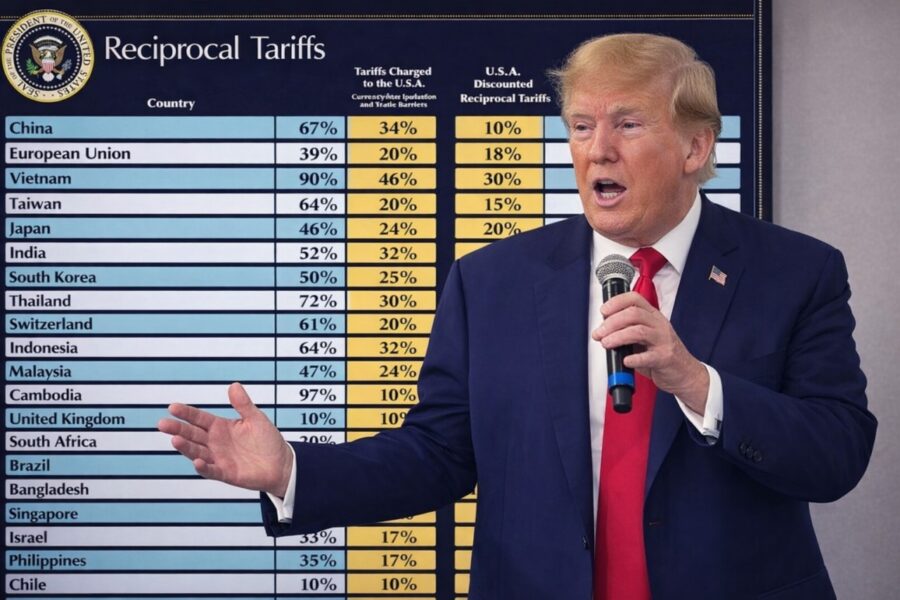

A new 10% tariff on most imports into the United States took effect early Monday, 24 February 2026, after the Supreme Court struck down President Donald Trump’s earlier, sweeping tariff regime imposed under emergency powers.
The new levy is being imposed under Section 122 of the Trade Act of 1974, a rarely used authority that allows a temporary import surcharge for up to 150 days, unless Congress extends it.
In the proclamation published by the White House, Trump says the 10% duty is intended to address what he calls a “large and serious balance-of-payments deficit,” and it applies broadly to “all articles imported into the United States,” subject to listed exceptions.
A Rapid Pivot After the Court’s Ruling
View this post on Instagram
The tariff move follows a Supreme Court decision released Friday, 20 February, in which the court held that the International Emergency Economic Powers Act (IEEPA) does not authorize the president to impose tariffs.
The case, Learning Resources, Inc. v. Trump, dealt with Trump’s prior tariff program, including tariffs he framed as responses to drug trafficking and trade deficits. The court’s syllabus states plainly that “IEEPA does not authorize the President to impose tariffs.”
The ruling undercut a central legal foundation of Trump’s earlier global tariff push, and it triggered immediate questions across markets and foreign capitals about what would remain in force, what would be unwound, and what could replace it.
Within hours, the White House shifted to Section 122, using its built-in time limit as a way to reimpose a broad charge quickly, without new congressional action.
The proclamation sets the effective date as February 24, 2026 and specifies that the surcharge can run through July 24, 2026 unless ended earlier or extended by Congress.
Trump Threatens 15%, but the Signed Order Sets 10%
Trump has publicly floated raising the levy to 15%, which is the statutory ceiling under Section 122.
But the White House proclamation currently in force sets the surcharge at 10%, and it notes the law’s cap at 15%.
The Economic Argument and the Deficit Problem
 You will find more infographics at Statista
Trump’s stated rationale is that tariffs are needed to narrow America’s external imbalances. In the White House document, the administration frames the measure as necessary to counter “fundamental international payments problems.”
Yet the latest trade data moving through global coverage points the other direction. Ireland’s public broadcaster, citing US government figures, reported that the US goods trade gap widened 2.1% to an all-time high of $1.24 trillion.
Economists also draw a sharp line between a persistent trade deficit and the kind of balance-of-payments crisis Section 122 was designed to address.
Reuters reported that multiple economists say the US is not facing a classic balance-of-payments emergency, despite the administration’s framing, and warned that the new tariff could face fresh legal scrutiny.
Businesses Face Another Round of Uncertainty, Lawsuits Are Already Piling Up
The Supreme Court ruling also opened the door to refund fights over tariffs previously collected under IEEPA.
Reuters reported that FedEx has sued the US government seeking refunds tied to the emergency-tariff regime, with more suits expected and potentially large sums at stake if courts order repayments.
For companies that import at scale, the immediate issue is not theory, it is operational whiplash: pricing, contracts, supply planning, and customs compliance, all shifting with each new legal and political move.
Trading Partners Weigh Retaliation as Deals Wobble
Trump has warned countries not to exploit the Supreme Court ruling, saying those that “play games” could face higher tariffs than recently negotiated rates.
Foreign governments, meanwhile, are recalculating. Public reporting indicates the ruling has prompted countries to reassess what trade terms still hold and how they respond if the US revises or ignores recent arrangements, with the risk of retaliation rising if partners conclude the US is escalating rather than stabilizing.