Skip to content
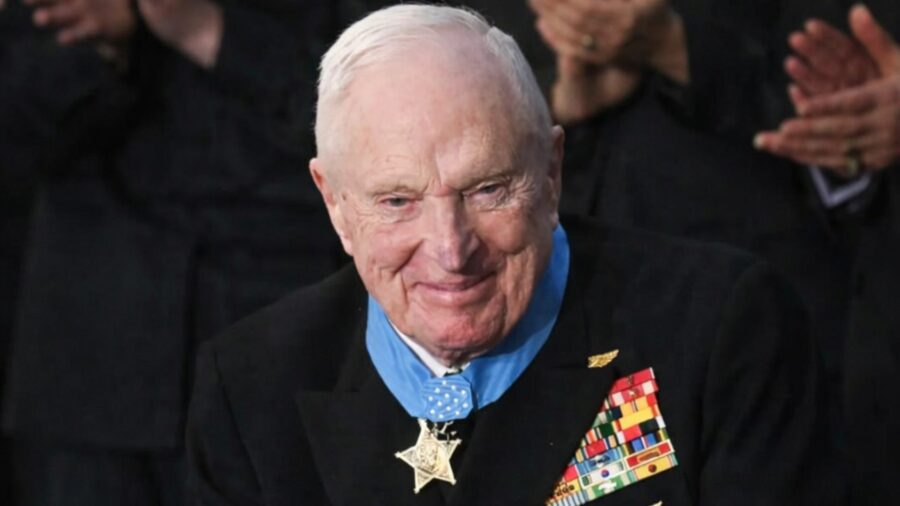

President Donald Trump used one of the most-watched moments in American politics to deliver one of the military’s highest symbols of recognition, awarding the Medal of Honor to retired Navy Capt. E. Royce Williams during the State of the Union address on February 24, 2026.
Williams, 100, received the medal in the House chamber, where First Lady Melania Trump placed it around his neck as lawmakers rose in a bipartisan standing ovation.
The ceremony capped a decades-long effort to fully recognize Williams’ actions in a Korean War air battle that remained classified for years because it involved Soviet pilots, a politically explosive detail at the height of the Cold War.
Table of Contents
ToggleA Secret Korean War Fight Finally Honored in Public
Williams’ citation stems from a November 18, 1952 combat patrol launched from the USS Oriskany, when he flew an F9F-5 Panther and was drawn into a solo fight against seven Soviet MiG-15s near North Korea.
Military Times reports that the battle lasted 35 minutes, that Williams downed four enemy aircraft, survived heavy damage including a 37mm cannon strike, and still made it back to his carrier, where crews later counted 263 holes in his aircraft.
A separate Military Times report from earlier this month described the engagement as the longest dogfight in U.S. military history and noted that no other American fighter pilot is credited by the U.S. Naval Institute with downing four MiG-15s in a single fight.
CBS News, which reported the plan ahead of the address and then covered the ceremony, said Williams fought seven Soviet MiGs in what it described as the longest aerial engagement in U.S. Navy history, shooting down four in a half-hour dogfight in 1952.
A State of the Union First
CBS News reported that the Williams presentation marked the first time a president has awarded the Medal of Honor during a State of the Union address. CBS also confirmed the chamber scene, including Trump’s remarks and Melania Trump placing the medal on Williams.
Military Times independently confirmed the same sequence, reporting that Trump highlighted Williams’ age and long-delayed recognition, and that the first lady bestowed the medal.
AP coverage, carried by local affiliates, added more detail from inside the chamber, including a military aide bringing the medal down from the House gallery before Melania Trump placed it around Williams’ neck.
Why the Recognition Took Decades
The delay was not due to a lack of valor, but to secrecy.
Military Times reports that Williams’ mission was classified as top secret to avoid revealing U.S. interception capabilities and to limit the diplomatic consequences of publicly acknowledging direct combat with Soviet pilots during the Korean War.
The same report says Williams remained silent for more than half a century, and only told his wife after the government later informed him the mission had been declassified.
CBS similarly reported that Soviet involvement was top secret and that Williams was instructed to keep the clash secret, describing it as a politically fraught encounter between Cold War adversaries trying to avoid open war.
That classification history matters because Medal of Honor recommendations typically face timing requirements. Congress addressed that barrier in Williams’ case.
Congress and the Long Upgrade Path
Williams was originally awarded the Silver Star in 1953. In 2023, the Navy upgraded that award to the Navy Cross, a major step that signaled official reassessment of his combat record. Military Times and the U.S. Navy both document that progression.
The Navy’s official release states that Secretary of the Navy Carlos Del Toro awarded Williams the Navy Cross on January 20, 2023 in San Diego, and explicitly notes it was an upgrade of the Silver Star previously awarded in 1953 for combat against seven Soviet MiG-15 aircraft.
Congress then moved to clear the way for a Medal of Honor award. The bill text for H.R. 1819, published by GovInfo, shows its purpose plainly: to authorize the president to award the Medal of Honor to E. Royce Williams for acts of valor during the Korean War.
The bill also includes a waiver of time limitations and identifies Williams’ November 18, 1952 actions as the qualifying conduct.
Rep. Darrell Issa, whose district includes Williams, was a central public advocate. On February 4, 2026, Issa announced that Trump had personally informed Williams he would receive the Medal of Honor. Issa’s press release also repeated the claim that Williams’ actions over more than 35 minutes saved fellow pilots and crew.
Military Times also credited Issa and referenced broader efforts to remove time barriers for extraordinary, often classified acts of valor that remained unrecognized for years.
The Politics of the Moment, and the Human Weight of It
The State of the Union setting gave the award a larger stage than a standard White House military ceremony. It also created an unusual split screen, a highly partisan speech interrupted by a moment that drew applause from both sides of the aisle. Military Times explicitly framed the presentation as a moment of unity.
CBS added another layer of timing, noting the award came on the anniversary week of Russia’s full-scale invasion of Ukraine, while Williams was being honored for a Korean War battle involving Soviet pilots.
That contrast gave the ceremony added geopolitical resonance, even as the emotional center of the story remained a centenarian veteran finally receiving the nation’s highest combat honor.
At the center of it all was Williams himself, a retired Navy captain whose wartime action had circulated for years in military history circles, but who had not received the Medal of Honor while still living through most of the postwar era.
On Tuesday night, the secret became national theater, and the long argument over recognition ended in public view.
Related Posts:
- Armed Forces Organizations, 500+ Veterans Announce…
- Virginia GOP Senate Candidate Questions Military…
- What Is the Most Dangerous Country in the World in 2025
- Machado Gave Trump Her Nobel Medal in a Bold Bid for…
- Pressure Peaks Before the State of the Union as…
- Safest Countries in the World in 2025 - GPI…