Skip to content
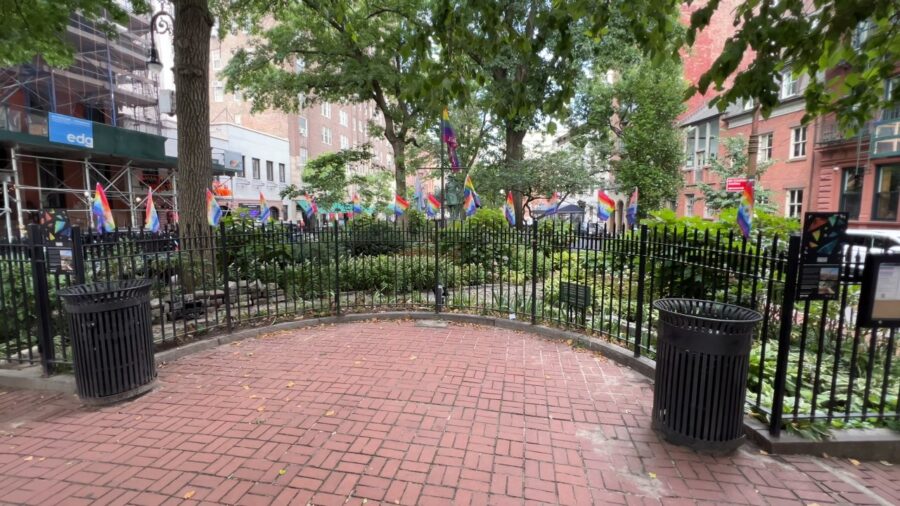

By Tuesday morning in New York City, the flagpole at Christopher Park was bare.
For years, visitors walking past the Stonewall Inn area have treated the rainbow flag as part marker and part message, a visible shorthand for what the site represents: a place where LGBTQ+ people fought police harassment in 1969 and helped ignite a modern civil rights movement.
Now the National Park Service has removed the rainbow Pride flag from the Stonewall monument’s flagpole, citing a new federal policy that tightens what can be flown on government-managed poles.
The move triggered immediate backlash from elected officials and advocates who describe it as deliberate erasure, a decision that strips the nation’s best-known LGBTQ+ historic site of the symbol most associated with LGBTQ+ visibility.
What Happened at Stonewall
Multiple outlets, including Reuters and the Associated Press, reported that the Pride flag was removed from the federal flagpole at Stonewall National Monument in early February 2026.
Local officials and advocates responded fast, framing the removal as political. Among those quoted across coverage: Brad Hoylman-Sigal, Julie Menin, and Chuck Schumer, with some vowing to restore the flag.
The administration’s rationale, as reported, is procedural: the flag was removed to align with government-wide guidance about what flags can fly on federal property and federal flagpoles.
The Policy Document Behind the Removal
View this post on Instagram
The backbone of the government’s explanation is a January 21, 2026, memorandum titled “Guidance on the Display and Flying of Non-Agency Flags and Pennants within the National Park System.”
The memo states that NPS-controlled public flagpoles are not intended to be public forums for free expression and emphasizes a narrow set of flags that can be flown as default, generally the U.S. flag, the Department of the Interior flag, and the POW/MIA flag.
It also describes exceptions for certain circumstances, including flags that provide historical context or relate to specific programs or co-managed sites, language that becomes critical at a place like Stonewall, where supporters argue the Pride flag functions as an interpretation of history, not a mere decoration.
The policy language echoes older federal practice in another corner of government real estate. A 2023 General Services Administration flag policy similarly says flagpoles at GSA-controlled buildings are not intended as public forums and that approved flags express the federal government’s official sentiments.
Why Stonewall Is Structurally Different From Many “National Monument” Sites
Stonewall National Monument is not a typical fenced park with a federal gate and a federal entrance fee.
In the original proclamation creating the monument, President Barack Obama described a small footprint of federally owned or controlled land interests, alongside a boundary that encompasses the site’s historic streetscape.
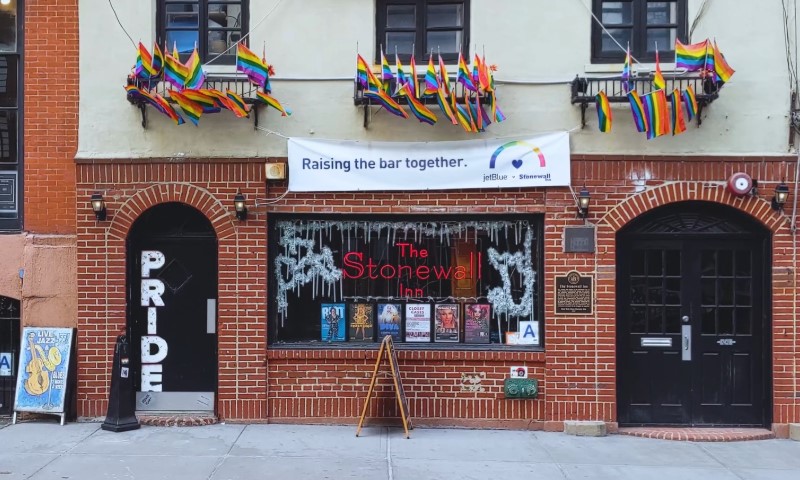
The National Park Service itself has described the site as a patchwork: the Stonewall Inn and adjacent buildings are privately owned, surrounding streets belong to the city, and Christopher Park is administered by NPS.
That matters because the fight is not only about symbolism. It is also about jurisdiction and control: who owns the flagpole, who decides what goes on it, and whether the public sees that pole as government speech, civic space, or something in between.
A Pride Flag Already Had an Official Role at the Monument
One detail undercutting claims that a Pride flag is inherently out of place at Stonewall is that the Park Service itself has treated Pride flags as interpretive material.
On the monument’s “Interpretative Flags” page, the Park Service describes an interpretive flag display in Christopher Park that features the Pride flag and offers historical context for its origins and symbolism.
That does not resolve the flagpole question, but it sharpens the dispute. The government is not arguing that the Pride flag is unrelated to Stonewall history. The government is saying that government-run flagpoles operate under a narrower set of rules, and that non-agency flags on such poles need to meet policy tests and approvals set by the agency.
The Legal Frame Hovering Over the Fight: The Flagpole as Government Speech
Even when a flag is plainly “speech,” the First Amendment question often turns on whose speech it is.
The U.S. Supreme Court’s decision in Shurtleff v. Boston is a recent, widely cited case on flagpoles and public property. The Court held that Boston violated the First Amendment when it refused to let a private group raise a flag, largely because the city’s program had operated as an open forum with little meaningful control over which flags were approved.
Governments learned a practical lesson from that ruling. If an agency wants to preserve a flagpole as government speech, it needs clear written rules, consistent practices, and visible control over approvals.
The 2026 NPS memo and the 2023 GSA policy read like policy documents written with that lesson in mind. Both emphasize that flagpoles are not intended as public forums and that approved flags are expressions of the federal government’s official sentiments or programs.
The Stonewall dispute sits inside that framework. Supporters of the Pride flag argue the symbol is inseparable from the monument’s meaning. The administration argues that a government-managed pole cannot become a general platform for expressive flags without turning into a forum, and that its job is to communicate limited official messages.
Edits to Stonewall’s Official Story
For critics, the flag removal lands in a context formed by earlier fights over federal language and inclusion.
In February 2025, major outlets reported that the Park Service removed references to transgender people from the official Stonewall National Monument website, shifting language away from “LGBTQ+” and toward “LGB” phrasing in key sections.
That episode also drew protests and political condemnation, with opponents describing the edits as historical revisionism that minimizes the role of trans people in Stonewall-era activism, often associated in public memory with figures like Marsha P. Johnson and Sylvia Rivera.
Separately, an Office of Personnel Management memo from early 2025 directed agencies to take down outward-facing media that promotes what it calls “gender ideology,” a phrase that has become a central organizing concept in federal battles over language and public presentation.
The flag removal is not proof of a coordinated censorship campaign by itself. The record that is visible publicly is narrower: an NPS memo restricting non-agency flags, and a concrete action at a symbol-heavy site.
What gives the move its political charge is the sequence, the site, and the accumulated signal of prior edits and disputes.
What Happens Next
The immediate conflict is practical: whether local officials or advocates attempt to raise another Pride flag on the federal pole, and how the Park Service responds.
Another track is administrative: whether NPS clarifies how it interprets its own exceptions for “historical context,” particularly at places created specifically to commemorate LGBTQ+ history.
A third track is legal and political: litigation is possible if challengers can frame the policy as discriminatory in application or inconsistent with past practice, while Congress, city leaders, and federal officials use the moment to rally supporters.
At this stage, most public reporting emphasizes protest and political condemnation rather than a filed lawsuit tied to the flag removal itself.
What remains is a familiar American struggle over public memory. Stonewall is a national monument precisely because the country decided the story belongs in the national record.
The flag fight asks a narrower question with an outsized consequence: whether the most recognizable symbol of that story can be treated as an interpretation of history, or whether it will be treated as prohibited expression on a federal pole.