Skip to content
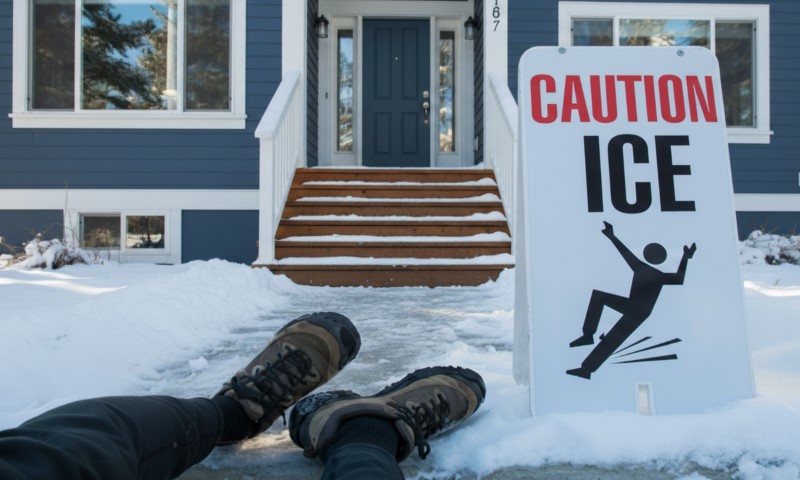

Winter turns ordinary pavement into a legal risk zone fast. A wet entry mat, a shaded curb ramp that never fully dries, a plow pile melting across a walking lane, a parking lot dip that turns slick overnight, all can produce the same result: someone on the ground and a claim heading toward an insurer or a courtroom.
Commercial responsibility in snow and ice cases often circles one core question. Did the business, or whoever controlled the property, act reasonably under the conditions that existed at the time?
That single word carries weight. It pulls in premises liability rules, local snow removal codes, state court doctrines, and the practical reality that storms can create hazards faster than any crew can remove them.
Rules vary by state and city. Today, we will focus on widely used United States principles and doctrines, paired with concrete examples and high authority public sources.
Why Snow And Ice Cases Matter For Businesses
Falls remain one of the most serious injury categories nationwide, and winter conditions raise outdoor risk in measurable ways.
The CDC tracked emergency department visits and found that outdoor falls show seasonal variation. About 1 in 3 outdoor fall-related ED visits in winter were linked to slips or trips on ice, snow, or rain.
The Bureau of Labor Statistics followed ice, sleet, and snow-related occupational injuries that led to days away from work. In 2017, the incidence rate reached 1.8 cases per 10,000 full-time workers, with noticeable variation across the 2008–2017 period.
Falls also remain a leading cause of serious harm. CDC fast stats list 47,026 unintentional fall deaths in 2023 within the United States mortality data.
For commercial property owners facing serious injury claims, consulting firms like Gallagher & Kennedy can clarify liability, documentation, and compensation strategy.
For a commercial property, the exposure goes beyond physical injury:
- claim costs that include medical treatment, wage loss, and legal fees
- operational disruption tied to incident response, staff time, and evidence preservation
- reputational damage when multiple incidents happen in one location
- accessibility complaints when curb ramps, access aisles, or routes stay blocked
Duty To Invitees And Reasonable Care
Most snow and ice slip and fall claims live under premises liability, which sits within negligence law. Businesses owe customers and other lawful visitors a duty tied to reasonable care.
A central category is the invitee, meaning someone present because the public is invited or because the visit benefits the property holder, such as shoppers, delivery drivers, or service vendors.
Cornell Law School’s Legal Information Institute explains that a property owner generally owes an invitee reasonable care to keep premises reasonably safe and to warn about known dangers that are not open and obvious.
Courts often rely on the Restatement (Second) of Torts when framing invitee duties. Sections 343 and 343A appear frequently in judicial opinions and legal education materials:
- Section 343 addresses dangerous conditions known to or discoverable by the possessor of land
- Section 343A covers known or obvious dangers and situations where liability can still exist if harm should have been anticipated
Snow and ice disputes turn on how such broad principles apply to hazards that can appear and change within hours.
What A Snow Or Ice Slip And Fall Claim Usually Must Prove
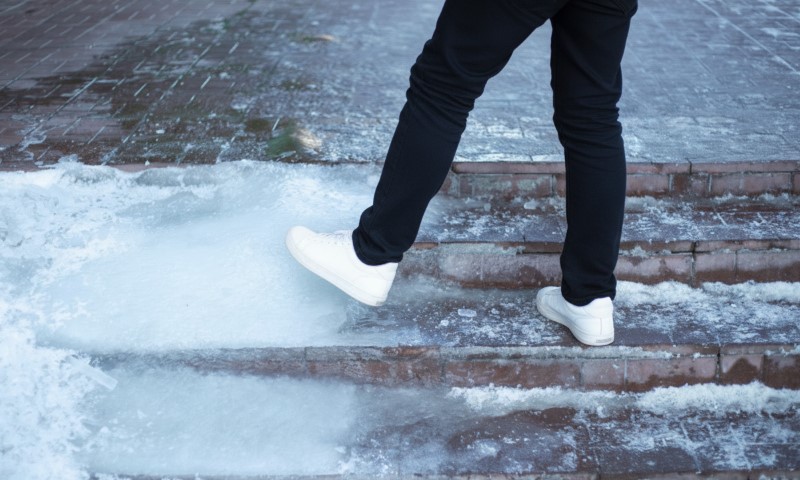
Although details differ by jurisdiction, a claimant usually must show evidence supporting four core negligence elements.
Duty
The party owing the duty depends on who controlled the location. That could involve an owner, tenant, property manager, or maintenance contractor. Courts focus on control rather than job titles.
Breach
Breach usually means a failure to act reasonably. Common allegations include:
- failure to clear or treat walking surfaces within a reasonable time
- failure to inspect when winter conditions made hazards foreseeable
- failure to address refreeze or recurring black ice
- failure to warn when immediate cleanup could not happen
Causation
The hazard must link to the fall. Litigation often debates:
- where the fall happened
- whether ice was present or whether the surface was only wet
- whether footwear, distraction, or running played a role
Damages
Medical records, wage loss, and changes in function often decide claim value.
Notice And Timing
Many defenses lean on notice. The argument centers on whether the business knew or reasonably should have known that a hazard existed.
- Actual notice arises when staff saw the ice or received a report
- Constructive notice exists when the hazard remained long enough that reasonable inspections would have found it
Snow and ice claims litigate timing heavily because storms and refreeze cycles create hazards quickly and repeatedly.
Snow And Ice Doctrines That Reshape Responsibility
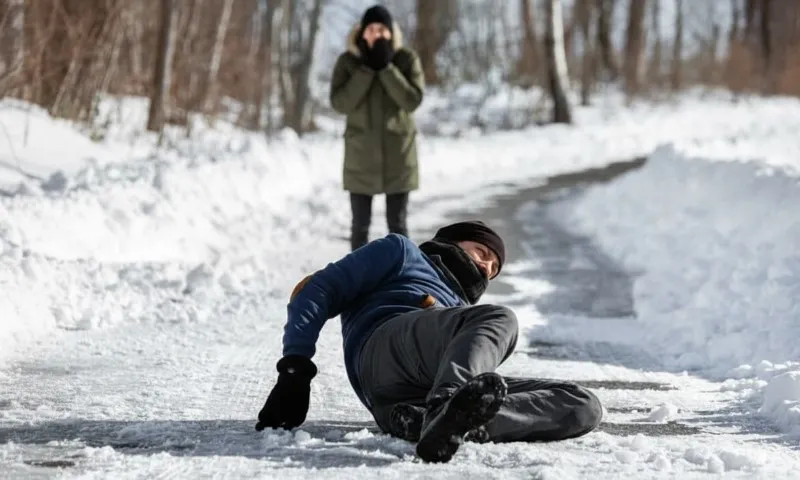
Several doctrines appear frequently in winter injury litigation.
The Storm In Progress Rule
Often called the ongoing storm doctrine, this principle allows a property holder to wait until a storm ends, plus a reasonable time afterward, before completing full remediation.
New York courts describe the doctrine clearly. Appellate decisions cite Court of Appeals authority stating that a property owner will not be held liable for injuries arising from icy conditions during an ongoing storm or for a reasonable time afterward.
Practical effect:
- If precipitation remains active or freezing continues, plaintiffs face a higher bar unless proof shows a pre-existing hazard unrelated to the storm
- Certified meteorological records become central evidence
The doctrine does not create blanket immunity. Refreeze after plowing or hazards unrelated to active precipitation can still create exposure.
Natural Accumulation Versus Reasonable Care
Some states historically limited liability for the natural accumulation of snow and ice. Massachusetts shifted course in Papadopoulos v. Target Corp. in 2010, where the Supreme Judicial Court moved toward a reasonable care framework rather than relying on the older Massachusetts rule.
In reasonable care states, focus turns to foreseeability, timing, and control. In jurisdictions that still stress natural accumulation, plaintiffs often try to show a property-created condition, such as downspout runoff freezing across a walkway.
Open And Obvious Hazards
Ice and snow may be visible, yet still dangerous in ways visitors may not fully appreciate. Restatement Section 343A explains that known or obvious dangers can still create liability when harm should have been anticipated.
Courts often look at:
- whether visitors had a realistic alternate route
- whether the business increased risk through lighting, slope, or surface design
- whether the route remained functionally unavoidable
Who Can Be Responsible In Commercial Settings
View this post on Instagram
Commercial sites often involve layered control. Claims frequently name more than one party.
Property Owner
Owners appear often because they benefit from the property and retain authority over common areas and snow management programs.
Tenant Or Occupant
Tenants may bear responsibility when leases assign exterior maintenance duties or when the tenant controls the specific area where a fall occurred.
Property Manager
Managers can face claims when they control inspections, contractor scheduling, or winter programs.
Snow And Ice Contractors
Contractors may face claims when plowing creates hazards, when salting fails, or when service records remain incomplete.
Even with a contractor, courts often treat certain duties as nondelegable in practice, meaning the owner or occupier may remain liable and later seek contractual indemnity.
Municipal And Public Entities
Public entity liability varies by state and may involve special notice rules and immunities. Many cities shift day to day, clearing duties to adjacent property owners through local ordinances, which affects commercial exposure.
Local Snow Removal Ordinances Shape Reasonableness
City codes can influence what courts view as reasonable care.
New York City
NYC Administrative Code Section 16-123 requires sidewalk snow and ice removal within 4 hours after snowfall ends, excluding overnight hours, with special provisions for long frontage in Queens and Staten Island.
Chicago
Chicago’s municipal code sets defined deadlines. Accumulation between 7:00 a.m. and 7:00 p.m. must be cleared as soon as practicable but no later than 10:00 p.m. Overnight accumulation must be cleared by 10:00 a.m.
Operational takeaway: codes create timing benchmarks. Waiting well beyond them invites allegations of unreasonable conduct.
Accessibility Adds Another Layer
Winter maintenance intersects with accessibility obligations.
The United States Department of Justice guidance tied to ADA compliance states that maintenance includes snow removal from:
- accessible parking spaces
- access aisles
- accessible routes to entrances
- accessible entrances
Blocked curb ramps, buried access aisles, or narrowed routes raise exposure even when a specific claim does not plead ADA violations.
Safety Expectations And OSHA Winter Guidance
OSHA winter weather guidance recommends clearing snow and ice from walking surfaces as quickly as possible after storms, spreading deicers, and training workers regarding winter hazards.
Written programs aligned with such guidance can help demonstrate reasonableness. Lack of planning and documentation often harms defense positions.
What Reasonable Snow And Ice Management Looks Like
Courts and insurers evaluate whether a system fits foreseeable winter risk.
Pre Storm Preparation
- contracts arranged before winter
- designated snow storage locations that avoid pedestrian drainage
- stocked deicers and application equipment
- drainage checks around high traffic areas
Trigger Points
- snowfall thresholds that activate plowing
- temperature triggers for refreeze patrols
- protocols for freeze thaw cycles
Inspections
- entrance checks during business hours
- patrol of known trouble spots
- time stamped logs
Treatment Choices
- salt or other deicers where effective
- abrasives when temperatures reduce salt performance
- interior mats and moisture control to reduce indoor slip risk
Warnings
- cones or signage during active remediation
- temporary closure of nonessential routes
Evidence That Often Decides Cases
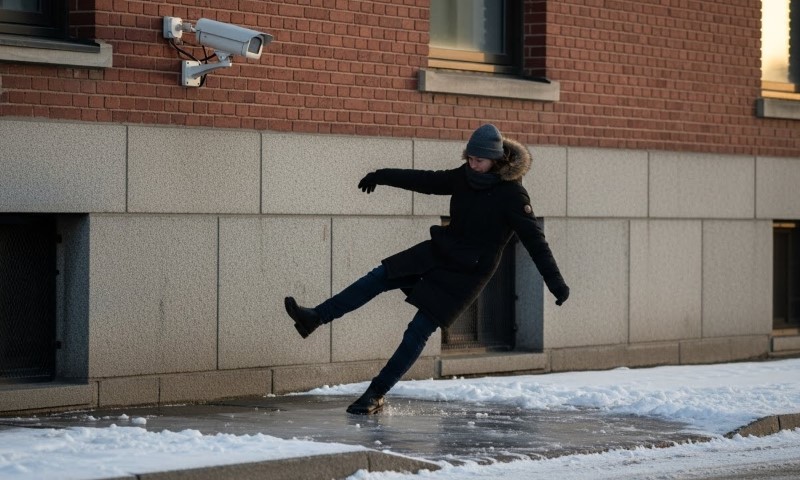
Claims often turn on simple, concrete proof that shows what the surface looked like, who inspected it, and how quickly anyone acted before the fall occurred.
Evidence Favoring Businesses
- surveillance video covering the fall and prior conditions
- snow removal logs and invoices
- GPS or contractor verification records
- timely incident reports
- immediate photographs
- localized weather records
Evidence Favoring Plaintiffs
- proof ice existed long enough for discovery
- prior complaints or similar falls
- proof of recurring drainage or refreeze
- proof that the route was unavoidable
Real Scenarios
Real winter claims rarely grow out of freak accidents, they tend to follow familiar patterns that repeat across parking lots, sidewalks, and entryways every cold season.
Refreeze From Plow Piles
A plow pile melts during the day, water drains across a walkway, and temperatures drop overnight. A visitor falls early the next morning.
Claim theory: negligent snow placement and failure to treat foreseeable refreeze.
Black Ice From Drainage
A downspout discharges across a walkway. Meltwater freezes overnight.
Claim theory: property created recurring hazard.
Sidewalk Clearing In Dense Commercial Corridors
A business clears its entry but leaves the sidewalk frontage untreated despite local code deadlines.
Claim theory: ordinance violation as evidence of negligence.
Practical Liability Snapshot
What Businesses Should Do Immediately After An Incident
- provide medical help and document response
- preserve video promptly
- photograph area from several angles
- document weather and treatment steps
- gather witness contact information
- notify insurers and preserve contractor records
Bottom Line
Commercial responsibility for snow and ice slip and fall claims centers on reasonableness. Courts examine inspections, treatment timing, drainage control, documentation, and how local codes and state doctrines apply to the precise conditions that existed when a fall occurred.
Storm in progress rules may protect businesses during active precipitation windows. Recurring refreeze hazards and failure to follow local clearing deadlines often erase defenses quickly.