Skip to content
Presidential portraiture in the United States began as a visual shorthand for authority.
Early official portraits usually captured presidents at the start of their terms, presenting confidence, control, and intentions in a single frame.
Modern reactions to presidential portraits show a public more interested in personal presence than distant authority, altering how power gets visually communicated.
Surely, the public expectations are completely different. But did that make a change in political portraits, particularly presidential portraits? Of course it did.
Let’s see what happened.
Key Takeaway:
- Early presidential portraits emphasized authority and distance through formality and restraint.
- Limited media access once gave painted portraits a strong influence over public perception.
- Constant modern media exposure reduced tolerance for detached political imagery.
- Obama’s 2018 portrait shifted focus toward biography and personal presence.
- Contemporary portraits balance authority with human familiarity.
Portraits as Image Control, Not Self-Expression
We can all agree that an institutional influence always had a massive impact on presidential imagery.
Smithsonian’s National Portrait Gallery maintains the only public collection that includes every U.S. president, and that continuity has helped define how a president is supposed to look in national memory.
All the choices made during the process of making a portrait were made by curators, artists, and administrations, quietly establishing visual norms that last for generations.
Believe it or not, many people perceive presidents more through their portraits than through actual history. When you think about it, that is perfectly normal. Not everyone has an interest in doing research.
Political meaning has often lived inside these portraits. Certain works sparked debate due to perceived symbolism, exaggerated features, or rumored references to controversy and scandal.
Public reaction proves that portraits never functioned as neutral art objects. Earlier examples reinforced role over personality.
Good examples of that are figures like Washington and Jefferson, who appeared surrounded by papers, desks, and objects of state, signaling duty and governance instead of inner life or emotion.
When you think about it, that makes sense since they are among the founding fathers of the United States. They bore the responsibility for creating this country; it’s only natural they’re presented like that.
Serious Faces and Symbolic Distance
Visual language across the eighteenth and nineteenth centuries focused on two major aspects:
- Formality
- Restraint to communicate power
Elements like stern expressions, upright posture, and carefully controlled settings signaled authority and moral seriousness. Emotional distance was not something done accidentally.
Artists presented presidents as steady figures meant to rise above ordinary life, reinforcing respect for office rather than personal familiarity.
Probably the best example of this approach is Lincoln’s familiar gaze. Weight, reflection, and responsibility define his expression, presenting itself as a symbol of national burden rather than warmth or intimacy.
Common visual conventions shaped how authority appeared during this period, and several elements appeared repeatedly across portraits to seal those expectations:
- Direct or slightly averted gazes suggested contemplation rather than engagement with viewers
- Dark clothing and muted color palettes conveyed seriousness and restraint
- Formal interiors replaced personal spaces, keeping private life out of sight
Portraits closely followed the political climate. Artists shaped presidential appearance during moments of instability to project calm and endurance.
Wartime leadership demanded visual reassurance, and painted images responded accordingly.
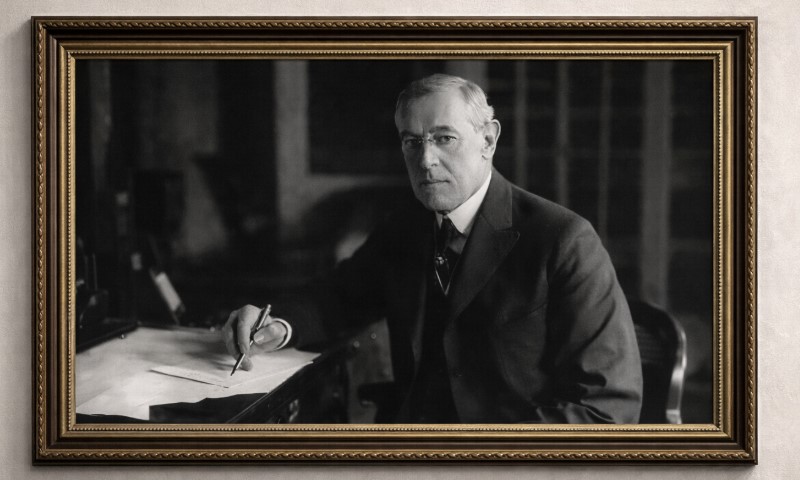
A good example of that is Wilson’s distant gaze during World War I, which showed his endurance and decisiveness. The goal was to steady public confidence instead of inviting emotional closeness.
What is interesting to know is that technological limits only increased the power of these images.
Photographs and broadcast media remained scarce or nonexistent for much of this period, giving painted portraits unusual authority over public perception.
Circulation methods reinforced that influence in specific ways:
- Engravings and prints reproduced painted portraits for wide distribution
- Official commissions served as primary visual records of presidential identity
- Public familiarity relied almost entirely on the artist’s interpretation
Presidential portraiture during these centuries functioned as a tool of symbolic distance.
When Portraits Started Letting Presidents Be People
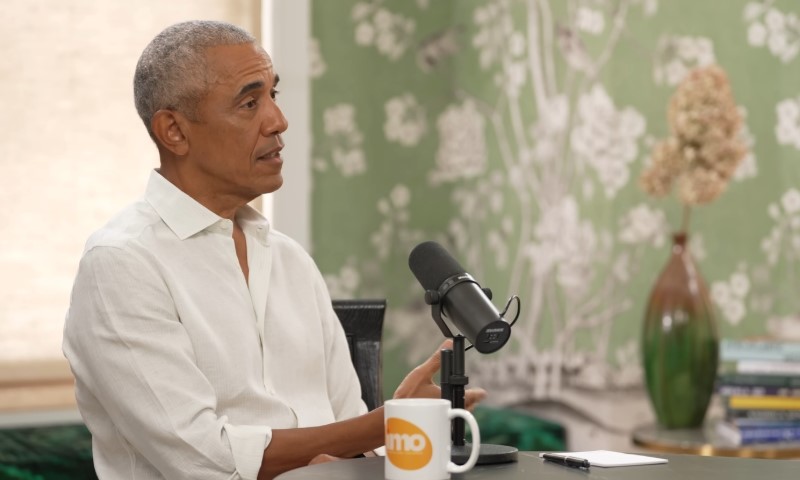
Earlier portrait traditions placed authority above individuality, but cultural attitudes changed as public life grew more visual and intimate.
Constant exposure to political figures through the media made purely formal imagery feel detached.
Portraiture responded by moving closer to lived experience, allowing biography and personality to shape representation.
Change became especially clear once artists were given more interpretive freedom. Presidential portraits no longer functioned only as symbols of office.
Personal history, identity, and narrative entered the frame, reshaping how power could be seen and felt.
Turning Biography Into Visual Language, Not Formality
A defining moment arrived in 2018 with the Obama portraits.
Kehinde Wiley presented Barack Obama seated amid a dense field of plant life connected directly to personal history.
The language of symbols was put instead of traditional interiors, allowing biography to guide composition rather than protocol.
Personal details shaped the reaction just as strongly as symbolism. Obama’s posture appeared relaxed, with an open collar and no tie, signaling approachability and everyday presence instead of rigid authority.
Personal history and mood started shaping the frame, similar to how photographers now rely on hand-painted backdrops to create settings that feel intentional, tactile, and closely tied to the subject rather than stiff or ceremonial.
Familiarity replaced distance, and as a result, public response followed that shift.
Attendance at the National Portrait Gallery nearly doubled around the unveiling, suggesting engagement with portraits that feel animated by story rather than formality. The result was astonishing; in 2017, the museum attracted 2.1 million visitors, which was almost double that of 2013.
Politics in a World Where Faces Are Everything
View this post on Instagram
Visual politics now operate in constant exposure. Images no longer arrive occasionally or ceremonially.
Faces circulate daily across screens, feeds, and broadcasts, shaping impressions long before any formal portrait enters public view.
Presidential imagery exists inside an environment saturated with repetition, familiarity, and instant comparison.
Authority no longer relies on rarity. Recognition builds through accumulation, and leadership presence becomes something people feel they already know.
Official portraiture must respond to that condition or risk feeling detached.
Presidents Outside the Frame
Mass media transformed how political figures are seen and remembered.
Radio created intimacy through voice, television introduced continuous facial presence, and digital platforms multiplied imagery at a pace never seen before.
Painted portraits now share space with countless other visuals that shape perception every day.
Several forms of imagery now compete directly with official portraiture:
- Campaign photography designed to convey confidence and momentum
- Informal moments captured during travel, speeches, or private interactions
- Viral clips and stills repeated across social platforms
Visual distance no longer feels natural. Audiences often feel familiar with presidents long before official portraits appear.
Paintings that ignore that familiarity can seem disconnected. Works that acknowledge public recognition and visual intimacy tend to resonate more strongly, aligning art with lived exposure.
Why Looks Still Matter
Face perception plays a powerful role in political judgment.
Psychological research shows that voters respond quickly to appearance, forming impressions tied to competence, trustworthiness, and familiarity.
Such reactions often occur faster than rational evaluation of policy or record.
Certain visual cues consistently influence perception:
- Facial structure linked to strength or decisiveness
- Eye spacing associated with trust or approachability
- Jaw shape is connected to perceived authority
Public discussion during the 2012 Republican primary reflected these tendencies clearly.
Commentary around Romney and Gingrich frequently tied physical appearance to assumptions about presidential suitability. Experimental studies later only reinforced that effect.
Ballots displaying candidate photographs alongside names can shift voting behavior, particularly among low-information voters who rely on visual shortcuts when political knowledge feels limited.
Why Modern Portraits Feel Human
Nowadays, humanity carries priority over hierarchy.
Painted or photographic images that reflect lived experience align more closely with how people already see leaders across screens.
As a result of that, art and portraiture have adapted to visual reality, recognizing that a single formal pose no longer defines public perception.
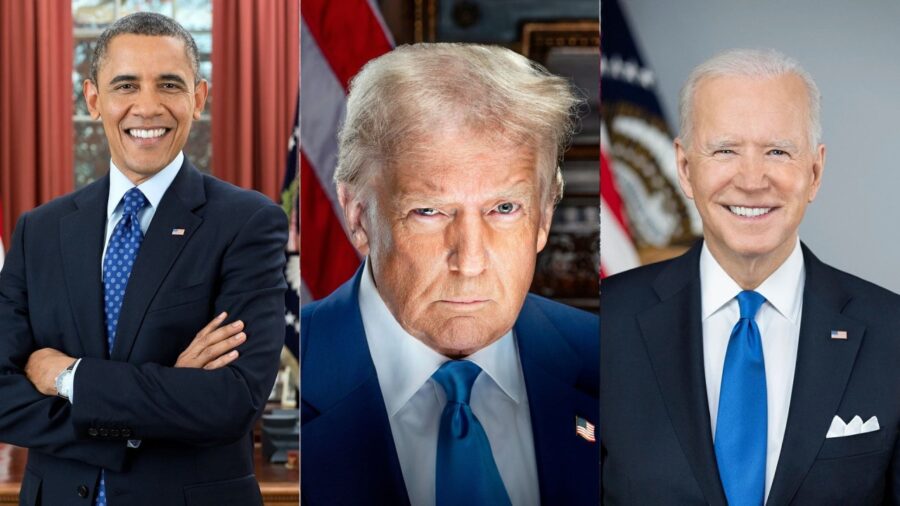
The current president, Donald Trump’s visual image that shows how modern expectations intersect with political communication.
Portraiture and related imagery around Trump employ a range of visual strategies that extend beyond classic formality, engaging continuously with public perception.
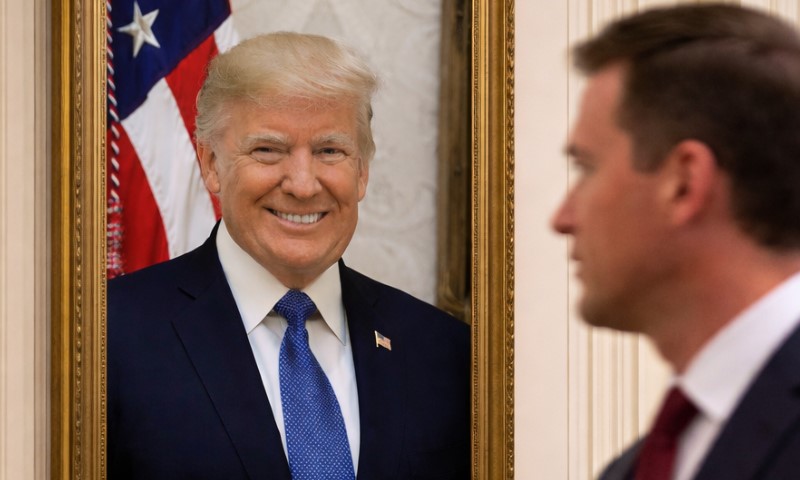
Official portraits of Trump have varied over time, with his 2017 White House image featuring him smiling broadly in front of an American flag while wearing a blue tie.
That formal photograph is part of the official record, yet his public image has been influenced far more widely by many other photos and representations circulating in the media.
Visual responses to Trump’s representation highlight how personal identity and presence influence interpretation.
A newer official portrait released in 2025 has been described as showing little expression, prompting analysis of how pose, lighting, and mood communicate strength or defiance rather than familiarity.
It is interesting to see that the vice-president, J.D. Vance’s official portrait somewhat resembles President Trump’s in his first mandate.
Back to the president, the images connected to Trump extend well past official portraits into AI-generated and social media art that reimagine his persona in dramatic contexts.
His team’s posting of digitally manipulated images that depict him in heroic or fantastical roles engages audiences on platforms where visual storytelling often outweighs formal symbolism.
Reaction even to unofficial painted portraits reflects personal expectations and identity cues. A portrait of Trump displayed in the Colorado State Capitol was removed after Trump publicly criticized it as “distorted,” arguing that it did not project his likeness as he preferred.
It is an interesting moment because it definitely shows the importance of a portrait, even in this day and age, when people ask for something more personal.
What Presidential Portraits Are Showing Us Now
Modern presidential portraits have not abandoned authority.
Personal narrative now exists alongside institutional weight, creating images that feel relevant and emotionally accessible.
Political portraiture always carried meaning and intention. Current works simply acknowledge that power and personality coexist. The best way to describe this approach is killing two birds with one stone, which simply wasn’t the case decades ago.
Audiences simply want to see more than command and status.
Faces on canvas now offer story, identity, and human presence, resembling a society that looks for people inside positions of power rather than symbols alone.