Skip to content
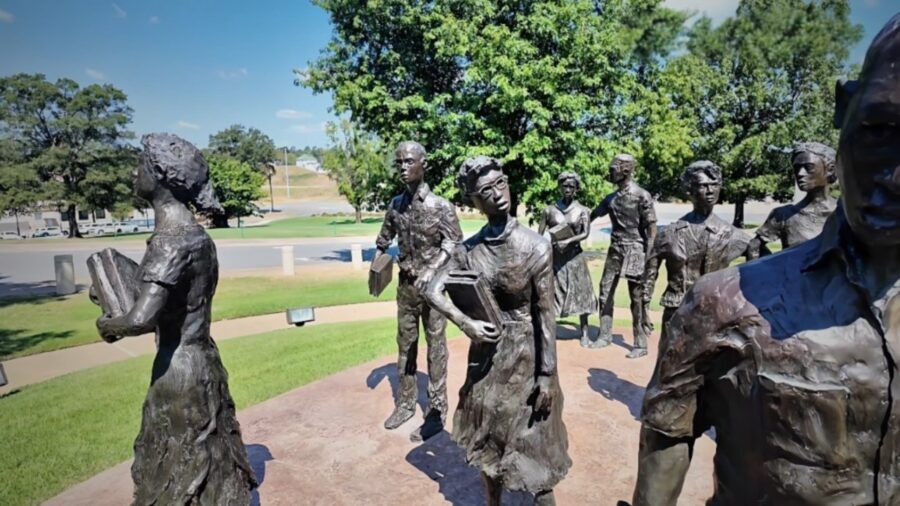

On West Ninth Street, memory has an address, even when much of the street’s original world does not.
In Little Rock, the corridor long known as West Ninth Street functioned for decades as a dense, self-sustaining center of Black commerce and social life, a place where segregation’s limits produced a parallel economy of shops, professional services, clubs, and meeting halls.
Historians and preservation advocates describe it as a “city within a city,” built by necessity and sustained by community.
At the start of Black History Month, that legacy is being highlighted again, not as nostalgia, but as a reminder of what was built, what was taken apart, and what it means to preserve history when the physical landscape has been deliberately altered.
Table of Contents
ToggleA Corridor Built Under Constraint, Then Shaped by Ambition
The origins of West Ninth Street trace to the Civil War era, when formerly enslaved people settled in the area while federal forces occupied the city. Over time, the neighborhood consolidated into a predominantly African American district, and the street evolved into a central artery of Black life and business.
By the early 20th century, West Ninth Street’s economy was substantial enough to leave a measurable paper trail.
An educational history document produced through the Mosaic Templars Cultural Center notes that in 1898, Little Rock had 142 Black-owned establishments, with 24 on West Ninth Street. It also documents later counts along the corridor, including 38 businesses by 1910 and 63 by 1925, reflecting a commercial ecosystem that expanded for decades.
The street’s identity, though, was never only about buying and selling. It was also about gathering.
Dreamland, Taborian Hall, and the Sound of a Thriving District
One of the most enduring landmarks from that era is Taborian Hall, the early 20th-century building that housed Dreamland Ballroom on its third floor. Local histories and cultural organizations describe the space as a major venue for Black entertainment and community functions, a place tied to a broader touring circuit that brought prominent musicians through segregated America.
The pattern is familiar in Black urban history: when mainstream venues were closed or unsafe, parallel stages became cultural engines.
West Ninth Street’s clubs and halls were not side notes to the city’s story; they were the story for thousands of residents who lived with exclusion as a daily policy.
The Turning Point: “Renewal” as Demolition
If West Ninth Street’s rise was driven by segregation, its decline was driven by a different set of decisions: “urban renewal” programs, clearance initiatives, and infrastructure projects that treated Black neighborhoods as expendable.
The Encyclopedia of Arkansas describes West Ninth Street’s mid-century boom, then its targeting for demolition and clearance under national urban renewal policy linked to the federal Housing Act of 1949, which promoted redevelopment of areas labeled “blighted.”
Local mapping work by the Central Arkansas Library System, through its Butler Center project, connects the clearance era to another force that reshaped the city: the construction of Interstate 630, which cut through the city’s core and worsened displacement pressures.
A public discussion posted by the University of Arkansas for Medical Sciences makes the point bluntly: urban renewal and the I-630 project further separated Black people from the community and deepened visible racial and economic divides.
What happened next was not a slow fade. When businesses lose nearby residents, foot traffic, and stable property conditions, the ecosystem collapses.
The Mosaic Templars educational document preserves a stark snapshot from the early 1980s: a local report cited there said only five businesses remained along the corridor.
What Remains, and Why It Matters Now
The most visible institutional anchor for the corridor today is the Mosaic Templars Cultural Center, a museum created under state law to preserve and interpret African American history and entrepreneurship in Arkansas, while honoring Mosaic Templars of America, a fraternal organization founded in Little Rock in 1883.
History comes with its own rupture. The Arkansas Heritage account notes that the original Mosaic Templars headquarters building was destroyed by fire in 2005, and a new facility opened in 2008. The Encyclopedia of Arkansas entry adds that the center earned accreditation from the American Alliance of Museums in 2020 and that new permanent exhibit work was unveiled in 2023.
Preservation here does not mean freezing a neighborhood in time. It means rebuilding context for a place where the physical evidence was intentionally removed. That is also why the Butler Center’s mapping exhibit matters: it uses spatial storytelling to show what stood where, and how the corridor fit into a living city.
A Short Timeline of West Ninth Street’s Arc
- Civil War era: Freed people settle in the area; the neighborhood consolidates.
- Early 1900s to mid-century: West Ninth Street grows as a Black commercial and nightlife corridor, with landmark venues including Dreamland Ballroom.
- Post-1949: Urban renewal policy and local clearance actions begin reshaping the area.
- Highway era: Interstate 630 construction worsens displacement and accelerates decline.
- 2000s to present: Public history infrastructure grows around preservation, mapping, and interpretation, including the Mosaic Templars Cultural Center and continuing work tied to Dreamland and West Ninth Street’s story.
Why West Ninth Street’s Story Lands Differently in 2026
West Ninth Street is not being revived as a simple heritage brand. It is being reintroduced as evidence.
Evidence that Black enterprise in Arkansas was not marginal, it was organized, durable, and visible enough to produce institutions, real estate, and nightlife that drew regional attention.
Evidence that “renewal” often functioned as a one-way transaction: Black neighborhoods paid the cost of modernization while receiving little of its upside.
And evidence that preservation is not only about buildings. It is about governance, power, and who gets to decide what parts of a city are worth keeping.
West Ninth Street’s legacy, highlighted at the beginning of Black History Month, is not merely a look back. It is a case study in how American cities built prosperity inside segregation, then tore it up in the name of progress, and how communities keep insisting that what was erased still counts.
Related Posts:
- Safest Countries in the World in 2025 - GPI…
- 25 Most Dangerous Cities in US - Updated Statistics for 2026
- Capital Cities in Europe: Top Destinations For You…
- America's Murder Capitals: A 2026 Ranking of the…
- What ICE Does and Why It Matters - U.S. Immigration…
- Gemini Checkout In The US: E-commerce Stores Now…