Skip to content
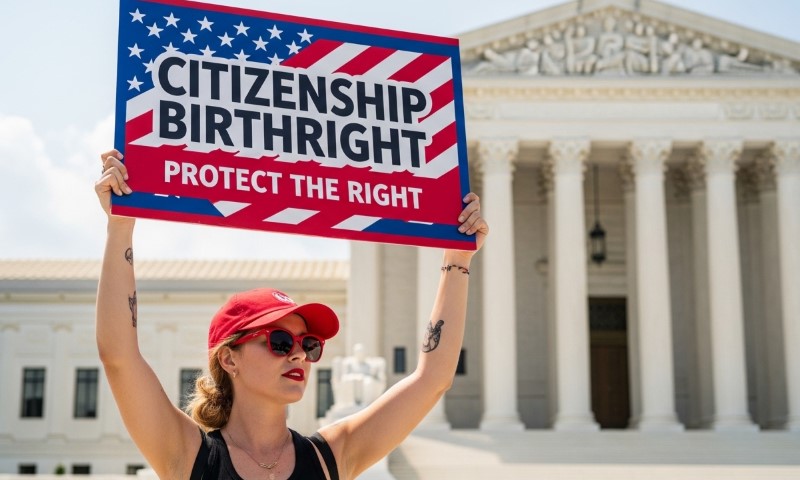

The latest clash over birthright citizenship has moved far beyond immigration policy. At stake now is a more foundational question: whether the United States still defines citizenship as a constitutional guarantee tied to birth on American soil, or whether that status can be narrowed by presidential decree and parental status.
The dispute reached the Supreme Court on April 1, where justices appeared skeptical of President Donald Trump’s effort to strip automatic citizenship from some children born in the United States.
Trump’s order would direct federal agencies not to recognize the citizenship of children born in the U.S. if neither parent is an American citizen or lawful permanent resident. Lower courts blocked the policy before it could take effect, and Reuters reported that the Supreme Court hearing suggested significant resistance from the bench, even from some conservative justices.
Chief Justice John Roberts and others pressed the administration over its reading of the Constitution, while the Court is expected to rule by the end of June.
Table of Contents
ToggleThe Constitutional Text Is Plain. The Legal Fight Is Not.
The argument begins with one sentence in the 14th Amendment, ratified in 1868 after the Civil War: “All persons born or naturalized in the United States, and subject to the jurisdiction thereof, are citizens of the United States.”
That language was written to establish a broad constitutional rule of national citizenship, one meant to survive changing politics and hostile state governments.
But that reading runs into a century of precedent, and into hard questioning from the justices themselves.
During arguments, several members of the Court pressed the government to explain how its theory could be squared with settled law and with the text’s lack of any reference to “domicile,” the concept the administration has leaned on heavily.
Wong Kim Ark Still Sits at the Center
No precedent matters more here than United States v. Wong Kim Ark, the 1898 Supreme Court decision that has long anchored modern birthright citizenship doctrine. The case involved a man born in San Francisco to Chinese-citizen parents who lived in the United States.
The Court held that he was a U.S. citizen by birth under the 14th Amendment. That ruling has stood for well over a century as the constitutional baseline for nearly everyone born on U.S. soil.
That is why the current challenge has alarmed legal scholars and civil-rights advocates. If the Court were to accept the administration’s interpretation, it would not merely trim a modern policy.
It would reopen one of the oldest settled questions in American constitutional law and invite the federal government to redefine citizenship through executive power.
Associated Press reported that federal courts have so far consistently blocked the order, calling it likely unconstitutional and warning of severe consequences for children born in the country.
The Numbers Show How Much Could Change
The human consequences are not abstract. Pew Research Center reported on March 31 that in 2023, mothers who were unauthorized immigrants or had legal temporary status gave birth to 320,000 babies in the United States, about 9% of all U.S. births that year.
Pew estimated that about 260,000 of those children would not have qualified for citizenship if Trump’s order had already been in force.
That scale helps explain why critics say the case is about more than border politics. A ruling for the administration could create a new class of U.S.-born children with no automatic claim to the country of their birth, raising questions about documentation, rights, and legal status from the first day of life.
Reuters reported that opponents see the order as a direct assault on a constitutional rule that has shaped American identity for generations.
America Is Not Alone, But It Is Being Tested
Trump has argued that the United States is uniquely lax in granting citizenship by birthplace. The data do not support that claim.
Pew found that 33 countries, including the U.S., still provide automatic birthright citizenship regardless of parents’ legal status, though the practice is concentrated heavily in the Americas and is uncommon elsewhere.
That leaves the Supreme Court with a decision that is legal on its face and civilizational in its effect. The justices are not simply weighing an immigration measure.
They are deciding whether the American promise of citizenship remains rooted in constitutional birthright, or whether it can be narrowed into something inherited, conditional, and politically revocable. In that sense, the case is not only about who belongs. It is about whether the country still means what its Constitution says.
Related Posts:
- What ICE Does and Why It Matters - U.S. Immigration…
- Supreme Court Upholds Jurisdiction Law Allowing Suit…
- Violence Against Women Act Protections: How VAWA Can…
- Safest Countries in the World in 2025 - GPI…
- Why Modern Political Portraits Today Feel More Human…
- How Is Each State Represented in the Electoral College?