
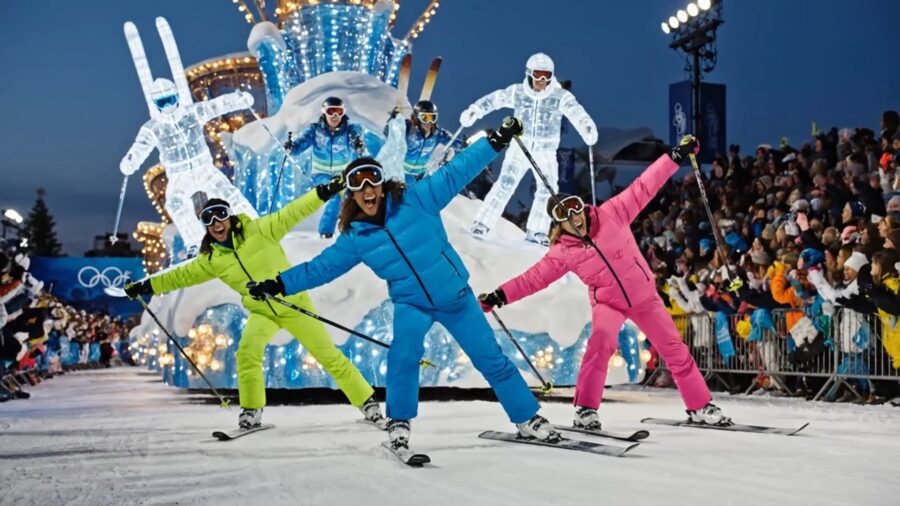

The 2026 Winter Olympics Opening Ceremony was held on February 6th, and competition is underway across northern Italy.
Inside that familiar Olympic churn of medal favorites, surprise contenders, and early setbacks, another storyline has sharpened now that the world is watching live: a record number of publicly out LGBTQ athletes are competing at the Winter Games, and their visibility is unfolding alongside a growing political and regulatory fight over gender categories in sport.
Table of Contents
ToggleA Record Count, Built as a Public Minimum
A tracking project led by Outsports identifies at least 47 publicly out LGBTQ athletes competing at these Games, a Winter Olympics record in its accounting.
The keyword is “publicly.” The list is not an estimate of how many LGBTQ athletes are in the Olympic village.
It is a catalog of athletes who are out through public reporting, direct statements, or verifiable public profiles. That makes the number both powerful and limited. It captures visibility, not identity.
Outsports’ running tally also sketches the shape of that visibility. In its count, women outnumber men by roughly 3 to 1, and women’s ice hockey is the single largest cluster.
The Human Cost of Being Visible, in Real Time
In the opening days of competition, American figure skater Amber Glenn became a case study in how quickly Olympic visibility can turn into personal exposure.
After making supportive comments about the LGBTQ community in an Olympic setting, Glenn said she would limit her social media use following what she described as a “scary amount” of hate and threats.
Reuters also reported that Glenn later said her performance struggles were not caused by the online abuse, underscoring how athletes can be forced to address off-ice pressure while trying to compete on the biggest stage of their lives.
The point is not that online harassment is new. The point is that the Olympics amplify everything. The platform expands. The blowback expands with it.
A Winter Olympics First, and a Policy Debate That Is Accelerating
The Outsports list also includes what it describes as the first publicly identified transgender athlete in Winter Olympics history, Elis Lundholm.
That milestone lands at a moment when the rules environment is unsettled and moving fast.
The International Olympic Committee has for years leaned toward a federation-led approach, encouraging sports bodies to craft their own eligibility rules rather than imposing one universal standard.
The IOC’s 2021 framework lays out principles on fairness, inclusion, and non-discrimination, but it does not operate as a single binding eligibility rule across every sport.
Now, Reuters reports the IOC is moving toward a uniform set of eligibility criteria, expected in the first half of 2026, after a consultation process with sports leaders.
Reuters also reports the emerging direction is expected to restrict transgender participation in women’s categories, particularly for athletes who experienced full male puberty before transitioning.
That means Milan is hosting two realities at once: record LGBTQ visibility inside the Games, and an intensifying global argument about the boundaries of the female category in sport.
Pride House in Milan, a Physical Space in the Middle of a Global Event
Beyond the venues, Pride House Milano 2026 is operating as a dedicated hub tied to the Games period, scheduled from 6 to 22 February at MEET Digital Culture Center.
Pride House initiatives have become a recognizable feature around large sporting events, partly symbolic and partly practical.
They create a visible gathering point for community, culture, and programming during a time when the Olympic brand can feel both omnipresent and impersonal.
Italy’s Backdrop, and Why Context Matters
The Olympics do not erase local politics or legal realities. They sit on top of them.
For readers trying to interpret what LGBTQ visibility means in Milan, rights benchmarks provide one reference point. ILGA-Europe ranks European countries through its Rainbow Map methodology, measuring laws and policy practices on a 0 to 100% scale.
Recent reporting citing ILGA-Europe’s 2025 edition places Italy at 21.4% and notes it ranks below many European peers in that index.
Numbers do not tell the full story of daily life, but they help explain why events like Pride House draw attention, and why some athletes calculate risk differently depending on where the Games are held.
What the Record Number Actually Means Now That the Games Are Live
The most defensible conclusion is narrow and measurable: more athletes are competing in Milan who are publicly out than in any prior Winter Olympics tracking effort of this type.
The broader interpretation requires more care. Visibility is not evenly distributed across sports, countries, and cultures. Outsports’ own breakdown highlights that reality, particularly the concentration in women’s hockey.
And visibility does not guarantee safety. Glenn’s experience, reported in real time during the Games, is a reminder that public support and public hostility can arrive in the same feed, on the same day.
Related Posts:
- The 100 Most Dangerous Cities in America (2026):…
- Best Places to Retire Abroad in 2026: An Honest…
- How Many Transgender Athletes Are There - Numbers for 2026
- Safest Cities in California in 2026: An Honest,…
- America’s Murder Capitals - Updated 2026 Rankings of…
- Safest Countries in the World in 2025 - GPI…