
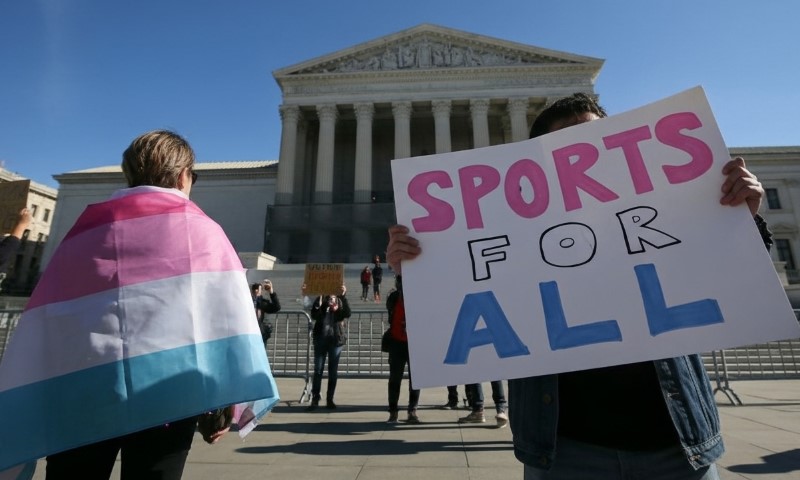

Counting transgender athletes sounds like a question with a clean numeric answer. In reality, it is one of those topics where the most accurate response starts with a pause.
There is no global registry. There is no unified tracking system across sports. And most athletic organizations do not publicly record gender identity in a consistent way.
What exists instead are fragments. Public testimony. Population surveys. Participation research. Policy documents. Put together carefully, they give a picture of scale, limits, and gaps. That picture matters more than any single number.
Let’s take a look at what can actually be counted, what can only be estimated, and why the missing pieces exist in the first place.
Key Points
- There is no comprehensive or global count of transgender athletes, only partial and context-specific data.
- In NCAA college sports, leadership has cited fewer than 10 known transgender athletes among about 510,000 participants.
- High school data shows how many students identify as transgender, not how many compete in school sports.
- Available research suggests transgender people participate in sports at lower rates, and elite-level participation is rare.
Why There Is No Single Global Count
There is no universal database that tracks transgender athletes across youth leagues, high school sports, college programs, professional leagues, and Olympic-level competition.
Researchers, legal analysts, and sports governing bodies have been clear about that reality for years.
Several factors make comprehensive counting unlikely:
- Privacy protections, especially for minors
- Inconsistent definitions of gender identity across institutions
- Uneven data collection, with many leagues choosing not to record sensitive identity data
- Policy variation, which affects disclosure and participation
Even when eligibility rules exist, many sports bodies do not publish how many athletes are affected.
In youth and school-based sports, data collection is often intentionally limited to avoid creating records tied to identity.
That means any honest answer has to work with partial data and be clear about its limits.
NCAA College Sports
The most direct and widely cited figure in the public record comes from NCAA leadership testimony.
In December 2024, National Collegiate Athletic Association President Charlie Baker told a U.S. Senate panel that he was aware of fewer than 10 transgender student-athletes among approximately 510,000 NCAA student-athletes nationwide.
That statement has been repeated across major news outlets and policy discussions. It is not treated as a precise census. It is treated as a scale indicator.
What That NCAA Number Tells Us
- Openly identified transgender participation in NCAA sports appears extremely small relative to total participation
- The number reflects athletes known through eligibility processes, team contexts, or administrative awareness
- It provides a rare executive-level statement tied to a specific system
What That NCAA Number Does Not Tell Us
- It is not a roster-by-roster audit
- It does not capture athletes who have not disclosed their gender identity
- It does not translate automatically to high school, youth, professional, or international sport
Still, if the goal is to anchor the discussion in something concrete, the NCAA is one of the few environments where a senior official has placed a number on the record.
High School Sports – Population Data Without Athlete Counts

At the high school level, the picture shifts. There is strong data on how many students identify as transgender. There is very little data on how many compete in organized school sports.
How Many U.S. High School Students Identify As Transgender
According to the 2023 Youth Risk Behavior Survey conducted by the Centers for Disease Control and Prevention:
- 3.3% of U.S. high school students identified as transgender
- 2.2% identified as questioning
That figure is widely cited and methodologically strong. It reflects student self-identification across a nationally representative sample.
Why Student Prevalence Is Not Athlete Prevalence
Several factors prevent a clean conversion from student identity rates to athlete counts:
- Many students do not participate in school sports at all
- Transgender students face documented barriers related to locker rooms, travel, and team culture
- Eligibility rules vary by state athletic association
- Disclosure is not required for participation in many settings
As a result, even legal briefs and academic reviews acknowledge that high school transgender athlete counts are often inferred rather than directly measured.
Population Context & How Many People Identify As Transgender
To estimate how many transgender athletes could exist, it helps to start with population prevalence.
United States Estimates
In August 2025, the Williams Institute released updated figures estimating:
- 2.8 million people age 13+ in the U.S. identify as transgender, about 1.0% of the population age 13+
- 724,000 youth ages 13–17, about 3.3% of that age group
- 2.1 million adults, about 0.8% of adults
That youth estimate aligns closely with the CDC’s 3.3% high school figure, which strengthens confidence in the overall prevalence range.
What Population Data Cannot Do Alone
Population prevalence does not equal athlete prevalence. Participation depends on:
- Access to teams and facilities
- Comfort with shared spaces
- Risk of harassment or exclusion
- Local eligibility policies
Any attempt to move from population counts to athlete counts has to account for participation differences.
Sports Participation Rates Among Transgender People
One of the most important pieces in estimating athlete numbers is the participation rate.
A 2024 study published in the British Journal of Sports Medicine reported that about 33% of transgender respondents described current regular participation in sport or fitness activities. In the same context, participation among the general population was substantially higher.
That finding lines up with a broader research pattern showing reduced participation among transgender people due to social and structural barriers.
Important caveats apply:
- The data comes from a national community sample, not a global one
- It blends organized sport with general fitness
- “Regular participation” is not the same as competitive or elite sport
Even with those limits, the takeaway is consistent. Athlete counts are likely smaller than the raw population prevalence might suggest.
Elite Sport And The Olympics
Elite sport draws outsized attention relative to participation numbers.
The International Olympic Committee does not maintain a public registry of transgender athletes.
Its 2021 Framework on Fairness, Inclusion and Non-Discrimination sets principles, not numeric reporting standards. Each international federation determines its own eligibility rules.
What We Can Say About Olympic Participation
- Eligibility policies vary widely by sport
- Open transgender participation at the Olympic level appears rare
- Public discussion is often driven by a handful of high-profile cases
Media outlets and advocacy groups sometimes track “out LGBTQ athletes” at the Olympic Games. Those counts are not official statistics, and they include lesbian, gay, bisexual, transgender, queer, and nonbinary athletes together.
For example:
- Outsports counted 199 out LGBTQ athletes at the Paris 2024 Olympics
- That figure is not a count of transgender athletes alone
The defensible conclusion remains simple. Open transgender participation in Olympic competition is small in absolute terms.
How Policies Affect Who Gets Counted
Eligibility policies shape participation. They also shape visibility.
Over the past few years, many sports bodies have revised rules for transgender women’s eligibility in women’s categories. Some have introduced or discussed open categories. Others have tightened the criteria.
Outside the NCAA, the National Association of Intercollegiate Athletics adopted a 2024 policy restricting women’s competition eligibility based on sex assigned at birth. That decision received national attention and illustrates how policy shifts can alter participation patterns quickly.
Policy changes affect numbers in several ways:
- Athletes may stop competing altogether
- Some may shift divisions or formats
- Disclosure may decrease in restrictive environments
- Participation may move to recreational or non-sanctioned leagues
When participation changes, counting becomes harder, not easier.
A Practical Way To Think About The Numbers
Since a single definitive figure does not exist, the most responsible approach is to separate what is known from what is not.
What Is Known And What Is Not
| Level of Sport | What Can Be Credibly Said | What Cannot Be Credibly Said |
| U.S. High School Students | About 3.3% identify as transgender (CDC YRBS 2023) | How many are varsity athletes nationwide |
| U.S. High School Athletes | No unified national count exists | A verified national athlete total |
| NCAA College Sports | Fewer than 10 known transgender athletes among ~510,000 (Dec 2024 statement) | A publicly auditable roster-level census |
| Elite And Olympic Sport | Participation varies by federation and appears rare | A global count across all sports |
That framework keeps the discussion grounded and avoids overstating certainty.
What You Can Responsibly Conclude

An evidence-based answer looks like this:
- There is no comprehensive count of transgender athletes across all sports and levels
- In the NCAA, leadership has described fewer than 10 known transgender athletes among roughly 510,000 participants
- At the high school level, 3.3% of students identify as transgender, but athlete participation cannot be directly inferred
- Research suggests transgender people participate in sport and fitness at lower rates than the general population in at least some contexts
- In elite sport, participation is rare and highly dependent on federation-specific rules
Any claim beyond that requires estimation, inference, or advocacy framing. Clear labeling matters.
If You Need A One-Line Answer
If a single sentence is required, the most defensible one stays narrow:
In the only system where a senior official has provided a public estimate, the NCAA reported fewer than 10 known transgender athletes among approximately 510,000 college athletes in December 2024.
Everything else needs context, explanation, and caution.
Why Precision Matters Here
Numbers shape public perception. Overstated participation feeds confusion. Understated participation erases lived experience. Accuracy sits in the middle.
The available evidence points to a small number of openly transgender athletes, especially in elite and collegiate sport, alongside a much larger transgender population that faces barriers to participation. Both facts can coexist.
Getting the count right is not about winning an argument. It is about describing reality as clearly as the data allows, and being honest about where the data stops.