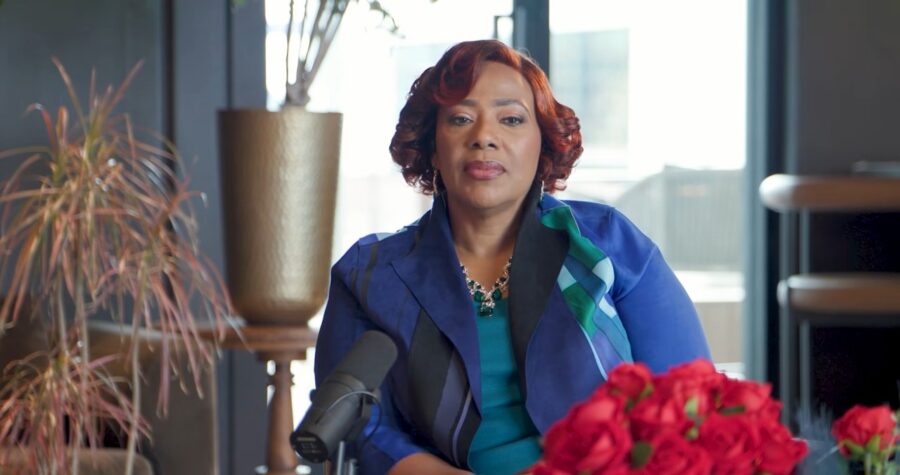

As Americans mark Martin Luther King Jr. Day, the Rev. Bernice A. King is urging the country to treat the holiday as more than a tribute. She describes it as a rare civic pause, one that can “insert a sense of sanity and morality” into what she calls a deeply troubling political climate.
King, the youngest daughter of the late civil rights leader and the CEO of The King Center, framed the day as a moment of accountability. Her message is rooted in the idea that her father’s legacy is most useful when applied to present-day conflicts, not recycled as comforting symbolism.
Her comments come as President Donald Trump approaches the first anniversary of his second term, a period that has reopened fierce debates over immigration enforcement, diversity initiatives, and how American history is taught and presented by public institutions.
“Hope” as a Discipline, Not a Slogan
In an interview with The Associated Press, King said the holiday serves as a yearly reminder that Dr. King’s work was built around moral clarity and the obligation to challenge “injustice and inhumanity.”
She connected that moral framework to the “three evils” her father warned about in 1967: racism, economic exploitation (often discussed alongside poverty), and war or militarism. The concept, frequently referenced in Dr. King’s later speeches, emphasized how those forces reinforce each other and shape public policy and daily life.
King argued that those forces are not historical artifacts. She sees them reflected in modern governance, public rhetoric, and the nation’s ongoing struggles over who is protected, who is excluded, and whose history is preserved.
A Direct Critique of Trump-Era Policies
View this post on Instagram
King pointed to developments she views as a rollback of civil-rights progress, including moves aimed at restricting diversity, equity, and inclusion initiatives and efforts to remove certain historical material from government platforms and cultural institutions.
The White House rejected that framing. A spokesperson said Trump’s actions are intended to serve the “best interest of the American people,” including reversing what the administration describes as “harmful DEI agendas” and pursuing deportations of “dangerous criminal illegal aliens.”
The competing statements underscore what MLK Day has become in a polarized America: a shared commemoration that often produces radically different interpretations of what King stood for, and what his message demands from leaders now.
Civil-Rights Leaders Warn of “Erasure” Battles
The AP report also included comments from Maya Wiley, president and CEO of the Leadership Conference on Civil and Human Rights, who described recent political trends as part of an effort to weaken civil-rights advancements and erase hard-won historical memory.
Wiley’s remarks reflect a broader concern among civil-rights groups that public institutions, including schools and museums, are becoming battlegrounds where narratives of American history are selectively reshaped.
Nonviolence, Applied to Protesters and the State
One of King’s most pointed arguments was that nonviolence cannot be treated as a rule reserved for demonstrators. She said it must also shape how law enforcement and immigration agents do their jobs, including in tense and high-stakes encounters.
She pointed to training work associated with The King Center and said the organization has developed curriculum in the past, with plans to redevelop it, aimed at helping officers carry out duties while respecting human dignity.
The King Center’s broader Nonviolence365® programming describes nonviolence as a practical methodology for personal and organizational change, with structured training experiences designed for groups and institutions.
“You Can’t Put Diversity Back in a Box”
King acknowledged national progress while warning against complacency. She argued that demographic change and cultural pluralism have advanced too far to be reversed, even if policy swings attempt to constrain them.
The line matters because it signals something beyond grief or outrage. It frames the current era as a struggle over governance, belonging, and memory, yet also as a moment where the country’s evolving identity remains visible in daily life.
A Holiday Born From Political Conflict
MLK Day’s current power is tied to how hard it was to establish in the first place. The federal holiday was signed into law in 1983 and first officially observed in 1986, following years of organizing, lobbying, and public pressure.
That history undercuts the idea that the holiday is merely ceremonial. It exists because the nation was pushed to recognize King’s legacy as part of its civic calendar, and that recognition has remained politically charged ever since.
A Call for Reflection and Service, With Long-Term Purpose
King urged Americans to use the day for introspection, community work, and sustained commitment, rather than treating MLK Day as a yearly performance that fades by Tuesday.
Her message, distilled, is an argument for moral consistency: measure your own choices, engage your community, and treat the holiday as an annual reminder that King’s work was never meant to be safely contained in history.