Skip to content
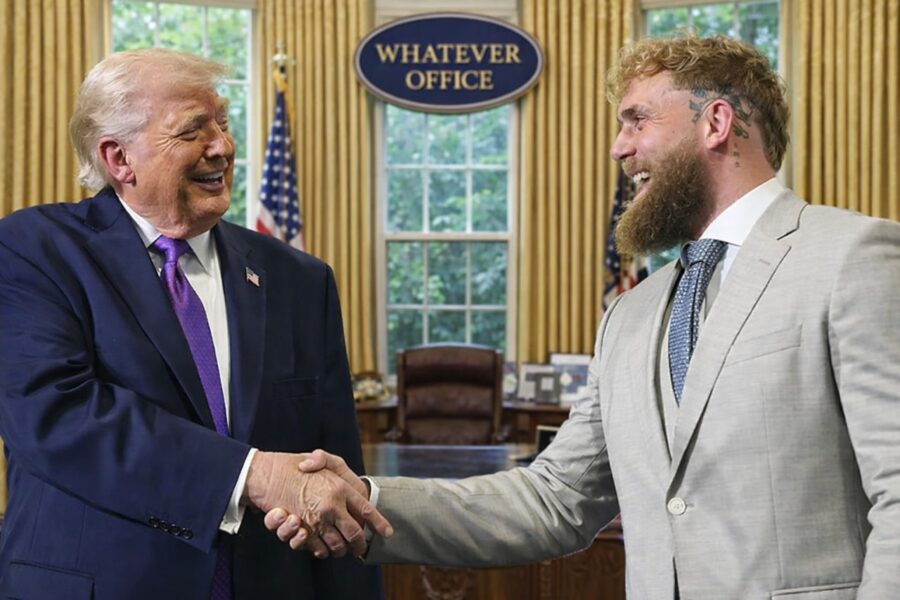

President Donald Trump turned a campaign-style stop in northern Kentucky into a striking piece of political theater on March 11, inviting boxer and online star Jake Paul onstage and telling the crowd he would back Paul for office if he ever chose to run.
According to Fox News reports from the event, Trump said Paul had his “complete and total endorsement,” elevating what might have been a brief cameo into one of the rally’s defining moments.
The scene was more than a viral aside. Trump’s appearance in Hebron came as part of a broader political offensive aimed at Republican Rep. Thomas Massie, one of the president’s most visible intraparty antagonists, and included an endorsement of Massie challenger Ed Gallrein.
In that setting, Paul’s appearance served a dual purpose: entertainment for the crowd, and a reminder that Trump still sees celebrity, combativeness, and attention as usable political currency.
Table of Contents
ToggleThe Moment That Drew the Headlines
Reports from the rally describe Trump bringing Paul onstage, praising his toughness and popularity, and predicting that the 29-year-old influencer-boxer would one day seek elected office.
Fox News’ account quoted Trump saying, “I’m going to make a prediction that you will be, in the not-too-distant future, running for political office,” before adding, “You have my complete and total endorsement.”
Separate coverage from the New York Post described the same endorsement language and the same rally setup in Hebron.
Coverage of the event says he praised Trump for teaching him courage, spoke favorably about American manufacturing, and framed the country as slowly recovering under Trump’s leadership.
That rhetoric mattered because it suggested Paul was not merely present as a celebrity attraction. He was playing a political role, however loosely defined.
A Rally About More Than Jake Paul
The Jake Paul moment grabbed headlines, but it was only one piece of a much larger message Trump was trying to deliver in Kentucky.
ABC News reported that Trump’s visit centered heavily on his clash with Massie and his endorsement of Gallrein in one of the most closely watched Republican House primaries of the 2026 cycle.
Louisville Public Media likewise reported that Trump used the rally to promote his economic agenda while hammering Massie, who has repeatedly broken with him on major issues.
The Washington Post placed the event in an even wider frame, describing it as part of Trump’s effort to hold together Republican support while war-related economic strain, especially rising fuel costs, tests public patience.
In that reading, the Paul cameo was not random. It fit a rally built to animate loyalists, punish dissenters inside the party, and keep Trump at the center of the national spectacle.
Why the Endorsement Resonates
Trump has long blurred the line between politics, entertainment, and personal branding, and Paul is almost a textbook figure for that kind of politics. He emerged from internet celebrity culture, crossed into combat sports, built a loyal digital following, and learned how to convert provocation into reach.
By pulling him into a live political event, Trump tapped into a familiar formula: treat fame itself as proof of public connection, then let crowd energy do the rest. The rally reports from Hebron showed exactly that dynamic at work.
There is also prior history here. Paul publicly endorsed Trump during the 2024 election cycle, a move covered at the time by Variety and Deadline.
That makes the Kentucky appearance feel less like a novelty and more like a continuation of an existing political alignment, one that has now moved from social media commentary into live-stage validation from the president himself.
Celebrity as Political Infrastructure
American politics has long made room for celebrities, but the Trump era has sharpened the logic behind that alliance. Fame can function as infrastructure. It delivers attention, bypasses gatekeepers, compresses messaging, and imports ready-made audiences into political space.
A figure like Paul does not need a conventional political résumé to matter in that system. He needs reach, recognition, and the ability to command reaction, which he clearly has. Trump’s public endorsement appeared to acknowledge exactly that.
That does not mean Paul is preparing a real campaign. No credible report I reviewed says he has announced plans to run for office. The more defensible conclusion is narrower: Trump used his rally stage to cast Paul as politically viable, or at least politically useful, and in doing so widened the already porous boundary between influencer culture and formal politics.
The Optics Trump Appears to Want
For Trump, the value of the moment was not limited to whether Paul ever appears on a ballot. The endorsement itself created a narrative: a younger celebrity figure with a massive following, standing beside the president, praising him before a partisan crowd.
That imagery helps Trump project cultural relevance and generational reach at a time when political coalitions are increasingly shaped by online ecosystems as much as by party machinery. Coverage of the rally also noted that the appearance quickly spilled onto social platforms, where clips of Trump and Paul circulated almost immediately.
Paul, for his part, also stood to gain. Appearing alongside a sitting president at a high-profile rally moved him beyond sports and internet celebrity into a different class of public visibility.
Whether that becomes a stepping stone to advocacy, partisan influence, or a more direct political future remains unknown. But the Hebron rally showed that the possibility is now part of the public conversation, at least because Trump chose to make it so.
What the Kentucky Rally Actually Revealed
The easiest way to read the moment is as stunt politics. That would miss part of the point. Modern campaigns are not only contests over policy or turnout. They are also contests over narrative, symbolism, and the ability to dominate public attention.
In Hebron, Trump used a rally nominally focused on economic themes and an intraparty House fight to stage a made-for-viral crossover with one of the country’s most recognizable digital-age celebrities. The message was implicit but clear: in Trump’s political world, celebrity is not decoration. It is a governing language of power.
Whether Jake Paul ever runs for office is still speculative. What is not speculative is what happened in Kentucky. Trump put him onstage, predicted a political future for him, and offered a full public endorsement in front of supporters.
In an era where political legitimacy is increasingly shaped by attention as much as institution, that moment landed as more than a joke line. It was a small but telling marker of where American politics now lives: at the crossroads of rally spectacle, digital fame, and presidential power.
Related Posts:
- Capital Cities in Europe: Top Destinations For You…
- Safest Countries in the World in 2025 - GPI…
- 25 Most Dangerous Cities in US - Updated Statistics for 2026
- How to File a Claim After Getting Hurt at a Political Rally
- Best Fireworks For New Years Eve 2026: Top Spots…
- 13 Richest Cities in the US 2026 - Luxury, Money,…