Skip to content
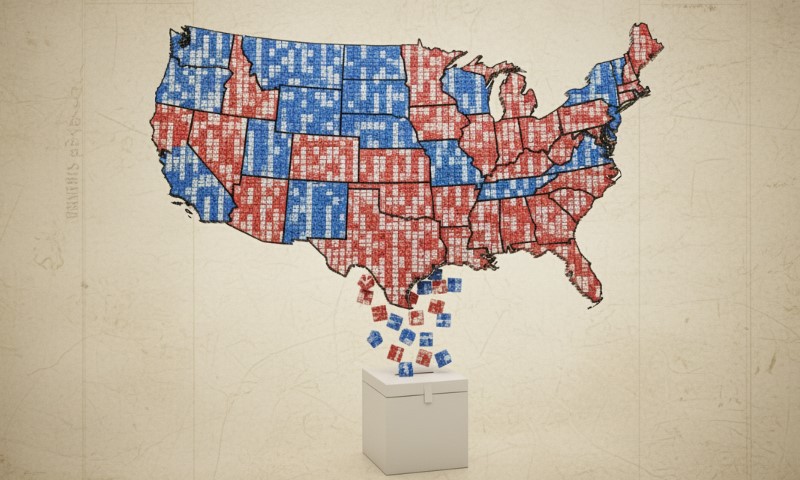

Presidential elections in the United States are often discussed as a national contest, but the system is built state by state.
Every ballot cast for president feeds into a structure that gives each state a fixed number of electoral votes, and that number can shape campaign strategy, recount battles, and the final outcome.
Once you know how each state is represented in the Electoral College, a lot of election-night math starts to make more sense. Also, you can find out more about Red and Blue states.
Electoral College In 4 Quick Hits
- Every state gets electoral votes based on House seats plus 2 senators.
- Bigger states get more votes, but smaller states get a built-in advantage per voter.
- Maine and Nebraska can split electoral votes by congressional district.
- Census changes can shift electoral votes and reshape future presidential maps.
What The Electoral College Actually Is
The Electoral College is the process used to elect the president and vice president. There are 538 electors in total, and a candidate needs 270 electoral votes to win.
Each state receives a number of electors equal to its total representation in Congress: one for every member it has in the House of Representatives, plus 2 more for its U.S. senators.
The District of Columbia also gets 3 electors under the 23rd Amendment, even though it has no voting members in Congress.
In practical terms, a state’s Electoral College weight comes from two ingredients:
- population, which determines House seats after each census
- equal statehood in the Senate, which adds 2 electors to every state no matter how large or small it is
A state can never fall below 3 electoral votes because every state has 2 senators and at least 1 House member.
Why Census Counts Matter So Much
Electoral College representation is not adjusted every election cycle. It changes after the decennial census, when the Census Bureau calculates how the 435 House seats are divided among the 50 states.
Once House seats shift, electoral votes shift with them. Current allocations are based on the 2020 Census and apply to the 2024 and 2028 presidential elections.
The Census Bureau explains that apportionment starts by giving every state 1 House seat. The remaining seats are then distributed using the Method of Equal Proportions, the formula Congress adopted for modern apportionment.
Bigger states usually gain more seats over time because they have larger populations, but growth rates matter as much as raw size. A fast-growing medium-size state can gain a seat while a larger but slower-growing state can lose one.
That process has major political consequences. After the 2020 Census, Texas gained 2 House seats, while Florida, Colorado, Montana, North Carolina, and Oregon gained 1 each.
California, Illinois, Michigan, New York, Ohio, Pennsylvania, and West Virginia each lost 1 seat. Because electoral votes follow House seats, presidential maps changed too.
The Basic Rule For Every State
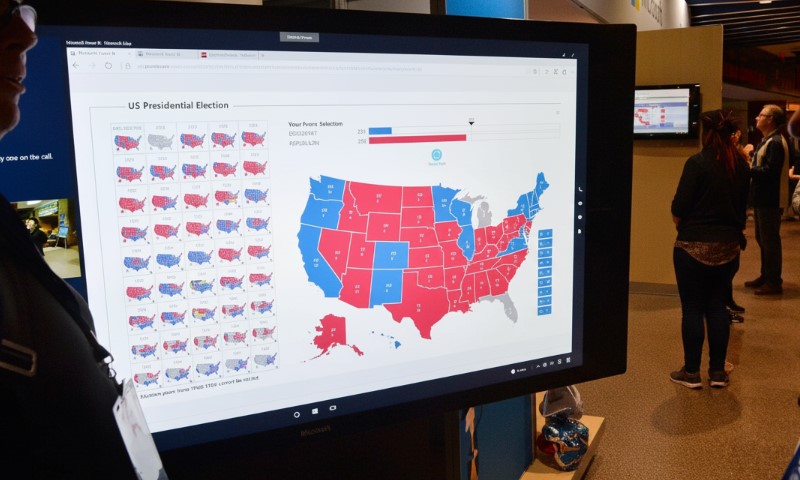
A quick way to remember the system is simple:
Electoral votes = House seats + 2 senators
For example:
- California has 52 House members, so it gets 54 electoral votes
- Texas has 38 House members, so it gets 40 electoral votes
- Florida has 28 House members, so it gets 30 electoral votes
- Wyoming has 1 House member, so it gets 3 electoral votes
That formula is one reason smaller states carry slightly more weight per voter than very large states. Every state gets the same 2-senator bonus, so the extra 2 votes are a much bigger share of Wyoming’s total than California’s.
That does not mean small states dominate the system, because large states still hold the biggest blocks of electoral votes, but it does mean representation is not purely proportional to population.
State-By-State Electoral Votes
Current allocations below are based on the 2020 Census and are in effect for the 2024 and 2028 presidential elections.
| State | Electoral Votes |
| Alabama | 9 |
| Alaska | 3 |
| Arizona | 11 |
| Arkansas | 6 |
| California | 54 |
| Colorado | 10 |
| Connecticut | 7 |
| Delaware | 3 |
| District of Columbia | 3 |
| Florida | 30 |
| Georgia | 16 |
| Hawaii | 4 |
| Idaho | 4 |
| Illinois | 19 |
| Indiana | 11 |
| Iowa | 6 |
| Kansas | 6 |
| Kentucky | 8 |
| Louisiana | 8 |
| Maine | 4 |
| Maryland | 10 |
| Massachusetts | 11 |
| Michigan | 15 |
| Minnesota | 10 |
| Mississippi | 6 |
| Missouri | 10 |
| Montana | 4 |
| Nebraska | 5 |
| Nevada | 6 |
| New Hampshire | 4 |
| New Jersey | 14 |
| New Mexico | 5 |
| New York | 28 |
| North Carolina | 16 |
| North Dakota | 3 |
| Ohio | 17 |
| Oklahoma | 7 |
| Oregon | 8 |
| Pennsylvania | 19 |
| Rhode Island | 4 |
| South Carolina | 9 |
| South Dakota | 3 |
| Tennessee | 11 |
| Texas | 40 |
| Utah | 6 |
| Vermont | 3 |
| Virginia | 13 |
| Washington | 12 |
| West Virginia | 4 |
| Wisconsin | 10 |
| Wyoming | 3 |
Which States Carry The Most Weight

A handful of states dominate the Electoral College map because of their population size. California leads with 54 electoral votes, followed by Texas with 40 and Florida with 30.
New York has 28. Illinois and Pennsylvania each have 19. Ohio has 17, while Georgia and North Carolina each have 16. Michigan has 15, and New Jersey has 14.
Campaigns care about more than size, though. A large state that leans heavily toward one party may receive less attention than a smaller battleground.
Florida’s 30 votes matter a lot, but so do Wisconsin’s 10 or Nevada’s 6 if the race is close and both parties believe they can win there.
Electoral College representation sets the value of a state’s prize, but competitiveness often determines whether candidates spend money and time trying to claim it.
Why Maine And Nebraska Work Differently
Most states use a winner-take-all rule. Whoever wins the statewide popular vote gets all of the state’s electoral votes. Maine and Nebraska use a district-based system instead. In both states, 2 electors go to the statewide winner, while 1 elector is awarded to the winner in each congressional district.
That structure can split a state’s electoral vote. Nebraska did so in 2008 and again in 2020. Maine split in 2016 and 2020. In a close national race, even one electoral vote from Omaha or a Maine congressional district can matter. Such splits also explain why campaigns sometimes target one metro area inside a state they are unlikely to win statewide.
For readers trying to map representation clearly, Maine’s 4 votes break down into 2 statewide electors plus 2 district electors. Nebraska’s 5 votes break down into 2 statewide electors plus 3 district electors. Same total formula, different method of awarding the votes.
Why Small States Have More Per-Person Influence
One of the most common criticisms of the Electoral College centers on unequal voting weight across states. Because every state gets 2 electors tied to the Senate, smaller states receive a bonus that does not depend on population.
A resident of Wyoming is effectively represented by 3 electors for a population small enough to support only 1 House seat, while a resident of California shares 54 electors across a much larger population. That creates a per-person gap in Electoral College influence.
At the same time, large states still command the biggest totals. California’s 54 electoral votes are far more valuable in raw numbers than Wyoming’s 3.
So the system gives smaller states a population bonus without turning them into the main power centers of presidential politics. Resulting tensions have fueled arguments for reform for generations, especially after elections where the national popular vote winner did not win the presidency.
What Happens When No One Reaches 270
Most presidential elections end with one candidate clearing the 270-vote threshold. If no candidate reaches that number, the election moves to Congress under the 12th Amendment.
The House of Representatives chooses the president from among the top 3 electoral vote winners, but it does so by state delegation, not by individual member vote. Each state gets 1 vote.
The Senate chooses the vice president from the top 2 vice presidential electoral vote winners, with each senator casting 1 vote. The District of Columbia does not get a vote in the House contingent election because it has no voting members there.
A contingent election is rare, but the rule matters because it shows how deeply state-based the system remains. Even after millions of ballots are counted nationwide, the final constitutional backstop still runs through state representation.
How Voters Relate To Electors
When Americans vote for president in November, they are technically choosing a slate of electors pledged to a candidate. Each party in each state selects potential electors before the election.
After the statewide result is certified, the winning slate is appointed under state law. Electors meet in December to cast the official votes for president and vice president, and Congress counts those votes in January.
That sequence often surprises people because election night feels like the final act. Legally, a few more steps still follow:
- States certify results and issue Certificates of Ascertainment
- Electors meet in their states and cast formal votes
- Congress counts electoral votes in joint session
- The winner is declared
Key dates for the 2024 cycle followed that pattern: Election Day on November 5, state certification deadlines by December 11, elector meetings on December 17, and congressional count on January 6, 2025.
Why Representation Shapes Campaign Strategy
State representation in the Electoral College changes the way campaigns spend money, build coalitions, and write political messages. A national popular vote system would reward raw vote totals everywhere equally.
The Electoral College rewards winning enough states, or enough key states, to get to 270. As a result, candidates often focus on states where the outcome is uncertain and the electoral prize is meaningful.
That helps explain why presidential campaigns often seem obsessed with a limited map. A safe state with 54 electoral votes can receive less campaign attention than a toss-up with 10. Representation gives every state a fixed role, but competition decides which roles become central in a given election year.
Population shifts also mean campaign maps evolve over time. Texas and Florida now carry more electoral weight than they did a decade ago. California and New York remain major prizes, but both have lost electoral votes over the long run compared with earlier eras.
North Carolina and Georgia have become more important because they combine significant electoral totals with highly competitive recent races.
Common Misunderstandings About State Representation

A few points cause confusion again and again.
Electoral Votes Are Not Based Only On Population
Population drives House seats, but every state also gets 2 electoral votes tied to Senate representation. That is why the system is only partly population-based.
The District Of Columbia Counts In Presidential Elections
Washington, D.C., has 3 electoral votes under the 23rd Amendment, even though it is not a state and has no voting senators or representatives.
Winner-Take-All Is Not Required By The Constitution
States choose how to appoint electors under their own laws, as long as rules are in place before Election Day. Winner-take-all is common, but Maine and Nebraska use a district system.
Census Results Matter For Two Presidential Elections At A Time
Current electoral vote totals are based on the 2020 Census, so they apply to 2024 and 2028. Another shift will come after the 2030 Census.
Why The System Still Sparks So Much Debate
Debate over the Electoral College rarely fades for long because state representation sits at the center of competing ideas about democracy and federalism.
Supporters often argue that the system protects the role of states in a union and pushes candidates to build geographically broad coalitions.
Critics argue that the structure can distort equal representation, overweight smaller states, and produce winners who lose the national popular vote. Historical arguments over its design have been part of American politics since the founding period.
Whatever side a person takes, one point is hard to dispute: state representation is the key to the whole structure. Without knowing how many electoral votes each state has, and why, it is almost impossible to read a presidential map with any real confidence.
FAQs
Summary
Each state’s representation in the Electoral College comes from a simple constitutional formula with very large consequences. House seats reflect population, Senate seats add an equal-state bonus, and the District of Columbia gets 3 votes of its own.
From there, campaigns, recounts, and election-night scenarios all follow. Once that framework is clear, the map stops looking random and starts looking like what it is: a state-based system built on census math, constitutional design, and political geography.