Skip to content
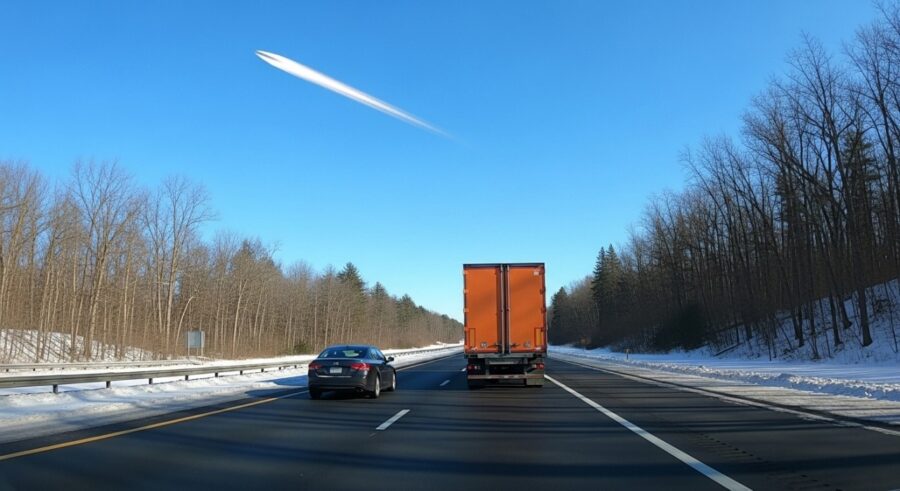

Residents across northern Ohio looked up Tuesday morning expecting an ordinary start to the day. Instead, many heard a violent boom, saw houses tremble, and watched a bright fireball streak across the sky in broad daylight.
By the end of the day, NASA had confirmed what many feared and hoped at once: the blast was real, but it was not the kind of space threat planetary defense systems are primarily built to catch.
According to NASA’s analysis, the object was a small asteroid about 6 feet in diameter and weighing roughly 7 tons. It first became visible about 50 miles above Lake Erie, traveled over northern Ohio at roughly 40,000 to 45,000 mph, and fragmented about 30 miles above Valley City, near Medina.
NASA estimated the energy release at about 250 tons of TNT, enough to produce the explosive noises and shaking reported on the ground.
Table of Contents
ToggleA Daylight Fireball Over the Midwest
What made the event so startling was not only its force, but its timing and visibility. The meteor appeared in full daylight around 9 a.m. local time, yet witnesses reported seeing it across a broad swath of the Midwest and Mid-Atlantic.
Reporting cited sightings from states including Ohio, Pennsylvania, Michigan, Illinois, Kentucky, Maryland, and western New York. A GOES East weather satellite also detected the flash, and a seismometer in Lorain County recorded subtle shaking moments later.
That wide footprint helped turn a regional sky event into a national story. In the immediate aftermath, many residents assumed the boom was caused by an industrial explosion, a transformer failure, or storm damage.
The National Weather Service in Cleveland later said satellite evidence was consistent with a meteor, helping narrow the explanation before NASA published its detailed event reconstruction.
Why NASA Did Not Detect It Before Impact
The answer is less dramatic than the headlines suggest, but more important. NASA’s near-Earth object observation efforts are primarily aimed at finding and tracking much larger objects, especially those 140 meters and above, because those are the bodies capable of causing major regional destruction.
A rock only about 2 meters wide falls far below that threshold, reflects very little sunlight, and can be extremely difficult to detect before it is already entering Earth’s atmosphere.
In other words, Ohio’s meteor did not expose a failure to detect a civilization-threatening asteroid. It highlighted a known blind spot involving very small objects that are common in the solar system, often harmless, and frequently discovered only when they burn up overhead.
NASA’s own future NEO Surveyor mission is designed to improve asteroid detection, but even that mission is primarily focused on larger near-Earth objects, not every small meteoroid headed toward Earth.
Loud, Frightening, but Not Catastrophic
The blast was powerful enough to rattle homes and trigger widespread alarm, but experts and official accounts indicate that most of the object likely disintegrated high in the atmosphere.
NASA said fragments may have fallen in Medina County, though reports following the event made clear that no confirmed debris field had yet been publicly established. That distinction matters. A spectacular airburst can feel apocalyptic at ground level while remaining far below the scale of a truly dangerous asteroid impact.
Events like this are rare enough to shock the public, but not rare in astronomical terms. Small space rocks strike Earth’s atmosphere regularly. Most pass unnoticed over oceans or remote regions, or they burn up without producing damage on the ground.
What made the Ohio event stand out was a combination of size, angle, daylight visibility, a populated corridor below, and the sharp acoustic shock that followed.
What the Ohio Explosion Actually Tells Us
The Ohio meteor is a reminder that “space surveillance” does not mean every incoming object is tracked in advance. Planetary defense is a system built around probabilities and priorities.
Its central mission is to find the asteroids that could devastate a city or region, not every small object capable of creating a dramatic sonic boom.
Tuesday’s blast over Ohio was real, loud, and powerful enough to jolt an entire region. But it was also a textbook case of the kind of small, fast-moving object that can slip through current detection networks and still burn up before doing major harm. For residents who heard the boom, that may be only partly reassuring. For scientists, it is a sharp illustration of what modern asteroid defense can do, and what it still cannot.
Related Posts:
- 25 Most Dangerous Cities in US - Updated Statistics for 2026
- Safest Countries in the World in 2025 - GPI…
- Capital Cities in Europe: Top Destinations For You…
- Most Dangerous Cities in Ohio - Top 10 Risky Areas…
- Daylight Savings Time 2026: When It Starts and Why It Exists
- 13 Richest Cities in the US 2026 - Luxury, Money,…