Skip to content


Ask ten lawyers, claims professionals, or journalists for the largest workers’ compensation settlement in U.S. history, and you will hear ten slightly different answers. That confusion is not a failure of research or memory. It reflects how the American workers’ compensation system actually works.
There is no single official nationwide ranking of workers’ compensation settlements. No federal leaderboard. No verified national database that confirms one settlement as the largest ever.
Reporting remains fragmented across states, agencies, courts, insurers, and law firms. Many settlements stay confidential. Others appear only in partial form through trade reporting or marketing announcements.
So the most accurate starting point looks like this:
There is no officially verified largest workers’ compensation settlement in U.S. history.
What exists instead are widely cited contenders, mostly from state systems, supported by trade publications, court approvals, and law firm disclosures. Among those, California cases in the $10 million to $13.2 million range appear most consistently in credible reporting.
Some newer law firm announcements claim even higher figures, including a $13.5 million settlement with a projected value exceeding $21 million when annuities are included, without independent nationwide verification.
The rest of this guide explains where those numbers come from, why they vary, and how to read “largest settlement” claims with professional caution.
Why “Largest Ever” Claims Conflict

Search results often show multiple cases described as the largest in history. That happens for predictable reasons.
Law firms publish case results as part of marketing. Those posts often rely on:
- State-specific comparisons
- Knowledge limited to one firm’s experience
- Lump sum figures presented without long-term context
- Projected structured values added to headline numbers
Those claims may be accurate within a defined scope. They rarely reflect an independently audited national comparison across all states and federal programs.
Trade publications tend to be more careful, often stating outright that no official rankings exist before presenting editorial roundups.
For guidance on evaluating claims and legal context, see https://www.choosecharlie.com/.
The Most Frequently Cited Large Settlement Contenders
Despite reporting limits, certain cases appear repeatedly across reputable coverage. The table below summarizes the most commonly cited contenders.
Frequently Cited “Largest” Workers’ Compensation Settlements
Sources referenced in reporting include Insurance Business, Daily Journal reprints, WorkCompCentral coverage, and disclosures from firms such as Rose, Klein & Marias and RITE Firm.
Why California Appears So Often
California dominates large-settlement discussions for practical reasons rather than coincidence.
The state has one of the largest labor forces in the country. Catastrophic injury claims occur across construction, transportation, healthcare, and industrial sectors.
Long-term medical care costs remain high. The system generates extensive litigation and reporting, which brings large cases into public view.
The 2017 California $10 Million Case
A Daily Journal article, later reprinted publicly, reported that a workers’ compensation judge approved a $10 million Compromise and Release in a commute crash involving traumatic brain injury.
Defense attorneys quoted in related coverage described such amounts as extremely rare, typically tied to young workers with high wages and extensive lifetime care needs.
WorkCompCentral coverage from the same period emphasized the absence of any official state ranking, even while acknowledging that few cases approached that dollar level.
That reporting matters because it includes commentary from both sides of the bar rather than promotional language alone.
The 2021 California $11.3 Million Nanny Case
Rose, Klein & Marias reported an $11.3 million settlement obtained for a nanny who suffered a catastrophic traumatic brain injury during a work-related trip. The firm described the worker as requiring wheelchair use and round-the-clock care.
Insurance Business also covered the case, repeating the $11.3 million figure and describing it as the largest workers’ compensation settlement in California history at that time. Coverage noted that the insurer initially denied liability before work-relatedness was established.
Multiple independent references strengthened the credibility of the reported amount.
The $13.2 Million California Case Cited in Trade Roundups
Insurance Business later published a roundup of notable settlements, placing a $13.2 million California ironworker case at the top of its list. The publication explicitly stated that no official national ranking exists and that the list reflected editorial selection rather than a definitive record.
Among widely cited figures, $13.2 million remains one of the highest lump sums reported through trade journalism rather than marketing alone.
Reading Newer “Largest In U.S. History” Claims Carefully

In 2025, a Florida law firm published a blog post claiming the largest workers’ compensation settlement in U.S. history. The firm described the settlement as $13.5 million, with a projected value exceeding $21 million once annuities were included.
The same page included a disclaimer stating that no guarantees of accuracy or completeness applied to website content.
That information does not imply fabrication. It signals important context.
Such claims typically rely on structured settlement projections rather than cash paid at approval. They also lack independent verification across every jurisdiction.
For journalists, editors, risk managers, and legal researchers, that distinction determines how the claim should be described in print.
What Actually Drives Extremely Large Settlements
Workers’ compensation does not award pain and suffering damages. Benefits focus on medical treatment, wage replacement, disability ratings, and long-term care. The highest settlement values almost always involve catastrophic injury with lifelong costs.
Common Drivers of Multi-Million Dollar Workers’ Compensation Settlements
- Severe traumatic brain injury
- Spinal cord injury or paralysis
- Ventilator dependence
- 100% permanent disability determinations
- Continuous attendant or nursing care
- Home modifications for accessibility
- Wheelchair-accessible vehicle needs
- Expensive medications and rehabilitation
- Young worker age with long life expectancy
- Prolonged disputes over compensability resolved in the worker’s favor
The WorkCompCentral reprint discussing the 2017 California case highlighted lifetime medical care, attendant services, home and vehicle modifications, and high-cost medications as the primary cost drivers behind eight-figure settlements.
Data Context: Why Record Cases Remain Rare
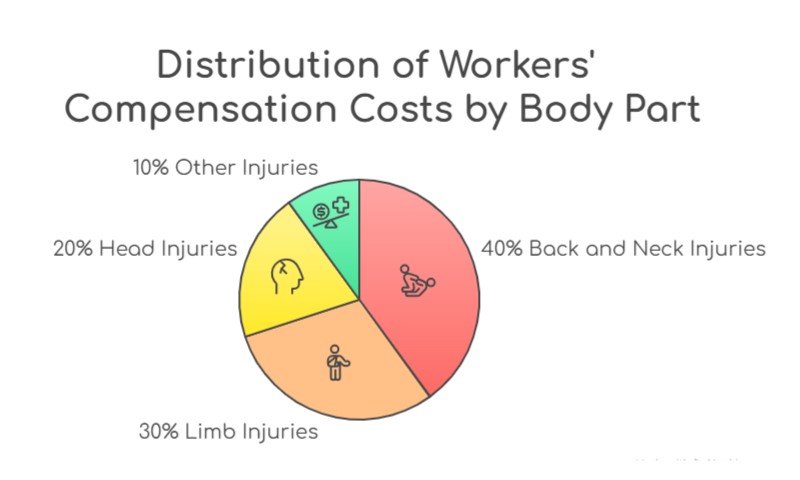
Large settlements draw attention precisely because they sit far outside typical claim experience.
NCCI Severity Trends
The National Council on Compensation Insurance reported in its 2025 State of the Line guide that average total lost-time claim severity for Accident Year 2024 is estimated to be about 6% higher than 2023.
Similar estimated increases apply to indemnity and medical lost-time severity. Inflation and wage growth play a significant role in those trends.
Even with rising severity, typical claims remain far below eight-figure levels.
Traumatic Brain Injury Cost Patterns
NCCI’s analysis of traumatic brain injury claims reported average total incurred costs of about $136,000, compared with roughly $51,000 for all lost-time claims.
About 2.5% of TBI claims exceed $1 million, accounting for more than half of total TBI incurred costs.
That distribution explains why catastrophic brain injury cases dominate large settlement reporting.
Injury Volume Provides Additional Perspective
The Bureau of Labor Statistics reported that private industry employers recorded about 2.5 million nonfatal workplace injuries and illnesses in 2024. The Census of Fatal Occupational Injuries reported 5,070 fatal work injuries that same year.
Multi-million dollar settlements represent a tiny fraction of the overall system.
Settlement Mechanics Matter More Than Headlines
Numbers alone rarely tell the full story.
Lump Sum Compromise And Release
California’s Division of Workers’ Compensation explains that a Compromise and Release settlement involves a lump sum payment that, once approved by a workers’ compensation judge, generally ends the claims administrator’s liability for future benefits tied to that claim.
Settlement submissions require detailed disclosure of amounts paid, benefit periods covered, and the basis for the agreement.
Structured Settlements And Projected Values
Some firms report both cash paid at settlement and projected lifetime annuity values. A settlement marketed as $21 million may involve a much smaller immediate payment combined with long-term structured benefits.
Both figures can exist simultaneously without representing the same measurement. Readers should confirm which number reflects actual money changing hands at approval.
Practical Guidance For Accurate Writing And Publishing

For anyone covering this topic professionally, careful phrasing matters more than chasing a superlative.
Recommended Language For Accuracy
There is no official nationwide ranking of workers’ compensation settlements in the United States. Publicly reported cases often cite California settlements in the $10 million to $13.2 million range as among the largest widely reported.
Some law firms have recently claimed higher settlements based on self-reported figures and structured payout valuations.
That wording reflects available evidence and avoids overstating certainty.
Final Takeaway
The question sounds straightforward. The evidence does not support a single definitive national record.
What the public record supports with confidence looks like this:
- No official U.S. national ranking of workers’ compensation settlements exists.
- California cases appear frequently among the highest reported amounts.
- A $13.2 million California settlement remains one of the highest widely cited figures in trade reporting.
- Higher claimed totals, including structured values above $20 million, rely on self-reported figures without nationwide independent verification.
Accuracy in this area comes from acknowledging system limits, explaining how settlements are measured, and separating lump sums from projected lifetime values.