Skip to content


A major licensing shift begins in July 2026. The National Conference of Bar Examiners launches the NextGen Uniform Bar Examination, marking the first full redesign of the national bar exam structure in decades.
For law students graduating in 2026, and for anyone planning admission soon after, planning decisions made in the next year can shape where, when, and how licensure becomes possible.
The rollout does not happen all at once. Some jurisdictions move first in 2026, others follow in 2027, and many large states wait until 2028. Exam structure, scoring, pacing, and even laptop preparation now play a direct role in passing strategy. Every part of preparation changes in measurable ways.
Let’s check out the real mechanics, the timeline that matters, the states involved, and the daily realities of test day under NextGen.
Why The Bar Exam Is Changing
NCBE began studying attorney practice nationwide in 2018. According to official resources, the research continued through 2021 and included a practice analysis survey completed by nearly 15,000 practicing attorneys. The findings reshaped how entry-level competence is defined.
NextGen aims to measure real foundational lawyering skills alongside core doctrine. The exam focuses on what new attorneys actually do, such as researching a file, applying supplied statutes, drafting written work, counseling a client, evaluating evidence, and managing professional responsibilities.
Legal memorization remains part of preparation, but the test structure now rewards applied performance across realistic tasks.
NextGen Rollout Timeline And Dates That Matter
NextGen follows the traditional February and July national bar schedule. According to the official website, the first live administration occurs July 28 and 29, 2026.
NCBE also defined a formal transition window. Jurisdictions may administer either the legacy UBE or NextGen from July 2026 through February 2028, but not both.
Starting July 2028, the legacy UBE retires in participating jurisdictions, leaving NextGen as the ongoing format.
Key Timeline Points
- July 2026: First live administration in a limited set of jurisdictions
- July 2027: Second wave of jurisdictions
- February 2028 and July 2028: Major adoption waves, plus late-transition states
- Date TBD: Mississippi
The practical meaning is simple. Exam format will differ by state for at least two years.
States And Jurisdictions Adopting NextGen
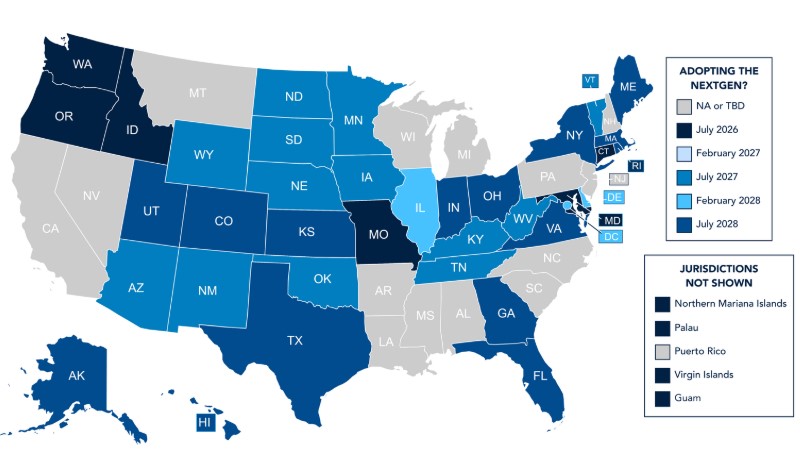
NCBE publishes an official adoption list by first administration date.
| First Administration | Jurisdictions |
| July 2026 | Connecticut, Guam, Idaho, Maryland, Missouri, Northern Mariana Islands, Oregon, Palau, Virgin Islands, Washington |
| July 2027 | Arizona, Iowa, Kentucky, Minnesota, Nebraska, New Mexico, North Dakota, Oklahoma, South Dakota, Tennessee, Vermont, West Virginia, Wyoming |
| February 2028 | Delaware, District of Columbia, Illinois |
| July 2028 | Alabama, Alaska, Colorado, Florida, Georgia, Hawaii, Indiana, Kansas, Maine, Massachusetts, Michigan, New Hampshire, New Jersey, New York, Ohio, Pennsylvania, Rhode Island, Texas, Utah, Virginia |
| Date TBD | Mississippi |
Two Practical Takeaways From The List
A 2026 graduate in major markets like New York and Texas still faces the legacy exam in 2026 because both list July 2028 as their first NextGen administration. Illinois lists February 2028.
A 2026 graduate sitting in a July 2026 jurisdiction has no internal flexibility to wait for later adopters. NCBE lists no additional jurisdictions administering NextGen in July 2026 beyond the table above.
What NextGen Looks Like On Test Day

NextGen runs fully computer-based on the examinee’s own laptop using a secure testing browser.
Duration And Structure
Total testing time equals 9 hours, delivered over 1.5 days. Each day contains three-hour sections.
- Day 1: Two sections
- Day 2: One section
NCBE also publishes pacing benchmarks:
- About 1.8 minutes per standalone multiple-choice question
- About 24 minutes per integrated question set
- About 60 minutes per performance task
These benchmarks shape both prep planning and in-exam time discipline.
Delivery Tools And Required Pre-Exam Preparation
NCBE’s platform introduces built-in exam tools that directly affect workflow and pacing.
Key tools include:
- Section countdown timer with a 5-minute warning
- Navigation overview showing answered, partially answered, unanswered, and marked-for-review items
- Highlighting and zoom features
- Light and dark color schemes
- Split-screen view for written work
- Notepad for scratch work
- Spell check
- Copy and paste from provided documents
- Formatting tools for bullets and numbering
Before exam day, examinees must download the secure browser and complete a pre-exam tutorial that checks laptop compatibility and provides interface familiarity.
Treat interface training as a real prep subject. Navigation habits can save minutes across each section.
What Is Being Tested

NextGen blends doctrinal law with applied lawyering skills.
Foundational Concepts And Principles For July 2026 Through February 2028
Eight foundational subjects apply:
- Business associations
- Civil procedure
- Constitutional law
- Contract law
- Criminal law
- Evidence
- Real property
- Torts
Starting July 2028, family law joins the foundational list.
Foundational Lawyering Skills
NextGen targets the following skills across question formats:
- Legal research
- Legal writing
- Issue spotting and analysis
- Investigation and evaluation
- Client counseling and advising
- Negotiation and dispute resolution
- Client relationship and management
Context Areas And Provided Legal Resources
Additional legal knowledge areas appear as context to support skills testing. Examinees receive statutes, regulations, and case law when required to complete tasks.
For July 2026 through February 2028, family law and trusts and estates appear in skills-focused questions on every exam.
Professional Responsibility Inside The Exam
Professional responsibility appears as a recurring context area. Select Model Rules of Professional Conduct apply in counseling, negotiation, and client management tasks. Recalled knowledge is expected.
Many criminal defense firms preparing to expand their post-licensure client pipelines already plan marketing infrastructure early, including services like criminal defense SEO.
Question Types And Exam Structure
@dellara For everyone taking the #barexam next week— YOU GOT THIS!!!
Legacy UBE uses three separate components. NextGen does not. Each three-hour section blends multiple formats.
Standalone Multiple-Choice Questions
Two formats apply:
- Select one of four options
- Select two of six options, with partial credit
Each section contains 40 questions. Total equals 120.
Integrated Question Sets
Each set revolves around a common fact scenario.
Two formats exist:
- Drafting sets with medium-answer responses
- Counseling sets with mixed multiple-choice and short-answer
Each section includes two sets, for six total. Sets may include statutes, judicial excerpts, police reports, and deposition materials.
Performance Tasks
Two formats exist:
- Standard performance tasks, which are longer writing assignments
- Legal research performance tasks, which include multiple-choice and short-answer items followed by a medium-answer writing assignment
Each section includes one performance task, for three total.
Scoring And Weights
NextGen produces a single score on a 500 to 750 scale. Each jurisdiction sets its own passing score.
Weighting
- Standalone multiple-choice: 49%
- Integrated question sets: 21%
- Performance tasks: 30%
Partial Credit
Partial credit applies widely:
- Select-two multiple-choice questions
- Short-answer responses
- Medium-answer responses
- Portions of performance tasks
Planning should account for partial scoring strategies.
Portability And Score Transfers
Portability remains a core feature. Many jurisdictions accept transferred NextGen scores.
Some jurisdictions accept transfers even before administering NextGen.
Examples:
- Illinois administers NextGen starting February 2028 but accepts transferred NextGen scores starting July 2026
- Arizona and Oklahoma administer starting July 2027 but accept transfers starting July 2026
- Alaska and Kansas administer starting July 2028 but accept transfers starting July 2026
For 2026 graduates, early portability can widen admission strategy options.
Legacy UBE Versus NextGen In Practical Terms
Legacy UBE currently operates in 41 jurisdictions, with more than 48,000 examinees in 2024.
| Feature | Legacy UBE | NextGen UBE |
| Structure | MEE, MPT, MBE as separate components | Three mixed-format sections |
| Total Time | Two-day administration | 9 hours over 1.5 days |
| Delivery | Jurisdiction-managed sites | Laptop-based secure browser |
| Content | General principles and skills via separate components | Core doctrine plus foundational skills |
| Portability | Portable UBE score | Portable NextGen score |
| Scoring | Traditional UBE scoring conventions | Single 500 to 750 score, weighted 49% MC, 21% sets, 30% tasks |
What To Expect If Graduating In 2026
Outcomes differ by jurisdiction.
Scenario 1: Sitting In A July 2026 NextGen Jurisdiction
Jurisdictions include Connecticut, Idaho, Maryland, Missouri, Oregon, and Washington.
Expect:
- Laptop-based secure testing
- 5-day schedule
- Mixed-format sections with performance tasks and integrated question sets
Planning priorities:
- Practice inside the official testing interface
- Train applied skills using provided law
- Drill drafting, counseling, and performance task formats
Scenario 2: Sitting In A Later Transition Jurisdiction
A 2026 graduate in a 2027 or 2028 jurisdiction may face the legacy exam first, then NextGen on a retake.
Practical implications:
- Delayed first attempts may shift exam format
- Retakes can require learning a new exam model midstream
Scenario 3: Aiming For Portability
Portability remains available, but scoring uses a new scale and weighting system. Transfer rules now open new planning routes.
What Credible Reporting Signals For 2026

Reuters has reported debate surrounding rollout readiness following technical failures in California’s February exam and NCBE’s vendor changes. Reuters also reports a planned beta test with 1,500 participants in January 2026.
Practical planning mindset remains simple. Software familiarity and hardware compliance deserve equal weight to doctrinal study.
Prep Checklist For NextGen
NextGen preparation starts with structure. A checklist keeps skills practice, content review, and software training moving on a predictable track.
Skills And Formats To Drill
- Standalone multiple-choice including select-two questions
- Drafting and counseling integrated sets
- Standard and legal research performance tasks
Content To Prioritize For July 2026 Through February 2027
- Eight foundational doctrinal subjects
- Family law and trusts and estates in skills contexts
- Professional responsibility rules flagged by NCBE
Interface Preparation
NCBE provides free sample questions, an exam software preview, and official study aids delivered on the same platform.
Interface work should include:
- Split-screen use
- Document navigation
- Copy and paste handling
- Timing discipline using pacing benchmarks
Closing Thoughts
NextGen reshapes how competence is measured. Laptop workflows, applied writing, research, and counseling now share the stage with doctrine. Jurisdiction timing matters. Transfer rules can change admission routes. Interface habits now belong in every serious study plan.
2026 candidates who treat structure, skills, and software as core subjects place themselves in a stronger position when July arrives.