
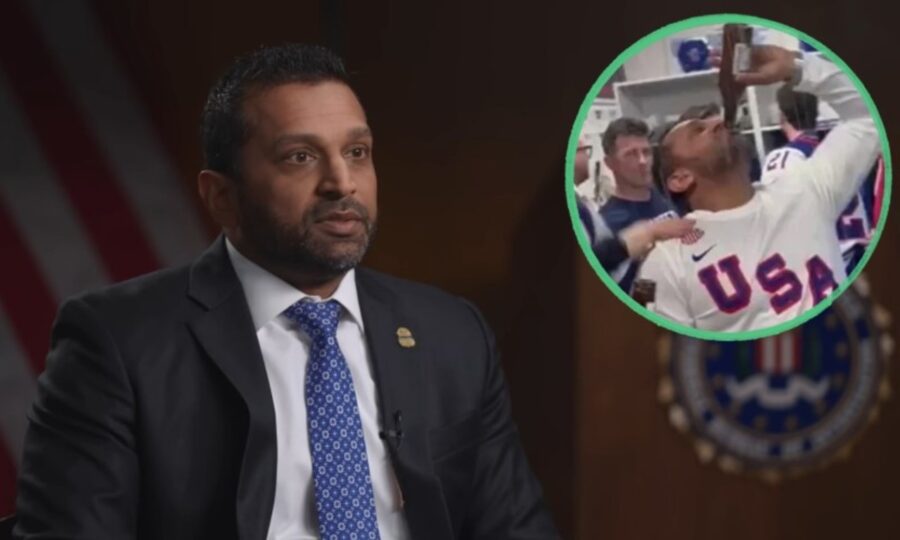

In the minutes after the United States men’s hockey team captured Olympic gold in Milan, the celebration spilled from the ice into the locker room. In social media videos, FBI Director Kash Patel appears inside that room with players, drinking, spraying beer, and briefly wearing a gold medal, an image that landed like a Rorschach test back home: harmless patriotism to supporters, a symbol of blurred lines to critics.
The flashpoint is not simply that a senior official attended the Olympics. It is that the country’s top federal law enforcement leader was filmed partying in a space usually reserved for athletes and coaches, while a high-profile security incident was unfolding at Mar-a-Lago in Florida, and while Patel’s travel practices were already under congressional scrutiny.
Table of Contents
ToggleA Win That Made History, and a Clip That Made Politics
The hockey result itself was the kind that invites mythology. The U.S. beat Canada 2–1 in overtime, sealing the country’s first Olympic men’s hockey gold since 1980, with reporting naming Jack Hughes as the overtime scorer and Connor Hellebuyck as a standout in goal.
But the postgame footage, amplified by politics, pulled attention away from the sporting storyline. The videos showed Patel celebrating alongside athletes, and the images traveled fast because they fit into an existing argument about the public face of federal power, what it should look like, and who gets access to the symbolism of a national team’s moment.
What Patel Says He Was Doing in Milan
For the very concerned media – yes, I love America and was extremely humbled when my friends, the newly minted Gold Medal winners on Team USA, invited me into the locker room to celebrate this historic moment with the boys- Greatest country on earth and greatest sport on earth.…
— Kash Patel (@Kash_Patel) February 23, 2026
Patel and the FBI have framed the trip as official work with a patriotic coda. Coverage reported that Patel’s travel to Italy included meetings tied to security coordination around the Games, including engagement with Italian law enforcement and U.S. officials involved in athlete protection.
Patel also described his locker room presence as an invitation and an honor, not a planned photo-op.
That is the core defense: the director was on duty abroad, then joined a celebration at the invitation of the team.
The Resource Question, and Why Travel Became the Pressure Point
The sharper critique is about government resources and judgment, especially aircraft use.
CBS reported that Patel traveled to Italy on a Justice Department aircraft and planned to attend the U.S. team’s medal-round games, while also holding official meetings.
That reporting landed in an environment where lawmakers had already been pressing the bureau about Patel’s travel, and where his critics describe a pattern of mixing high-profile events with official itineraries.
Separate reporting has described turbulence around internal attention to aviation logs and travel scrutiny, including a Bloomberg Law account of a senior aviation-related official being forced out after Patel was angered by public attention to flight records.
Taken together, the Milan clip did not create the travel narrative. It poured fuel on it.
What the Rules Actually Say About “Required Use” Travel
A key fact, often missed in the partisan framing, is that top Justice Department leadership has long been treated as “required use” travelers for government aircraft, driven by security and secure-communications needs.
A Government Accountability Office report on executive aircraft use states that attorneys general and FBI directors are “required use” travelers under executive branch policy and are required to use government aircraft for travel, including personal travel, due to security and communications needs.
That does not end the controversy, but it changes what can be responsibly alleged. If policy requires the director to use government aircraft, the question shifts from “why did he use a government plane” to narrower, documentable issues:
- Whether the itinerary was primarily official, primarily personal, or mixed
- How costs were allocated when personal activities occurred during official travel
- Whether reimbursement rules were followed for any personal portion
Those are oversight questions that can be answered with schedules, expense documentation, and reimbursement records, not with a viral clip alone.
Why the Mar-A-Lago Incident Became Part of the Story
Patel’s critics did not only argue about plane travel. They argued about priorities and optics.
The AP story that circulated alongside the locker room footage reported that, while Patel was overseas, an armed man was shot and killed after driving into Mar-a-Lago, and that Patel acknowledged the incident publicly while saying FBI resources would support the investigation.
To supporters, that sequence reads like modern leadership, staying connected and responsive while traveling. To critics, it reads like a jarring split-screen, celebratory optics abroad while a domestic security event demanded seriousness at home.
The Deeper Issue Is Access and Institutional Credibility
The reason this episode matters is not beer, medals, or locker room culture. It is institutional credibility.
The FBI director is not a cabinet celebrity. The role sits at the intersection of intelligence, criminal enforcement, and political legitimacy, and every public image becomes a proxy fight over whether the bureau is disciplined, apolitical, and worthy of trust.
In that environment, even a genuine, spontaneous moment can be interpreted as entitlement, especially when paired with existing allegations about travel and perks.
At a practical level, watchdog scrutiny rarely turns on whether a director is allowed to attend a major sporting event. It turns on paper: travel authorizations, logs, cost allocation, and whether internal controls are followed consistently.
That is where the Milan story is likely to head next, because that is where oversight can prove or disprove misconduct.
What Happens Next
Expect three tracks.
- Congressional oversight pressure intensifies. A December 2025 letter from House Judiciary Democrats, available publicly, shows lawmakers already building a record around aircraft use and accountability themes.
- The bureau leans harder on the “required use” framework. The GAO and other summaries of executive branch policy offer a ready-made rebuttal to simplistic claims about aircraft use.
- The public narrative stays visual. Even if the documentation favors Patel, the political cost can persist because the locker room footage is easy to replay, and easy to weaponize.
The U.S. men’s hockey team left Milan with a gold medal that resets the program’s modern story. Patel left with something else, a viral symbol that will keep showing up every time Congress, the press, or the public asks what power looks like, and who it is for.